By Ruslan Averin.
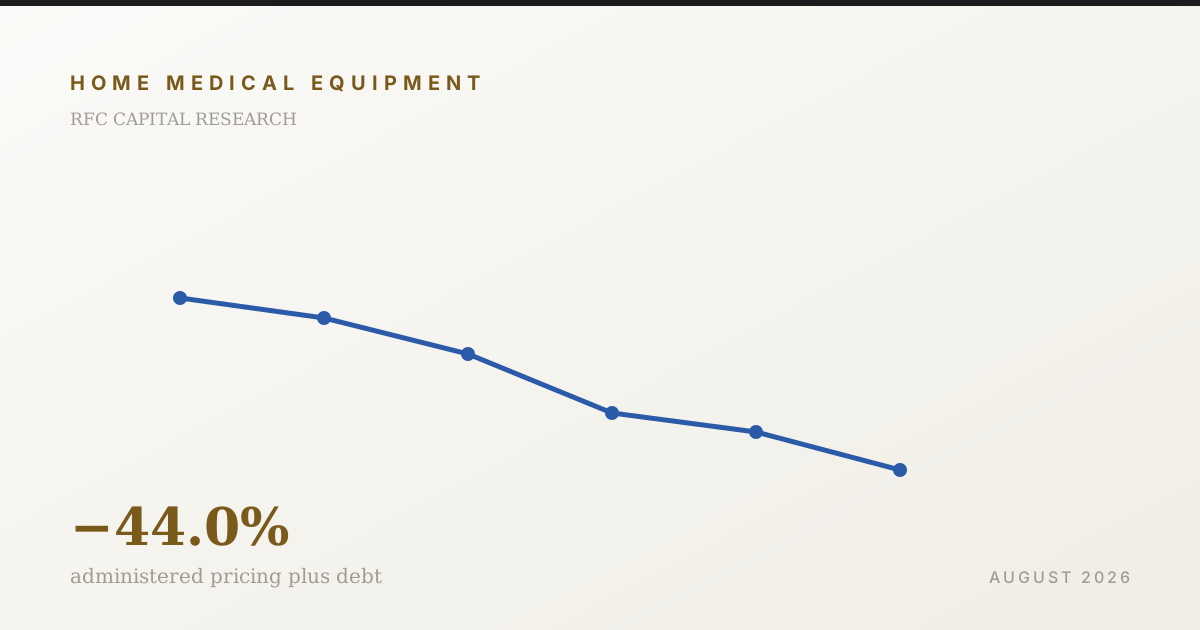
AdaptHealth fell 44% over the week to approximately $5.98. The company distributes home medical equipment, and the decline illustrates two risks that compound in that business: administered pricing and acquisition-funded leverage.
Administered pricing
Home medical equipment — respiratory devices, sleep therapy equipment, diabetes supplies, mobility aids — is paid for predominantly by government programmes and insurers rather than by patients.
That means the seller does not set the price. Reimbursement rates are set administratively, adjusted periodically, and in some categories determined by competitive bidding processes that award supply at the lowest acceptable bid.
The consequence is a business with limited pricing power and full exposure to input costs. When reimbursement rates are reduced, revenue per unit falls immediately with no offsetting lever. Cost reductions are the only available response, and they are finite.
This structure makes the sector's earnings unusually sensitive to policy decisions that arrive on a regulatory calendar rather than an economic one.
Roll-up leverage
The second risk is the balance sheet, and it is common across healthcare distribution.
Companies in this space have typically grown by acquiring regional providers, funded with debt, on the argument that consolidation produces purchasing scale and administrative efficiency. The strategy works while cash flows are stable and interest costs are low.
It inverts when either assumption fails. Debt taken on against expected synergies becomes a fixed obligation against a cash flow that reimbursement changes can reduce. Leverage that looked conservative at one reimbursement level becomes aggressive at a lower one, without the company doing anything.
A decline of 44% in a week in a leveraged healthcare distributor generally reflects the market re-rating that combination rather than reacting to a single operating figure.
What to watch
Net leverage against covenant thresholds. In a leveraged roll-up this is the first-order question, ahead of margins or growth. Covenant proximity determines whether the company controls its own decisions.
Revenue per patient by category. The direct measure of reimbursement pressure, and it must be examined by product line because rates change unevenly.
Organic growth excluding acquisitions. Acquisition-driven revenue growth can mask organic decline for several years. The underlying rate is what services the debt.
Free cash flow conversion. Equipment distribution is working-capital intensive, and reported earnings can diverge substantially from cash generation.
Conclusion
Administered pricing removes the ability to offset cost inflation, and acquisition-funded leverage removes the ability to absorb a revenue decline. Each is manageable alone. Together they produce equity that responds to modest changes in reimbursement expectations with very large percentage moves.
The general lesson applies across healthcare services: where price is set by a third party and growth was funded with debt, the equity is a residual claim on a policy decision.
This is analysis, not investment advice.