By Ruslan Averin.
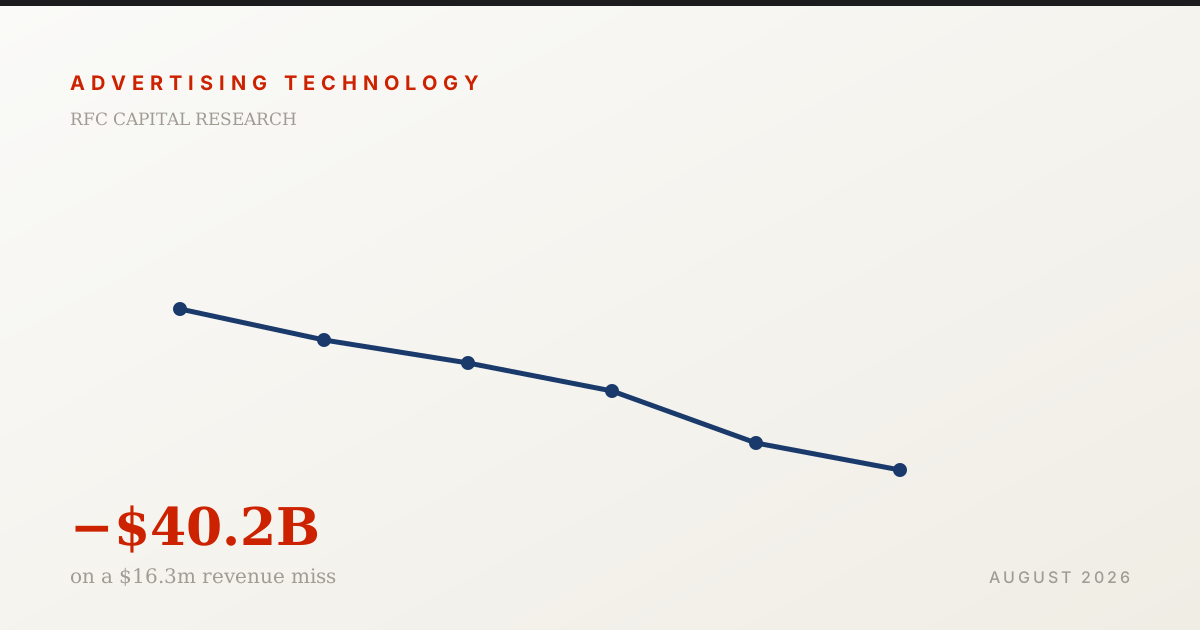
AppLovin reported second-quarter revenue of $1.924 billion against a consensus of $1.935 billion. The shortfall was $16.3 million — roughly eight tenths of one percent. The stock fell by as much as 28.7%, and at the session low the company had shed approximately $40.2 billion in equity value.
That ratio — a $16 million operating shortfall producing a $40 billion valuation loss — is the most instructive number produced by any company this week.
The quarter
| Metric | Q2 2026 | Consensus |
|---|---|---|
| Revenue | $1.924B | $1.935B |
| Revenue growth | +53% y/y | — |
| EPS | $3.76 | $3.67 |
| Q3 revenue guidance | $2.055–2.085B | $2.068B |
| Q3 adjusted EBITDA guidance | $1.71–1.74B | — |
Read without the share price, this is a strong quarter. Revenue grew 53% year over year. Earnings beat. Third-quarter guidance brackets the consensus figure rather than falling below it.
A company growing revenue at 53% does not typically lose a quarter of its market capitalisation in a session.
What was actually repriced
Nothing in the operating results justifies a $40 billion move. What changed was the market's confidence in a forward assumption.
A high-growth advertising technology company trades on an implied path — that hypergrowth continues for a defined number of quarters before decelerating to a mature rate. The entire valuation rests on how long that path runs before the fade begins. Small changes to the assumed fade point produce very large changes in present value.
A revenue miss of 0.8% is operationally trivial. As evidence about the fade point, it is not. It is the first quarter in a long sequence where the company did not clear its own trajectory — and for a valuation built on the trajectory rather than on the current quarter, that is the information that matters.
The guidance compounds it. Third-quarter revenue guided to $2.055–2.085 billion against a $2.068 billion consensus means the midpoint is roughly in line. For a company whose history has been beating and raising, guiding in line reads as a change in posture.
The general principle
This is a clean illustration of a mechanism that applies well beyond one ticker.
When an asset is priced for continued acceleration, the risk is not that results deteriorate. The risk is that results stop exceeding. A company can grow revenue 53%, beat on earnings, and still lose a quarter of its value — because the price was never a claim about 53% growth. It was a claim about growth that keeps surprising.
Investors who hold such assets are, whether they frame it this way or not, short the expectation of a slowdown. The position pays as long as nothing challenges the trajectory, and it reprices violently on the first datapoint that does — regardless of that datapoint's operating significance.
What to watch from here
Whether Q3 is met or beaten. Guiding in line and then delivering in line confirms the fade. Guiding in line and beating restores the pattern. This is the single determining observation.
Net revenue retention among advertisers. The durability question underneath the growth rate: are the same advertisers spending more, or is growth coming from new logos that may not repeat?
EBITDA margin against the guided range. Advertising technology margins compress when customer acquisition costs rise, and margin is the earlier indicator of competitive pressure than revenue is.
Conclusion
The operating quarter was strong and the reaction was not about the operating quarter. A 0.8% revenue shortfall was read as evidence about the deceleration point, and in a valuation constructed from that assumption, the revision is worth billions rather than millions.
The transferable lesson is that expectation risk and business risk are different exposures. This week they were separated with unusual clarity.
This is analysis, not investment advice.