By Ruslan Averin.
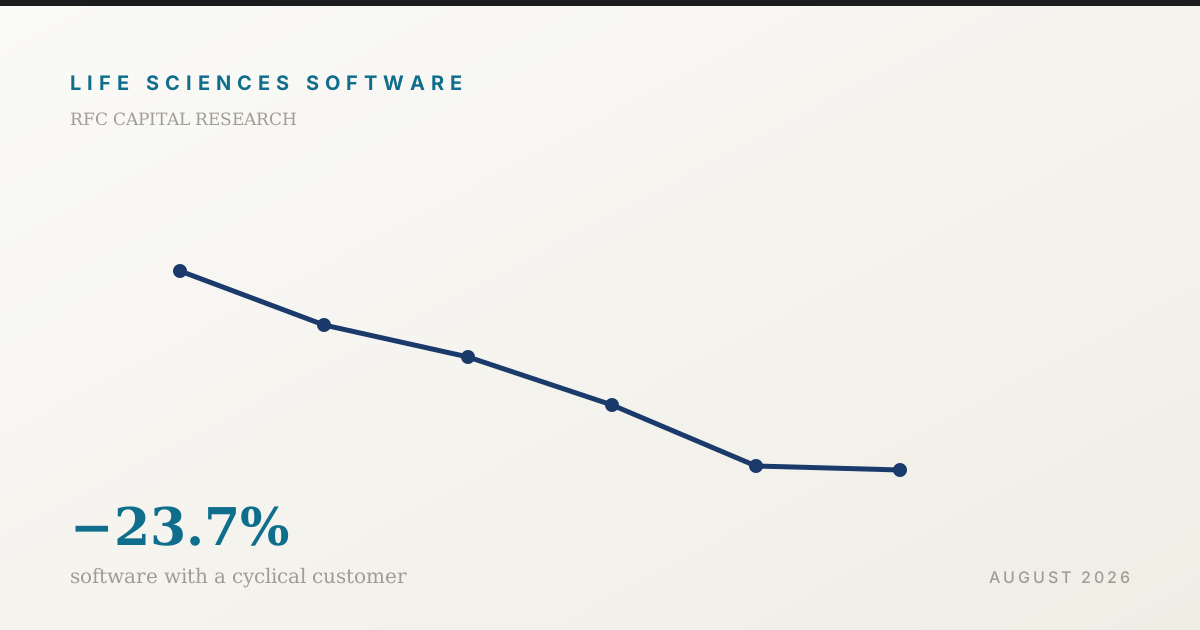
Certara missed Wall Street's second-quarter earnings expectations and fell 23.7%. The company sells biosimulation and drug development software, and the size of the decline reflects a structural feature of that position rather than the size of the miss.
Software with a cyclical customer
Software businesses are valued on the assumption that revenue is recurring and therefore predictable. That assumption holds when the customer's own spending is stable. It holds much less well when the customer's budget is itself cyclical.
Certara's customers are pharmaceutical and biotechnology companies, and its product supports drug development programmes. When those customers run more programmes, they consume more software. When they cut programmes, the consumption falls — and unlike headcount-based enterprise software, there is no floor set by an installed employee base.
That gives the business the multiple of a software company and the demand profile of a research services company. The gap between those two is what closed on the day of the miss.
The end-market context
The biotechnology funding contraction that followed the rise in interest rates removed the marginal customer across the entire drug development supply chain. Small and mid-cap biotechs, which depend on capital markets rather than cash flow to fund research, reduced programme counts. Every vendor downstream of those programmes felt it.
This makes the miss interesting beyond the company. Software consumption is a more immediate read on programme activity than services revenue, because software seats and usage adjust faster than contracted study work. A miss here can lead the services companies.
It is worth setting against the opposite signal elsewhere in the same supply chain this week: a contract research organisation reporting stronger-than-expected results and raising full-year guidance. Two companies serving the same end market moving in opposite directions means the recovery, if there is one, is uneven — and that the aggregate sector call is currently unreliable.
What to watch
Net revenue retention. In this model the metric measures whether existing pharmaceutical customers are expanding usage. Falling retention means programmes are being cut at existing accounts, which is the end-market signal.
Bookings versus revenue. Recognised revenue lags contracted work; the booking line shows current demand.
Customer concentration between large pharma and small biotech. Exposure to small biotech is exposure to the capital markets. Large pharma spending is steadier and lower-growth.
Whether guidance was cut alongside the miss. A miss with maintained guidance implies timing. A miss with reduced guidance implies demand.
Conclusion
A 23.7% decline on an earnings miss reflects the market re-examining whether this is a software business or a business exposed to research budgets that happens to sell software. In a funding environment that has not fully normalised, that distinction carries most of the valuation.
The wider point is that recurring revenue is only as durable as the customer's ability to keep spending. Software sold into a cyclical end market inherits the cycle, and the multiple usually does not reflect that until a quarter like this one.
This is analysis, not investment advice.