By Ruslan Averin.
Peloton reported its first annual net profit since becoming a public company, beat on fiscal fourth-quarter results, and then guided fiscal 2027 revenue to $2.3–2.4 billion — a decline of roughly 3.9% at the midpoint against a consensus of about $2.44 billion. The shares fell more than 15%.
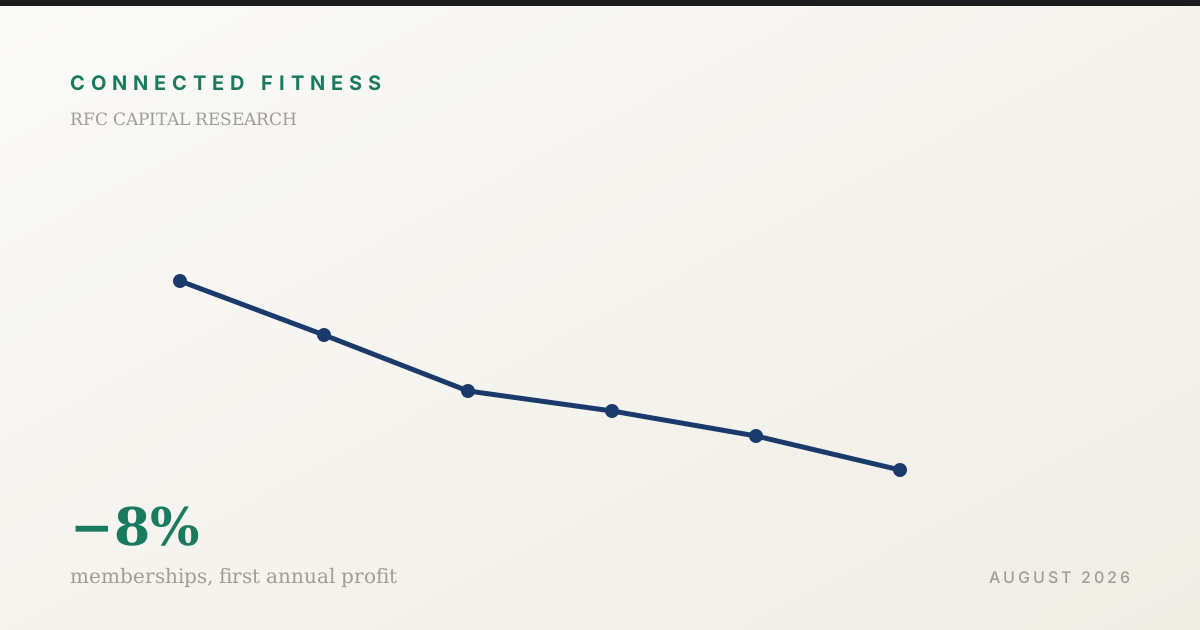
Memberships declined 8%.
The results
| Metric | Reading |
|---|---|
| FY2026 net profit | first annual profit in company history |
| Fiscal Q4 | beat expectations |
| FY2027 revenue guidance | $2.3–2.4B |
| Implied change at midpoint | −3.9% |
| Consensus FY2027 revenue | ~$2.44B |
| Memberships | −8% |
Two different turnarounds
The results describe a company that has completed one transformation and has not begun the other.
The cost turnaround is finished. Reaching profitability for the first time, after years of losses at scale, is a genuine achievement of operational discipline. Costs were removed, the manufacturing and distribution footprint was rationalised, and the business now generates a profit on a smaller revenue base.
The demand turnaround has not started. Guiding revenue down 3.9% with memberships already 8% lower says the subscriber base is contracting. Profitability achieved while the top line shrinks is a stabilisation, not a recovery.
Markets price the second one. A cost turnaround has a finite endpoint — there is a floor below which further cuts damage the business — and once reached, the question immediately becomes what grows from here.
The membership number is the company
An 8% decline in memberships matters more than the revenue guide, because in this model memberships are the revenue.
The economics depend on hardware sold at low or negative margin being followed by a high-margin subscription held for years. That structure works only if the subscriber base is stable or growing. A contracting base means the installed hardware is being retired faster than it is being replaced, and each departing member removes recurring revenue at full margin.
It also compounds. Fewer members mean less content amortisation, weaker community effects in a product whose value partly depends on other users, and a smaller base from which to sell anything new.
What has to change
Membership stabilisation. Not growth — stabilisation. The first requirement is a quarter in which the base does not shrink. Until that happens, every other metric is a description of managed decline.
Subscription revenue per member. If the base is shrinking, revenue per remaining member becomes the only offsetting lever, and raising it accelerates churn among price-sensitive members.
Hardware attach. New members require hardware, and hardware demand is the discretionary purchase most exposed to consumer conditions.
Whether profitability survives the shrinkage. Fixed costs against a declining revenue base is the classic path back into losses. The first profit is not the same as durable profitability.
Conclusion
Peloton has proved it can be profitable at its current size. It has not shown that its current size is stable. Guidance implying a further revenue decline against an already 8% smaller membership base is the market's answer to which of those two facts matters more.
The general form of this situation is common in consumer turnarounds: the cost phase is executable by management, the demand phase is not. Only the second one re-rates a stock.
This is analysis, not investment advice.