A session stopped twice before lunch
The Korea Exchange spent Thursday 15 October 2026 pulling its own emergency levers. A sell-side sidecar fired on the main board at 9:07 a.m., and by 12:38 p.m. a market-wide circuit breaker froze all trading for 20 minutes. The Kosdaq ran the same sequence earlier, with a sidecar at 9:12 a.m. and a breaker at 12:23 p.m.
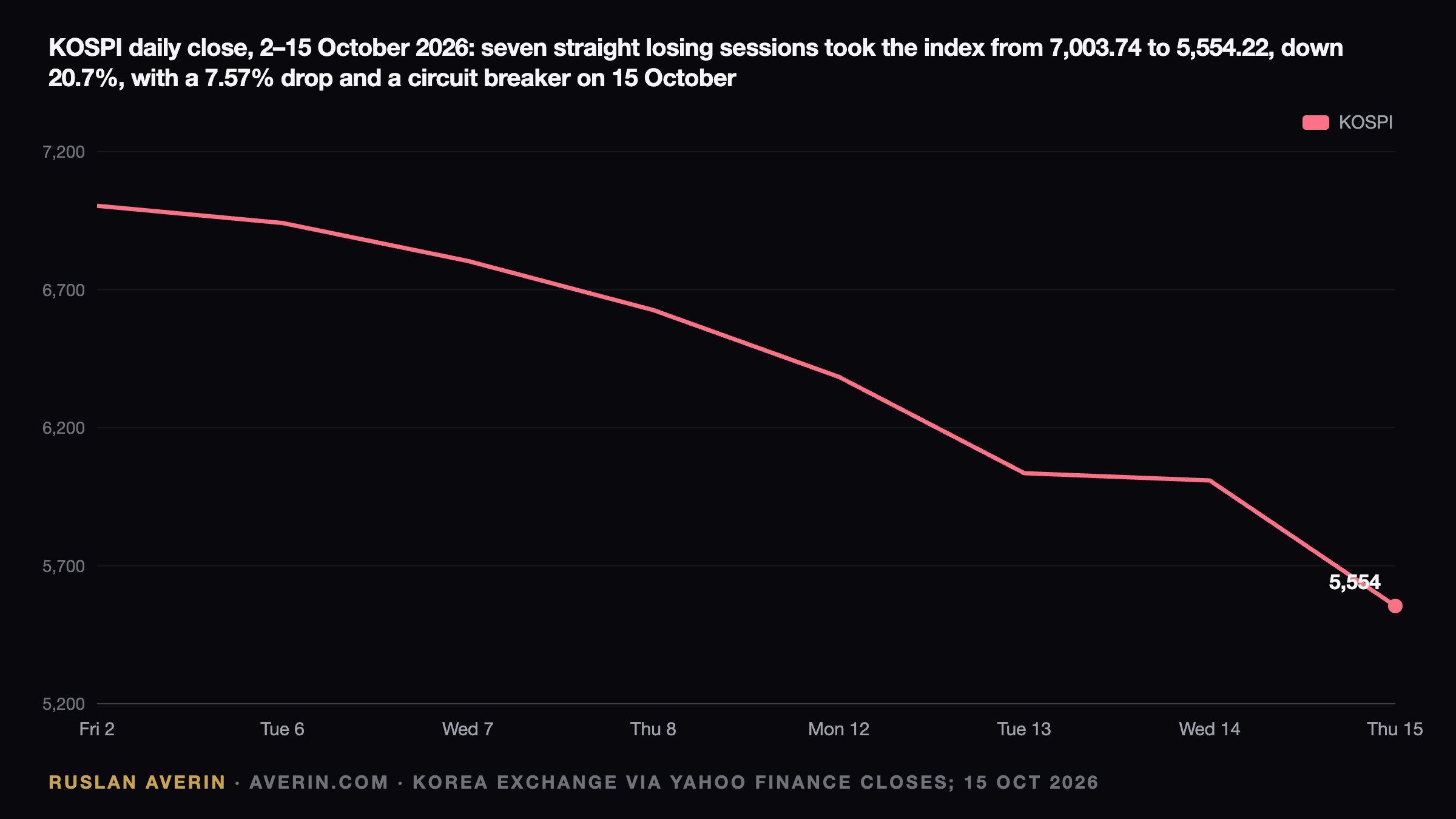
Neither pause changed the direction. The KOSPI closed at 5,554.22, down 454.59 points or 7.57%, the lowest finish since 7 April and the seventh consecutive losing session. The Kosdaq lost 7.65% to 760.82. According to the Korea Times, close to 400 trillion won of market value disappeared in a single day.
Context matters here: this was the tenth KOSPI circuit breaker of 2026 and the first since July, Seoul Economic Daily reported, while the sidecar was the 27th of the year. A market that needs ten halts in ten months is not a market in orderly retreat.
Memory stocks took the hit, defensives did not
The damage was concentrated with unusual precision. Samsung Electronics ended at 210,000 won, down 9.48%, and SK hynix at 1,262,000 won, down 11.06%. The supply chain around them fared worse: Samsung Electro-Mechanics fell 15.36%, Hanmi Semiconductor 11.63% and SK Square 10.21%.
Investors who stayed in Seoul rotated rather than left. Samsung Biologics rose 5.50%, Yuhan 5.09% and KT&G 3.96%. That split — chips down double digits, pharma and tobacco up — is the signature of a sector repricing rather than a broad liquidity panic.
Foreign investors sold a net 3.6243 trillion won on the main board, roughly $2.7 billion at Thursday's exchange rate, an eighth straight session of net selling. Institutions absorbed 1.69 trillion won and individuals 1.29 trillion won. On the Kosdaq, foreigners were modest net buyers of 215.8 billion won.
Seven sessions that erased a fifth of the market
The streak began on Tuesday 6 October, after the index closed at 7,003.74 on Friday 2 October. The daily declines ran 0.89%, 1.98%, 2.62%, 3.65%, 5.46%, 0.44% and then 7.57% — a cumulative 20.7% fall. The Korea Times estimates more than 1,100 trillion won of value was erased over the run.
Measured from the peak, the picture is harsher. The record close of 9,114.55 on 22 June leaves Thursday 39.1% lower; from the 19 June intraday high of 9,385 the Korea Times calculates a 40.4% fall. Samsung dropped 23.9% across the seven sessions and SK hynix 31.5%.
Three pressures arriving in the same week
The first was competitive. On Tuesday 13 October the KOSPI fell 5.46% after China's ChangXin Memory Technologies announced it had commercialised a new DRAM architecture — a direct challenge to the premise that Samsung and SK hynix are scarce suppliers of memory for AI.
The second was macro. On Wednesday the BLS reported US consumer prices up 0.6% in September and 3.7% over twelve months, against 3.4% in August, with gasoline up 9.1% on the month. Core inflation ran 2.6% year on year and 0.3% month on month, above forecasts. CME FedWatch briefly put October hike odds at 49.3%; the 10-year Treasury yield closed at 5.19%.
The third was the credit side of the AI build-out. CoreWeave fell 15.46% to $65.78, Oracle 8.83%, Nvidia 3.16% to $221.30, and the Nasdaq Composite 1.88% to 26,692.87. When borrowing costs rise against uncertain data-centre returns, the purest listed proxies for that spending fall first.
Regional selling, and TSMC's inconvenient numbers
Japan and Taiwan moved in sympathy. The Nikkei 225 lost 4.90% to about 64,426, with SoftBank Group down 9.33% and Kioxia down 12.32%. Taiwan's TAIEX fell 3.41% to 46,969.87 and TSMC slipped 2.01% to NT$2,440.
TSMC's third-quarter results, released the same day, argued against a demand collapse. Revenue reached NT$1,494.24 billion, or $46.72 billion, up 41.2% in dollar terms. Net income rose 68.7% to NT$763.06 billion, NT$29.43 a share, on a 66.4% gross margin. Fourth-quarter guidance is $52.3–54.3 billion with a 65–67% margin.
Regulators respond, the currency stays calm
Financial Services Commission chairman Lee Eok-won convened an emergency market meeting with the Financial Supervisory Service and the Korea Exchange. Officials called the speed of the decline excessive, pointed to solid earnings in semiconductors, defence and shipbuilding, and to firm reserves and the current account, and promised zero tolerance for manipulation and illegal short selling, with contingency plans "if necessary".
Lee's warning that "investing on excessive debt and credit is dangerous" was aimed squarely at margin borrowing. The won closed the Seoul daytime session at 1,344.6 per dollar, 6.3 won weaker after briefly passing 1,350 — still far stronger than June's 1,550 area, which frames this as an equity shock, not a currency crisis.
What previous breaker days did next
A Level 1 breaker fires when the index sits more than 8% below the prior close for one minute. Using Korea Exchange closes from Yahoo Finance, the aftermath has been inconsistent.
| Breaker date | 21 sessions | 63 sessions |
|---|---|---|
| 19 March 2020 | +30.2% | +45.9% |
| 5 August 2024 | +5.7% | +3.7% |
| 4 March 2026 | +2.8% | +60.2% |
| 8 June 2026 | +2.3% | −6.5% |
| 26 June 2026 | −28.4% | −18.3% |
| 29 July 2026 | +19.9% | — |
Thursday's close sits 1.9% below the 5,663.24 recorded on 29 July. Breakers caused by sudden external shocks tended to mark lows within days; those arriving early in a repricing of earnings or rates, as in June, preceded a further drop of roughly a quarter. Daishin Securities' Lee Kyoung-min notes the 40.4% peak decline approaches the 43.7% median across seven earlier crises, including 1997 and 2008.
Valuation markers and the four signposts
Seoul Economic Daily reports a 12-month forward price-to-earnings ratio below 4.5 times, with price-to-book at 1 times near the 5,200 line; Samsung Securities cites 5,000 as support. Cheapness alone has rarely stopped a repricing driven by rates.
In the view of analyst Ruslan Averin, this episode resembles June more than March 2020, which argues against treating the halt itself as a bottom signal. Four markers deserve attention: whether TSMC's record quarter steadies the Korean memory names; whether stress in AI credit spreads further after CoreWeave's 15% drop; the Fed meeting on 27–28 October, with the target range at 3.75–4.00%; and, most telling of all, the first session in which foreign investors turn net buyers on the main board.