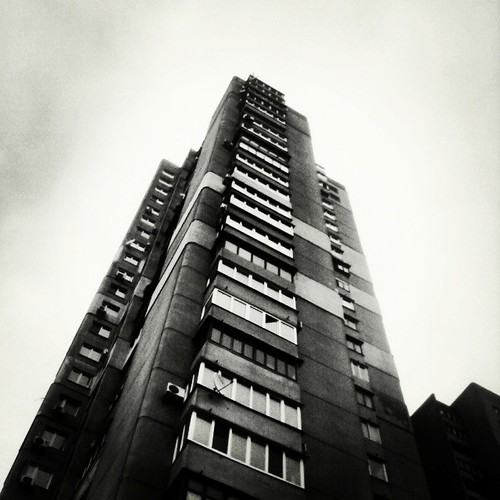
Kyiv's premium housing market did something in 2025 that almost no Western analyst predicted: it rose. Premium-class apartments reached $4,596 per square metre — up 4% on the year — in a capital city under periodic missile fire. That single data point dismantles most of the assumptions foreign investors bring to wartime real estate.
The Number That Shouldn't Exist
Conventional risk models say capital flees conflict zones. The Kyiv premium segment says otherwise. Premium-class stock appreciated through 2025, and the consensus forecast for Pechersk — the city's most expensive district — is a further 8–10% in 2026.
This is not speculative froth. It is the signature of a structurally supply-constrained market where the buyer base is insulated from the credit cycle. Premium buyers in Kyiv are not leveraged. They are deploying preserved capital, diaspora liquidity, and domestic business proceeds into the one asset class that has held value through three years of war.
When I model a market like this, I start with the question most investors skip: who is the marginal buyer, and what is their cost of capital? In Pechersk, the answer is a buyer with no mortgage and a multi-year horizon. That buyer does not panic-sell on a bad week. It is the most price-stable demand profile in European real estate right now.
Why Pechersk Is Structurally Different
Pechersk is not Kyiv. It is a sub-market with its own supply physics. The district sits on the government quarter, the embassy belt, and the Lavra heritage zone — which means buildable land within two kilometres of the centre can be counted on one hand. Construction is heavily regulated. New premium supply is structurally capped regardless of demand.
The current price ladder tells the story. As of early 2026, a one-bedroom Pechersk apartment averages $150,000, a two-bedroom $213,000, and a three-bedroom $340,000. Premium developments in the district — projects such as Taryan Towers and other class-A complexes built in the 2020–2023 cycle — trade well above the city average precisely because the supply of comparable units is finite and cannot expand on command.
Compare this to the broader Kyiv primary market, where the 2025 average sat at $2,011 per square metre. Premium Pechersk commands more than double that. The spread is not a bubble — it is the market pricing genuine, permanent scarcity.
The Yield Argument Foreign Buyers Miss
Western investors anchor on Warsaw, Prague, and the Baltics — prime yields of roughly 4–5%. Kyiv premium yields run materially higher, and the tenant base is more resilient than the headlines suggest: diplomatic missions, international organisations, returning professionals, and the staff of the reconstruction economy that is already forming.
The mistake institutional capital makes is treating "Ukraine" as a single risk variable. It is not. Physical risk in Pechersk differs from the front-line oblasts by orders of magnitude. Title risk, currency risk, and liquidity risk are each separable, measurable, and — critically — already priced into an entry point that will not survive a ceasefire. This is the same separable-risk discipline I apply to capital allocation across emerging markets.
The Reconstruction Option Nobody Is Paying For
Here is the asymmetry. The downside in Kyiv premium is partially priced: three years of war discount is already in the numbers. The upside — a ceasefire, the return of institutional capital, EU-accession momentum — is priced at essentially zero.
That is the structure of a good asymmetric position: bounded downside, open upside, and positive carry while you wait. Post-conflict capital cities historically re-rate prime residential to pre-conflict peaks within five to eight years. The investors who capture that move are the ones already positioned when the institutional desks are still writing "uninvestable" in their country notes. The broader real estate allocation framework treats this kind of dislocation as the point of the exercise, not the risk to avoid.
How I Think About a Position Here
This is not a trade for everyone. The discipline is in the structure, not the conviction. Three filters decide whether Kyiv premium belongs in a portfolio:
Can you hold for five years without a forced exit? Liquidity is thin; exits take months, not weeks. If your capital has a shorter clock, this is not your asset.
Is the position sized for a further drawdown? A renewed escalation could compress prices again. Size it so that scenario is survivable, not portfolio-ending.
Is your exit thesis tied to an event, not a price? Ceasefire, EU framework, institutional re-entry — those are the catalysts. A simple price target is the wrong frame for an asset that re-rates on regime change.
If all three pass, the risk-adjusted case is stronger than the institutional models suggest — because those models are still pricing a war that the premium market has already looked through.
The Kyiv premium segment is not a bet on Ukraine winning the war tomorrow. It is a position on scarcity, capital preservation, and the mathematics of a market that cannot build its way out of constrained supply. The price action of 2025 was not noise. It was information.
Related analysis
- Real Estate as a Capital Allocation Tool in 2026
- HELOC Rates Just Bounced Off Their 2026 Lows — Home Equity Loans Jumped 50bp in a Month
- Why I Invest in Ukrainian Real Estate During the War
Ruslan Averin is an independent investor focused on emerging and frontier market capital allocation, real estate, and risk pricing under uncertainty.