A financing instrument dressed as a split
Most share splits are cosmetic. The one Meta Platforms disclosed alongside third-quarter 2026 results on Wednesday 21 October is not. The company will create a new class of non-voting Class C shares and distribute them as a one-for-one stock dividend in January 2027, telling shareholders the Class A price should then reflect "the effect of a two-for-one stock split". The outcome is a share Meta can print without touching its founder's grip on the company.
The timing is the tell. Meta posted a quarter in which operating cash flow failed to cover capital spending, and it has already borrowed heavily. A non-voting currency solves a funding problem, not a liquidity problem in the stock.
Revenue beat, user growth cooled
Revenue reached $64.60 billion, up 26% year on year and ahead of the $63.37 billion LSEG consensus. Advertising contributed $63.06 billion against the $61.87 billion CNBC cited as expected. The stock closed at $697.52 on Wednesday 21 October, up 0.47% on the day, and added roughly 3% after hours following the release, according to CNBC.
| Line | Q3 2026 | Consensus or prior |
|---|---|---|
| Revenue | $64.60 billion, +26% | $63.37 billion (LSEG) |
| Advertising revenue | $63.06 billion | $61.87 billion expected (CNBC) |
| Diluted EPS, GAAP | $3.83 | $1.05 in Q3 2025 |
| EPS excluding legal charge | $7.40 | $7.25 in Q3 2025, ex tax charge |
| Family daily active people | 3.64 billion, +3% | 3.65 billion (StreetAccount) |
| Reality Labs operating loss | $4.13 billion | $4.54 billion (StreetAccount) |
| Q4 revenue guidance | $73–76 billion | $73.73 billion (LSEG) |
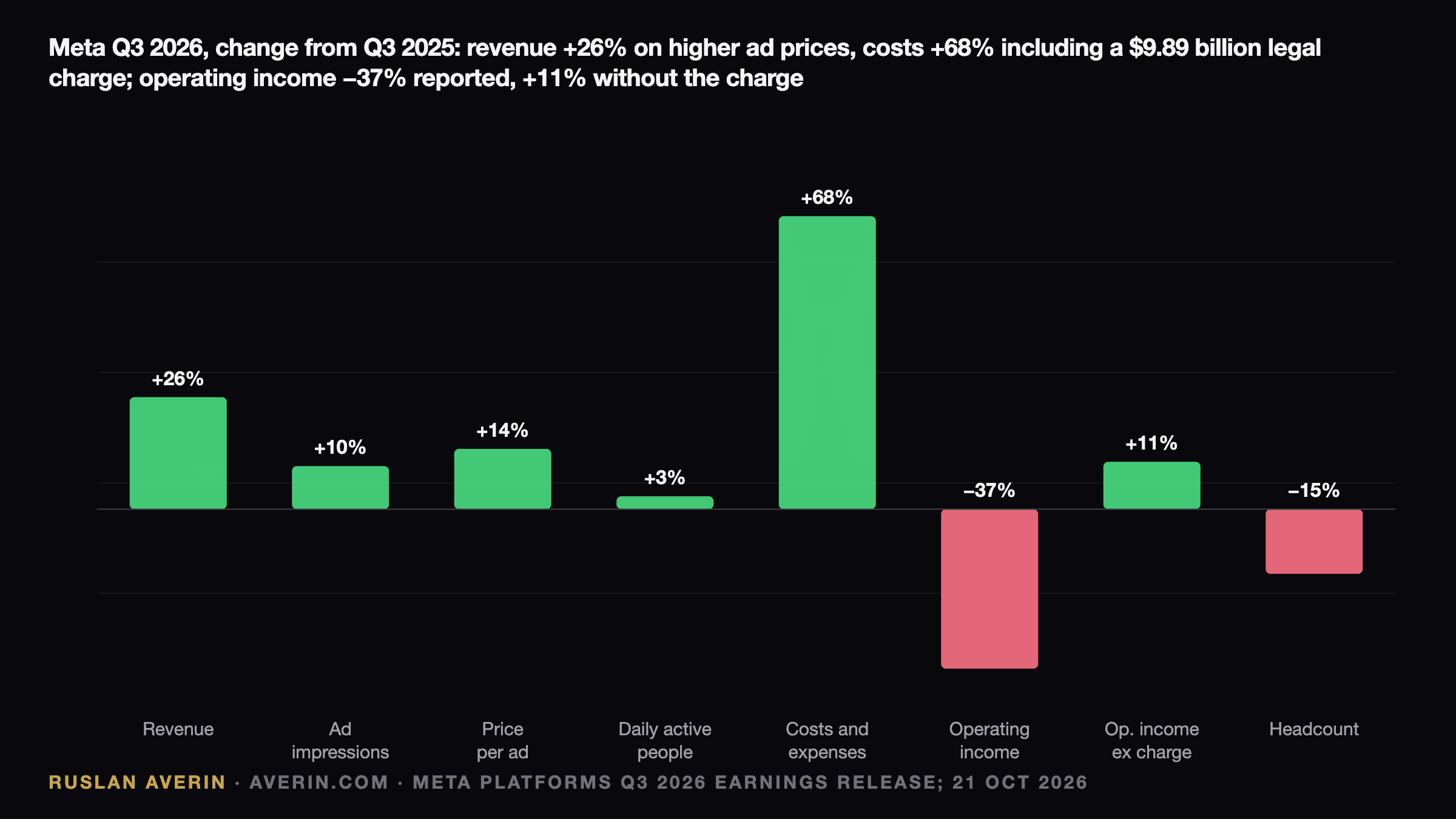
The mix inside the beat matters. Ad impressions grew 10% while the average price per ad climbed 14%, so pricing did the heavy lifting. Family daily active people rose 3%, down from 8% a year earlier, and landed just below the StreetAccount estimate of 3.65 billion. Monetisation is still improving faster than the audience is expanding.
The $9.89 billion that broke the earnings line
Total costs and expenses surged 68% to $51.61 billion, including a $9.89 billion charge for the August agreement with 52 US state attorneys general resolving teen mental health litigation. Meta says that agreement provides for payments of up to about $18.59 billion. An earlier version of the deal covered 29 states at $16.68 billion.
Strip the charge out and operating income would have been $22.88 billion rather than $12.99 billion, with diluted EPS of $7.40 instead of $3.83. The comparison base is equally distorted: Q3 2025 absorbed a one-off $15.93 billion tax charge, leaving adjusted EPS of $7.25. On that like-for-like basis earnings per share advanced roughly 2% while revenue grew 26%. Spending explains most of the gap, helped by a tax rate of 17% excluding the charge versus 14% a year earlier.
Another bill landed the same day. A New Mexico judge imposed a $25 billion penalty in a Cambridge Analytica-related case, CNBC reported. Meta's chief legal officer said the company is confident it will "prevail on appeal". That amount sits outside the third-quarter accounts.
Negative free cash flow is the real headline
Capital expenditures, including finance lease principal, totalled $34.91 billion against operating cash flow of $32.79 billion, producing free cash flow of negative $2.12 billion. Cash and marketable securities ended September at $82.45 billion. Over nine months Meta raised a net $24.91 billion of long-term debt and repurchased no stock.
Guidance tightened rather than eased. The 2026 capex range narrowed to $135–145 billion from $130–145 billion, against an analyst expectation of $138.27 billion cited by CNBC. Full-year expense guidance rose to $175–179 billion to absorb the legal charge. No 2027 capex figure was given beyond a pledge to "continue investing aggressively", with Reality Labs losses expected to narrow to about $15 billion from $18–19 billion in 2026. Headcount fell 15% to 66,775.
How the Class C dividend is engineered
Every Class A and Class B holder receives one Class C share per share owned. The restated charter takes effect on 19 January 2027, and the dividend must be paid no later than the fifth business day afterwards, which points to late January; the board will set record and payment dates later. Class A carries one vote, Class B ten and Class C none, and all three classes share equally in a liquidation.
Class A continues trading as META on Nasdaq, and Meta intends to list Class C there once issued, though no ticker has been announced. No shareholder vote is required: Zuckerberg-controlled entities holding about 56.1% of the voting power approved the change by written consent, with details set out in the preliminary information statement filed with the SEC on 21 October.
Control, Proposition 40 and the founder's lock-up
As of 1 October Mark Zuckerberg controlled about 60.6% of votes while owning only 13.4% of the economics. Every Class A share issued for deals, pay or financing erodes that spread; Class C shares do not. The filing names the purpose plainly: a currency for "capital raising, employee compensation, potential acquisitions". Meta's special committee pointed to Alphabet's roughly $80 billion equity raise as evidence that AI capital is becoming scarcer.
California's Proposition 40, the wealth tax measure on the 3 November ballot, supplies the second motive. Under a Founder Alignment Agreement, 20% of Zuckerberg's Class C shares, about 10% of his economic stake, can be sold freely, for example to fund that tax. The remaining 80% can only be sold if he sells or converts an equal number of voting shares, and he committed to remain resident in California, or wherever Meta is headquartered, for eight years.
What a holder gains, and what stays the same
Value does not move on day one: at Wednesday's close, $697.52 becomes roughly $348.76 per share across two shares, before any price gap opens between classes. Voting rights are unchanged, since the new shares add none. For US federal purposes Meta does not expect the dividend to be taxable, with cost basis allocated between old and new shares by their market values on the dividend date; holders elsewhere should check local rules. Listed META options will be adjusted by the Options Clearing Corporation once dates are fixed. The durable change is future dilution capacity.
Alphabet shows how this film ends
Google ran the same play in 2014. Non-voting Class C shares (GOOG) began trading on 3 April 2014 while the voting shares took GOOGL, and on Yahoo Finance closes GOOGL traded 0.5–2% above GOOG through the first year. The 2022 20-for-1 split illustrates the limits of split euphoria: GOOGL began split-adjusted trading on 18 July 2022 at a close of $109.03, fell to $83.43 by 3 November, down 23.5%, and a year later was up 13.5% against 26.4% for the Nasdaq Composite. Fundamentals and rates set the price, not the share count.
Four markers to track
Meta closed 10.3% below its 24 September record of $777.59 after a difficult week for the Nasdaq. In analyst Ruslan Averin's view, the quarter settles the revenue question and leaves the cash question wide open. Four markers follow: whether Thursday's close holds the roughly 3% after-hours gain once the New Mexico penalty is absorbed; the 2027 capex figure, usually disclosed with fourth-quarter results, where anything well above $145 billion keeps free cash flow negative; the size and price of the first Class C issuance, which reveals how much dilution the structure was built for; and the 3 November vote on Proposition 40, since passage puts the freely sellable 20% of Zuckerberg's Class C shares into play as supply.