RCI Hospitality is the largest listed operator of adult nightclubs in the United States. It also runs the Bombshells restaurant chain and owns much of the property underneath both. Trailing revenue is $284.4 million; the market capitalisation on 7 August 2026 was $214.6 million.
The interesting thing about this company is not the business it is in. It is the arithmetic of the share count.
The numbers
| Metric | Value |
|---|---|
| Share price (7 Aug 2026) | $28.07 |
| Market cap | $214.6M |
| Revenue TTM | $284.4M |
| Free cash flow | ~$45.4M, 11.8% CAGR |
| Adjusted EBITDA | $52.6M, 4.4% CAGR |
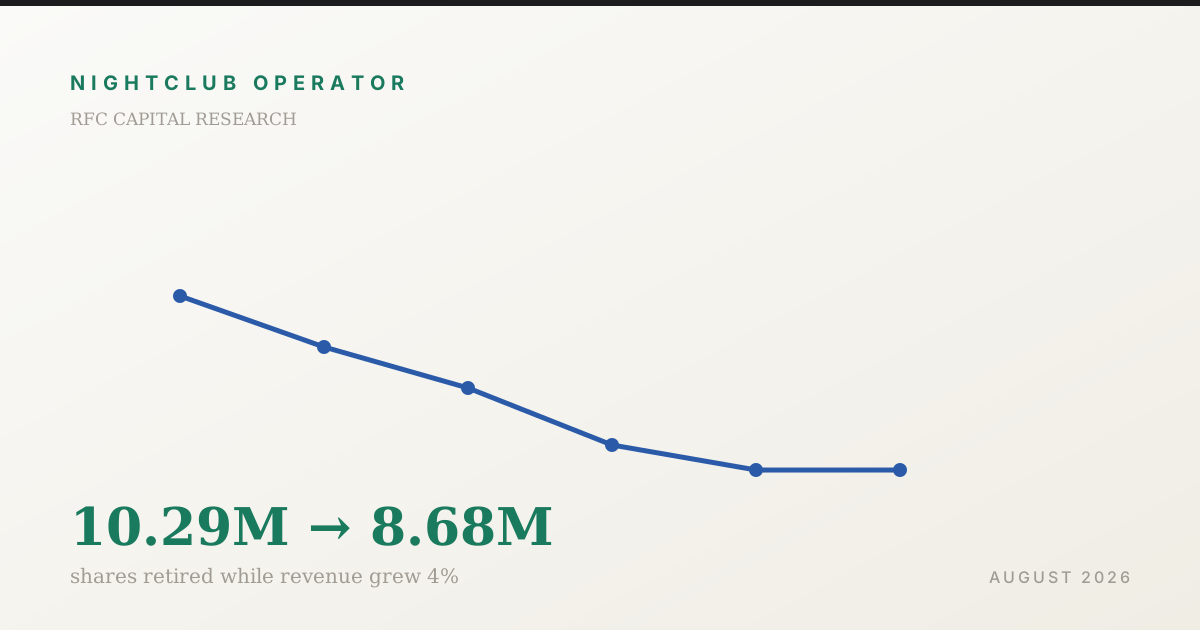
| Fully diluted shares | 10.29M → 8.68M |
| Dividend | $0.32 (1.14%) |
| 52-week range | $20.76 – $38.25 |
Fiscal Q3 2026, presented on 6 August: revenue up 4% to $73.9 million, non-GAAP earnings per share up 17% to $0.90, margins expanded, Bombshells rebounded.
The mechanism
Free cash flow of roughly $45.4 million against a $214.6 million market capitalisation is a free cash flow yield above 20%. That number is the entire investment case, and it needs to be stated carefully: it is high because the market applies a heavy discount to this business, not because the business is unusually productive.
Management's stated policy is to direct about 40% of free cash flow into acquiring clubs and about 60% into buybacks, debt reduction and dividends. The result is visible in the share count: 10.29 million fully diluted shares have become 8.68 million, a 1.6% annual reduction, with 895,061 shares repurchased in the first quarter alone at a cost of $31.8 million.
The five-year plan through fiscal 2029 targets $400 million of revenue, $75 million of free cash flow and 7.5 million shares outstanding. Buybacks are expected to resume around 1 October, at the start of the new fiscal year, assuming leverage improves further.
A company that grows revenue slowly while shrinking its share count faster produces rising per-share figures without rising demand. That is the compounder mechanic, and it works — until either the cash flow or the discipline breaks.
What the negative earnings mean
Trailing GAAP figures show a net loss of $4.21 million, or −$0.52 per share, which is why no meaningful P/E is quoted. The gap between that and $0.90 of quarterly non-GAAP earnings is legal and restructuring costs.
This deserves more scrutiny than a typical adjustment. In most industries, legal costs are episodic and genuinely separable from operations. In this one, litigation and regulatory friction are a recurring feature of the operating environment rather than an interruption to it. An adjustment that removes them every year is not removing noise — it is removing a cost of doing business.
The conservative approach is to treat some normalised level of legal expense as permanent and haircut the free cash flow accordingly. Do that, and the yield remains attractive; it simply stops being extraordinary.
The risks that actually matter
Concentration in permits and locations. Individual clubs depend on local licensing. A licence lost is revenue lost with no substitute, and the asset is difficult to redeploy.
Leverage against acquisitions. The strategy buys clubs with cash flow. If cash flow tightens while debt is outstanding, the acquisition engine stops and the balance sheet becomes the story.
A truncated buyer base. Many institutional mandates exclude this sector regardless of the financials. That is precisely why the free cash flow yield is above 20% — and it is also why it may stay there. A discount that never closes is not a discount; it is a permanent feature of the price.
How to read it
This is a small-cap cash generator with real estate underneath, run by management that has been consistent about returning capital, trading at a yield the market assigns to businesses it does not want to own.
The bull case does not require growth. It requires the free cash flow to hold and the share count to keep falling, and it is arithmetically sound if both continue.
The bear case is that the discount is structural rather than temporary, in which case the per-share progress is real but the multiple never re-rates, and total return converges to the buyback rate plus the dividend. That is not a disaster — it is roughly a high-single-digit outcome — but it is far short of what a 20% free cash flow yield superficially suggests.