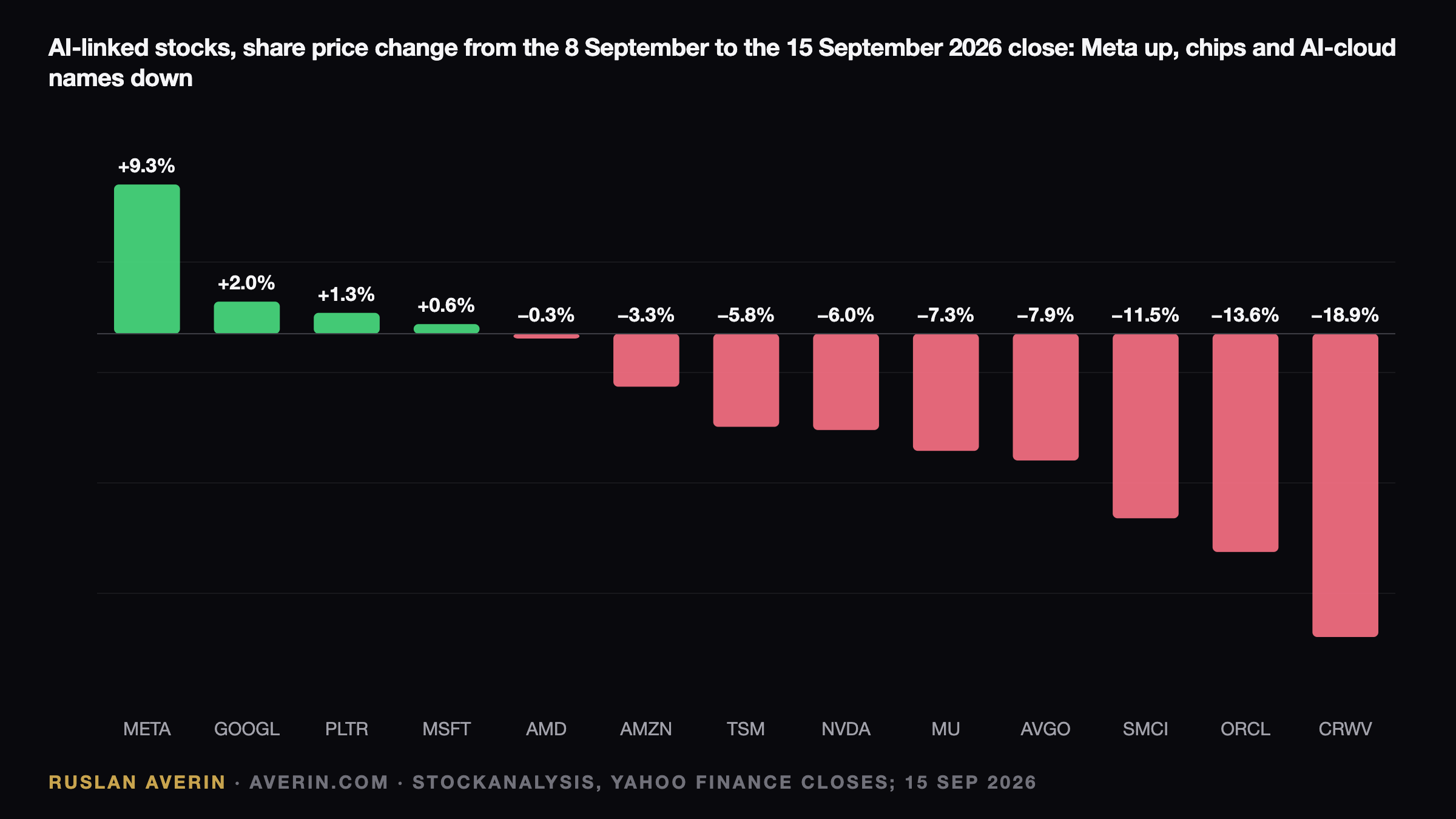
Eight days of essays, one week of repricing
Between 8 and 15 September the artificial intelligence industry produced a resignation, a manifesto, a chorus of co-signatures, a presidential dismissal and, on Tuesday, a rebuttal from Mark Zuckerberg that the New York Times framed as aimed squarely at Anthropic. Yet the price action was already in motion. The Philadelphia semiconductor index shed 5.86% on Monday, Oracle sits 28% lower for the year, and the company that publicly refused to slow down is the one that rose.
How the sequence actually ran
On 8 September Jacob Coxon resigned from Anthropic, writing that labs are "racing straight to self-improving superintelligence and gambling with our lives"; the post drew 90 million views in a day. On 10 September Oracle guided FY2027 capital expenditure to $90–95 billion alongside a $40 billion raise, and ORCL fell 5.4%, Micron 4.9% and the SOX index 2.7%.
Dario Amodei published "We Must Pace the Frontier" on 12 September, with Sam Altman ("I agree with Dario"), Elon Musk ("Dario is right") and Demis Hassabis co-signing. On 13 and 14 September Yann LeCun, David Sacks, Michael Burry, Chamath Palihapitiya and Beijing pushed back; Jensen Huang told the All-In Summit that "slowing down is definitely the wrong strategy", and Donald Trump called it "a hoax" by phone.
The 14 September tape and the yield behind it
Monday brought the SOX index down 5.86%, with NVDA down 3.4%, AMD 4.4%, AVGO 4.8%, MU 5.3%, TSM 3.5%, SMCI 8.4% and CRWV 6.8%, while the 10-year Treasury crossed 5%. Oracle's disclosure was the trigger: FY2026 capex of $55.7 billion, up 162%, free cash flow of −$23.7 billion, and $40 billion of new debt and equity. Brent at $108 completed the picture.
Two cross-checks support the financing reading. Cybersecurity names rallied on Monday, with Okta up 5% and CrowdStrike and Palo Alto up 4.5%, consistent with investors taking Amodei's cyber warning at face value. And Meta, which spends $130–145 billion this year, gained 9.3% between 8 and 15 September while Nvidia lost 6.0%. A market pricing a genuine capability pause would not reward the heaviest spender.
Two documents, two theories of restraint
Amodei's proposal is narrower than the headlines suggested: frontier labs should "slow the pace at which we improve the capabilities of AI models", beginning with third-party evaluators from METR embedded inside Anthropic on employee-like access. He is explicit that "pacing does not mean halting model training or technical progress". The line Fortune amplified is a 6–12 month horizon for a persistent botnet inflicting "hundreds of billions of dollars in damage".
Zuckerberg's counter, posted on 15 September and echoed by Alexandr Wang, argues that each lab paces itself: "Every lab has the responsibility and incentive to move at the pace required to train its models safely." Meta delayed Muse "for several months to focus on safety and security. We didn't call for everyone else to do this before we would." META closed up 0.7% at $670.24, 4.2% higher over three sessions.
Budgets, not manifestos
| Company | 2026 capex guidance | Previous | Date |
|---|---|---|---|
| Amazon | $220 billion | $200 billion | 30 July |
| Alphabet | $195–205 billion | $180–190 billion | 22 July |
| Microsoft | ~$175 billion (calendar 2026) | $190 billion before accounting change | 29 July |
| Meta | $130–145 billion | $125–145 billion; $115–135 billion in January | 29 July |
| Oracle | ~$70 billion net, $90–95 billion gross (FY2027) | $55.7 billion actual FY2026 | 10 September |
| Total, midpoints | ≈ $800 billion |
Every prior figure was raised over the summer and none has been cut. Amazon attributed its $20 billion increase to "soaring memory chip prices", which is why Micron is up 225% for the year even after last week. Alphabet's CFO said 2027 capex will "significantly increase". Consensus for 2027 is $920 billion, Goldman's base case $1.1 trillion with a $1.4 trillion upside, Morgan Stanley around $1.1 trillion.
Suppliers confirm, mix shifts, leverage breaks
Nvidia's July quarter revenue reached $96.2 billion, up 106%, with a $108 billion guide; Broadcom's AI semiconductor revenue hit $16.7 billion, up 221%, guided to $21.7 billion. Pacing would reallocate hours from training the next model to evaluating the current one; Zuckerberg's alternative moves compute toward "serving people", meaning inference. Both remain GPU-intensive.
The casualties are the businesses tied to one customer's training cadence. CoreWeave fell 18.9% in the week and is 40% below its high; Oracle carries $300 billion of OpenAI commitments in the tally. Nvidia, at 17.6 times forward earnings, escaped comparatively lightly.
Reading the incentives
Burry noted "how self-serving it is for OpenAI, Anthropic and other execs of big hyperscalers to talk of slowing things down". Sacks added that labs "face massive product-liability exposure if your products enable a truly damaging cyberattack". Anthropic closed a $65 billion round at a $965 billion valuation in May, reported a $65 billion revenue run-rate at the end of July against roughly $9 billion at the end of 2025, and has filed confidentially for an autumn listing at a reported $2 trillion target. Altman co-signed the same day, running a company with $1.15 trillion of compute commitments and a projected $27 billion cash burn.
Anthropic appeared in 43.5% of businesses in Ramp's August card data against 39.7% for OpenAI; a slower industry norm protects that l