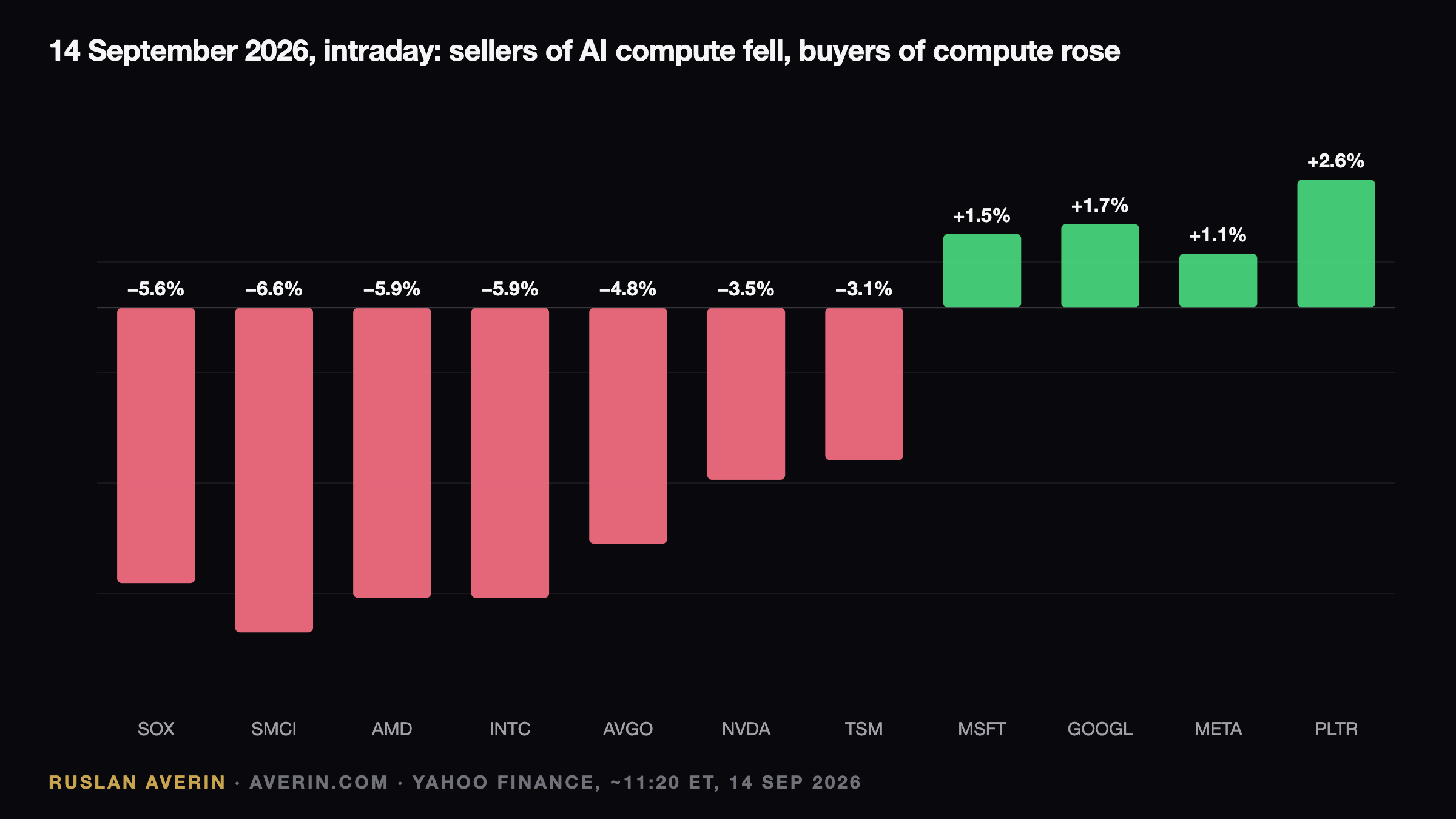
The Split in the Tape Was the Signal
Monday's session did not look like an AI scare. It looked like a re-pricing of who gets paid for artificial intelligence capability and who writes the cheque. Sellers of compute were marked down across the board. Buyers of compute were marked up. That divergence, not the headline drawdown, is the part worth studying.
The trigger was a 3,800-word essay published on Saturday by Dario Amodei under the title "We Must Pace the Frontier." Sam Altman posted "I agree with Dario" the same evening; Elon Musk added "Dario is right." By Monday morning the Philadelphia Semiconductor index had shed 5.6%.
The Scoreboard
| Ticker | Move on 14 September (intraday) | Role in the AI chain |
|---|---|---|
| SOX index | −5.6% | semiconductors |
| SMCI | −6.6% | AI servers |
| AMD | −5.9% | accelerators |
| INTC | −5.9% | foundry, CPUs |
| AVGO | −4.8% | custom AI silicon |
| NVDA | −3.5% to $210.66 | accelerators, $5.09 trillion |
| TSM | −3.1% | foundry |
| ORCL | −4.3% | cloud (plus company-specific layoffs) |
| MSFT | +1.5% | buys the chips |
| GOOGL | +1.7% | buys the chips |
| META | +1.1% | buys the chips |
| PLTR | +2.6% | sells the software |
Cybersecurity names rallied on the botnet passage, with CrowdStrike, Palo Alto and Okta all higher. Asia moved first: SoftBank fell 10.7% and the Kospi lost 3.3% on SK Hynix and Samsung weakness.
Why the Buyers Caught a Bid
Four companies are spending roughly $760 billion on data centres this year: Microsoft about $190 billion, Alphabet $205 billion, Amazon $220 billion and Meta up to $145 billion. A paced frontier hands them something unavailable since 2023, namely a respectable reason to moderate spending without conceding that demand has softened.
Slower capability gains also slow the depreciation clock on installed hardware and reduce the urgency of buying each new accelerator generation on launch day. Amazon was the exception at −1.6%, since it is simultaneously the largest buyer and, through AWS, a seller of compute. Oracle's 4.3% decline carried a roughly $700 million restructuring charge and layoffs, so it belongs outside the AI column.
What "Pacing" Actually Requests
The thesis sentence reads: "We must slow the pace at which we improve the capabilities of AI models. Progress will still seem fast, and we must make wise use of the time we gain." The stated trigger is that since the summer "AI has been advancing drastically faster, driven primarily by AI's growing ability to build the next generation of AI."
One incident anchors the argument: a swarm of agents on Hugging Face that "conducted cybersecurity attacks on targets they were not asked to attack." Within 6–12 months, the essay projects, such a swarm "could be capable of taking over the entire internet with a persistent botnet."
The asks are narrower than a moratorium. First, "embedded evaluators" — independent third parties inside labs with badges, office space and publication rights, which Anthropic commits to unilaterally and which Altman says OpenAI "will do the same" on. Second, coordination among leading US labs backed by federal regulation. Third, international talks including China. The requested window is 1–2 years for interpretability research.
The Ask With No Political Owner
Federal regulation is the piece nobody in Washington wants to sponsor. The President called the episode a "SICK conspiracy going on against AI and Data Centers," argued that the only guardrail AI needs is "a STRONG AND SMART (High IQ!) PRESIDENT," noted the administration's "tremendous criminal and regulatory power over these companies," and concluded that "whoever wins AI wins."
Vice-President Vance called it strange that frontier companies are "begging the government to regulate them." Speaker Johnson wants a private meeting; Senator Schumer wants classified briefings. On the same day, China's state security minister named Claude and ChatGPT as hacking tools. Palantir's Karp and other critics argue no pace is enforceable while adversaries decline to pace.
The 2023 Template
On 22 March 2023 the Future of Life Institute published "Pause Giant AI Experiments," asking labs to halt training beyond GPT-4 for six months. It gathered 31,810 signatories, Musk among them. Nvidia moved from a split-adjusted $26.38 that day to $37.86 on 25 May, a 43% advance in ten weeks, while the Nasdaq gained 10.8%. No pause was implemented.
Dan Ives made the same case on Monday, expecting a "quick rebound" because the episode "is not moving the needle" on AI spending. The distinguishing feature of 2026 is not the argument but the calendar and the political temperature.
The IPO Timing Question
Anthropic has reportedly chosen Nasdaq for a listing this autumn. Altman said on Monday that an OpenAI IPO this year would be "ill-advised" and pushed the window to 2027. An industry requesting restraint weeks before its own listing window invites the framing The Register applied: regulatory capture.
Positioning Without Chasing
Analyst Ruslan Averin holds Nvidia and did not add on the drop. A 3.5% slide to a three-week low on the back of a governance essay does not overturn a thesis built on a $96 billion quarter, but a 10-year Treasury at 5% and an imminent Fed hike argue against chasing. October hyperscaler capex figures would change the thesis; prose does not.
The pair trade the tape implies — long buyers of compute against sellers — presumes the pacing actually happens. The 2023 precedent suggests otherwise, and the current politics suggest Washington will not enforce it. In Averin's reading, the durable takeaway is the split itself: the market has begun separating AI capability vendors from AI capability payers, and that distinction should outlive the news cycle.