The Map Matters Less Than the Invoice
Kyiv's September 2026 numbers deliver an uncomfortable message to anyone choosing a rental flat by neighbourhood reputation. Across ten districts, purchase prices for a one-room apartment span a 3.6-times range, yet gross yields compress into a narrow 5.9–7.5% band. The rental market has already repriced location risk. What remains unpriced is the discount a buyer extracts at the negotiating table.
District Table: Wide Prices, Narrow Returns
Prices below are OLX listings for July, rents are LUN medians for September, both rounded. The pattern is consistent: where buying costs more, renting costs more too, and the ratio barely moves.
| District | One-room price | One-room rent | Gross yield |
|---|---|---|---|
| Pechersk | $164,100 | UAH 38,100 | 6.3% |
| Shevchenkivskyi | $98,900 | UAH 24,000 | 6.5% |
| Holosiivskyi | $84,700 | UAH 20,000 | 6.4% |
| Podil | $82,300 | UAH 20,000 | 6.5% |
| Solomianskyi | $69,300 | UAH 17,000 | 6.6% |
| Darnytsia | $65,000 | UAH 16,000 | 6.6% |
| Dniprovskyi | $62,100 | UAH 16,000 | 6.9% |
| Obolon | $60,900 | UAH 17,000 | 7.5% |
| Sviatoshyn | $51,500 | UAH 14,000 | 7.3% |
| Desnianskyi | $45,300 | UAH 10,000 | 5.9% |
Two districts break the pattern. Obolon and Sviatoshyn deliver above-average yields at below-average prices, supported by metro access and relative distance from strike targets. Desnianskyi does the opposite: the cheapest entry point produces the weakest return, because rent of UAH 10,000 collides with what tenants can actually afford rather than with housing quality.
The Negotiation Premium
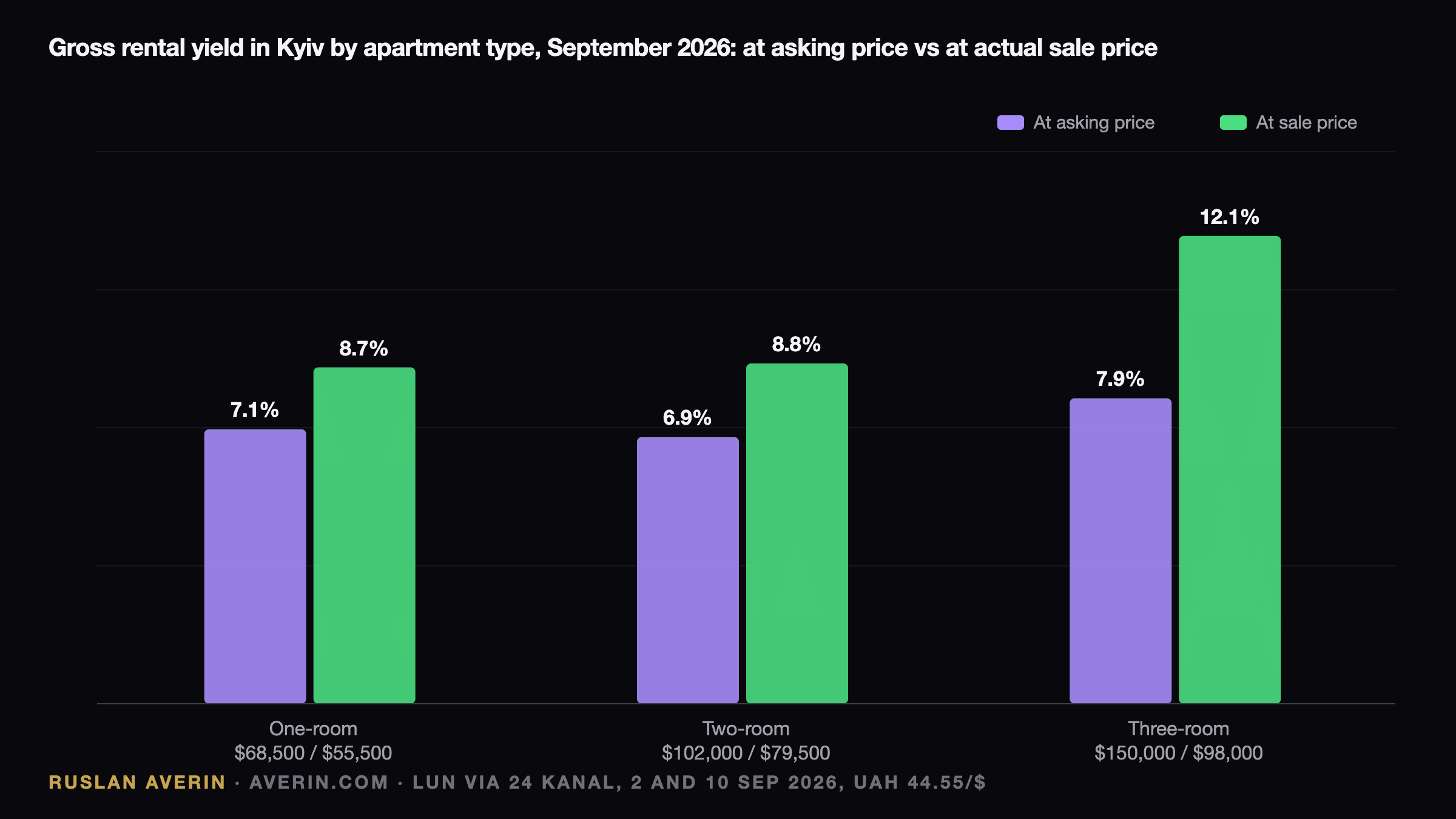
Medians by apartment type, at an exchange rate of 44.55 hryvnia per dollar, show where the real leverage sits. A one-room flat lists at $68,500 and trades at $55,500, renting for UAH 18,000, which turns 7.1% at the asking price into 8.7% at the deal price. That gap of 1.6 percentage points exceeds anything district selection can contribute.
Two-room flats follow the same logic: $102,000 listed, $79,500 transacted, UAH 26,000 in rent, 6.9% against 8.8%. Three-room stock appears strongest of all, at $150,000 listed and $98,000 transacted against UAH 44,200 in rent, producing 7.9% and 12.1%. The headline figure is the least reliable number in the dataset.
Why Three-Room Flats Flatter the Spreadsheet
The UAH 44,200 rent is a listing median, never tested by a signed contract. Larger flats take up to two weeks to let against roughly one week for a one-room, the tenant pool is thinner, and three-room rents dropped 5% in the month to September. Adjusted for realistic vacancy, the achievable return sits closer to 6%.
Tenants Are Buying Safety, Not Views
The autumn student surge did not materialise in 2026. Agents report that renters now screen for proximity to shelters and for buildings with backup heating, as 2,500 Kyiv buildings enter the heating season without it, with the left bank more exposed. Lukianivka and part of Darnytsia have lost demand after strikes. A gas hob, a shelter, underground parking and a generator move a flat faster and dearer.
Gross to Net: The Arithmetic That Decides
Take the one-room flat at the $68,500 listing price. Rent of UAH 18,000 over eleven paid months, allowing one vacancy, gives UAH 198,000, or $4,445. Against that run FOP group 3 charges of 5% single tax plus 1% military levy, UAH 11,880, and USC of UAH 1,902.34 monthly, UAH 22,828 a year.
Add upkeep and minor repairs at roughly 1% of value, $685, an agent fee on tenant change every two years averaging UAH 9,000 annually, and UAH 3,000 of utilities during the empty month. Net income lands near $2,710, or 4.0%. On the $55,500 deal price the identical $2,710 becomes 4.9%.
Tax structure moves the result almost as much as price. An individual letting without a FOP pays 23% of turnover rather than 6%, and net yield slides to 3.6%. Registration in the first month of ownership is therefore an economic decision, not an administrative formality.
New Build Versus Secondary: A Question of Horizon
Comfort-class new construction in a residential district runs $1,220 per square metre, so a 40 m² one-room costs $48,800, with $8,000–15,000 of fit-out and furniture on top. The 57,000–64,000 total matches a secondary deal price, but comes with a year of waiting and zero income during it.
The compensation is real: such a flat lets 15–20% above comparable secondary stock, attracts tenants with budgets of 20,000 and up, and needs no repairs for five years. Over a ten-year hold, the fitted new build wins. Over three years, secondary wins, simply because it starts producing cash immediately.
The Order of Operations
In analyst Ruslan Averin's view, the sequence for a Kyiv rental purchase in autumn 2026 runs as follows. Entry price comes first: negotiate toward the deal median, 15–20% below asking, since this outweighs any district choice. Type comes second, favouring one-room or compact two-room flats up to 55 m², with three-room stock acceptable only at deal price.
Building quality ranks third, with shelter, backup heat and a generator replacing what "the view" used to mean. District comes fourth: metro within walking distance, and among Obolon, Sviatoshyn, Solomianka and Darnytsia the specific building decides, not the name. Structure comes fifth, with FOP group 3 registered from month one.
Averin notes that a flat selected in this order nets roughly 5% plus any capital appreciation, while the same budget deployed in reverse order delivers 3–3.5%. The difference is not market luck but process discipline, and it is available to every buyer before a single contract is signed.