An Export Auction That Would Have Been Unthinkable a Year Ago
On 15 October private companies sold about 12.75 million cubic metres of gas at the first export auction of the Ukrainian Energy Exchange — Ukraine's first gas export since 2022, according to ExPro Consulting data cited by UNIAN. Buyers paid €69–69.03 per MWh, roughly 21% below the starting prices, for a total of about €9.36 million. Everything offered was sold.
The gap with the home market was striking: the export price came in 89% above the domestic price. That spread explains why the rules are deliberately tight. Private producers may ship out no more than 15% of monthly production, only between 1 March and 30 November, and only when the domestic exchange shows no demand.
From 1 December to 28 February exports are banned outright. Volodymyr Omelchenko of the Razumkov Centre notes that the state can halt sales immediately at the first genuine threat of a shortage, and argues the revenue should be channelled into protecting gas production from attacks. For households the volume is irrelevant: 12.75 million cubic metres is under 0.1% of stored gas.
The Starting Stock in Numbers
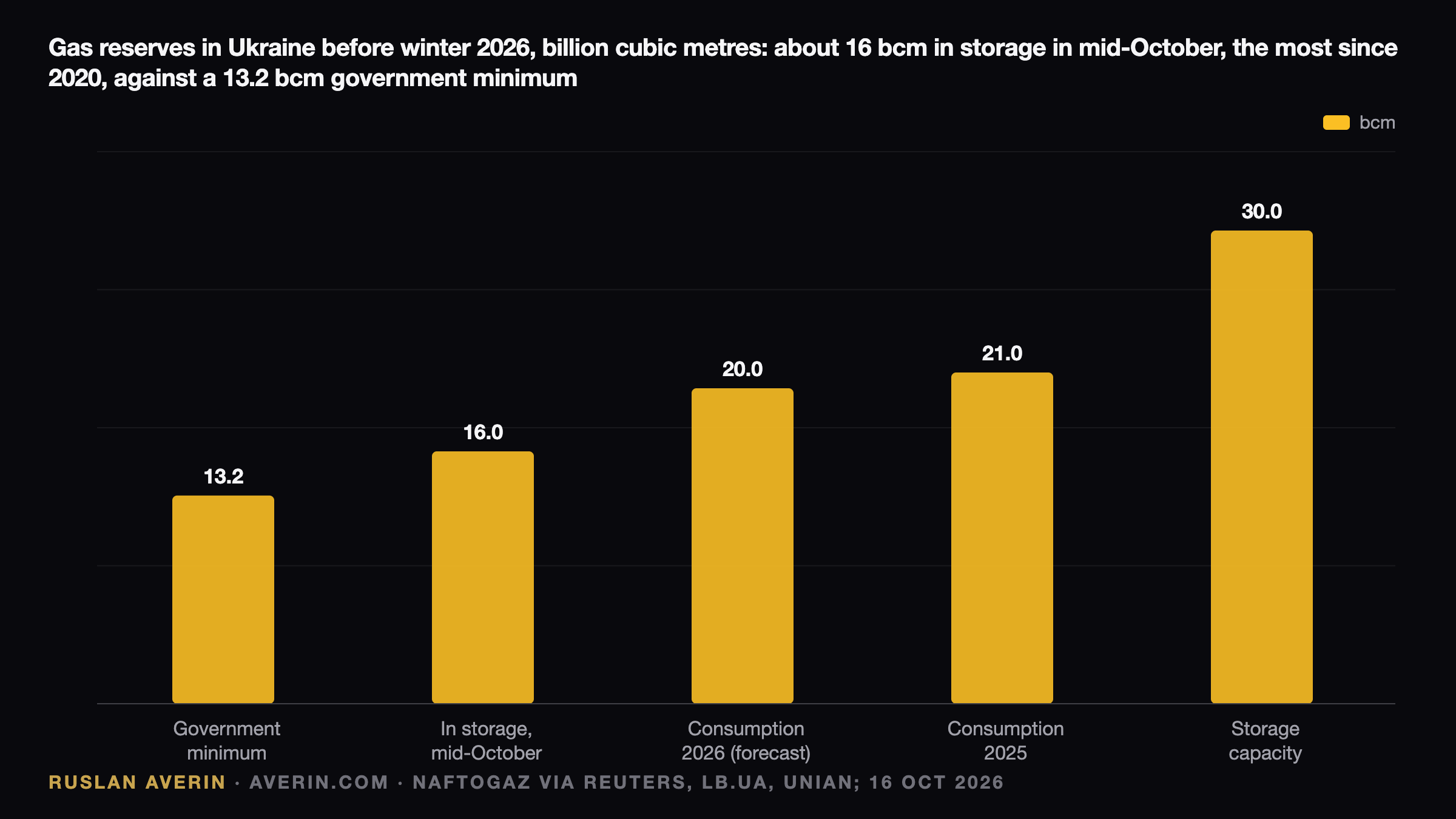
Serhii Fedorenko, acting chairman of the Naftogaz management board, put storage at about 16 bcm in an interview with Reuters published on Friday 16 October, as reported by LB.ua and UNIAN. It is the largest pre-winter volume since 2020, and it sits comfortably above the level the government treats as the survival threshold.
| Indicator | Value |
|---|---|
| Gas in storage, mid-October | about 16 bcm |
| Government minimum for the winter | 13.2 bcm |
| Start of the 2025/26 season | under 14 bcm |
| Expected consumption in 2026 | about 20 bcm |
| Consumption in 2025 | 21 bcm |
| Storage capacity | about 30 bcm |
| Independent estimate (Razumkov Centre) | almost 15.8 bcm |
| Contracted imports this season | more than 1 bcm |
| Household price until 30 April 2027 | UAH 7.96 per cubic metre |
Omelchenko's figure of almost 15.8 bcm, published a few days earlier, sits 2.6 bcm above the required minimum and 1.2 bcm above the target level written into the forecast balance. His conclusion was that the 2026/2027 balance leaves the country fully supplied for the autumn-winter period.
One element of the improvement is not a success. UNIAN points out that consumption fell mainly because Russian strikes damaged industrial infrastructure and forced some enterprises to stop working. Lower demand from a shrinking industrial base is a different thing from lower demand through efficiency.
Why the Buffer Is Thinner Than the Headline
Storage is not the winter supply; it is the shock absorber between daily demand and what domestic fields plus imports can physically deliver. The higher the level in November, the longer the system can survive a sudden loss of production in January. Three variables decide whether about 16 bcm turns out to be enough.
The first is bombardment. Russia has attacked Naftogaz facilities more than 400 times since the start of 2026, twice as often as in the whole of 2025, hitting production, processing and transport assets as well as thermal plants in frontline regions. Every well knocked out has to be replaced from storage or from purchases abroad.
The second is weather: a prolonged cold spell lifts daily withdrawals, and the 13.2 bcm minimum is calibrated for a normal winter, not a severe one. The third is imports. Naftogaz has already contracted more than 1 bcm, about 25% of it LNG, with deliveries scheduled from December to March — buying started earlier than usual.
In analyst Ruslan Averin's view, the 16 bcm figure buys time rather than certainty: the 2.8 bcm margin over the minimum equals roughly one-seventh of a year's consumption, so a winter with heavy production losses would still force additional purchases in Europe.
From a Record 7.8 bcm to a Modest Top-Up
The contrast with last season is the real measure of progress. Naftogaz imported a record 7.8 bcm across 2025 and the first quarter of 2026 after strikes cut domestic output and storage fell to its lowest level in years. This year's contracted volume is a fraction of that — the clearest evidence the starting position has improved.
The LNG share carries its own economics. Liquefied cargoes land at European terminals and reach Ukraine through neighbouring pipeline systems, adding regasification and transit costs relative to pipeline gas bought near the border. A quarter of contracted volumes in LNG works as insurance against pipeline disruption, not as the backbone of supply.
Fedorenko told Reuters the company is reinforcing physical protection of its facilities. Kyiv has separately offered the European Union the use of about a third of Ukraine's storage capacity — the largest underground system in Europe at roughly 30 bcm — for European reserves.
What Households Actually Pay
The tariff side is settled for this heating season. The Naftogaz "Fixed" plan holds at UAH 7.96 per cubic metre including VAT until 30 April 2027, a price the company confirmed again on 12 October. The plan can end earlier only if a customer voluntarily switches to another tariff.
The reach is near-universal: Naftogaz supplies about 98% of Ukrainian households, more than 12 million consumers, according to Kyiv Post. Delivery is not included — the distribution fee appears as a separate line at the rate of the local gas distribution operator, which varies by region.
On 28 September the Cabinet of Ministers extended the public service obligations mechanism on the gas market until 31 March 2027, as announced by Prime Minister Serhii Koretskyi. Under it, Naftogaz Trading sells gas to heat and hot water suppliers serving households at UAH 7,420 per 1,000 cubic metres.
Translated into bills: a flat burning 10 cubic metres a month for cooking pays about UAH 80 for the gas itself. A private house using 100 cubic metres in a cold month pays UAH 796, and one consuming 1,500 cubic metres across the season pays about UAH 11,940, before distribution. Housing subsidies remain available; heating costs are counted from 16 October 2026 to 15 April 2027, alongside the separate Winter Support payment of UAH 19,400.
Four Markers to Track
The level on 1 November matters most, since the injection season normally closes around then and that figure becomes the true starting stock. Withdrawal speed in December and January comes next: a fast drawdown in the first cold weeks means heavier import needs later. Strikes on Kharkiv and Poltava regions, the main producing areas, remain the key operational risk.
The fourth marker is political. Both the UAH 7.96 price and the PSO regime are temporary instruments with fixed end dates, and the 89% gap between export and domestic prices illustrates the pressure building behind the next decision. Averin expects any revision to arrive only after the heating season closes, not during it.