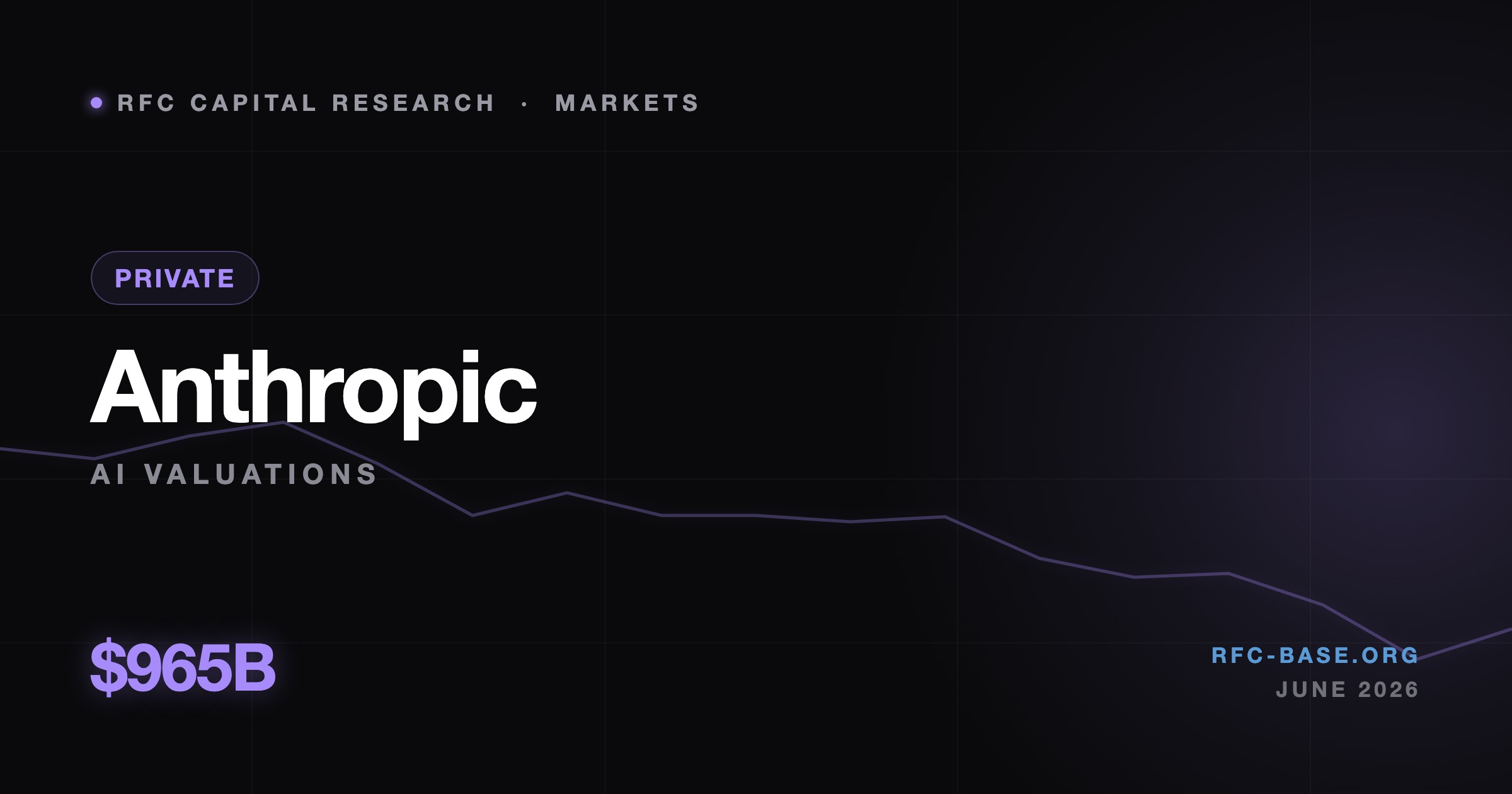
For the first time since the AI race began, OpenAI is not the most valuable AI company in the world.
By Ruslan Averin.
This is Ruslan Averin's read on the leadership flip — and what it tells allocators about where AI value is actually settling.
| Metric | Anthropic | OpenAI |
|---|---|---|
| Valuation | $965B (Series H) | $862B |
| Run-rate revenue | $47B+ | — |
| Flagship model | Claude Opus 4.8 | GPT-5.5 |
What flipped
Two years ago the gap between OpenAI and everyone else looked structural. The Series H that crowned Anthropic at $965 billion — above OpenAI's $862 billion — closed on the back of $47 billion in run-rate revenue and the Claude Opus 4.8 release, which Anthropic claims outperforms GPT-5.5 and Gemini 3.1 Pro. Corporate spending data has shown both labs adopted by 30%+ of business customers; the valuation premium went to the one converting adoption into enterprise revenue at better unit economics.
The investor read
Three signals matter beyond the headline:
- Enterprise beats consumer in monetization. The flip rewards B2B revenue quality over app-store reach. Recurring enterprise contracts are what late-stage investors will pay near-trillion valuations for.
- Model leadership is now a horse race. Leapfrogging every release cycle means no lab holds durable pricing power from capability alone — distribution and trust do the compounding.
- Private AI valuations are public-market problems now. At $965 billion and $862 billion, these two private companies are worth more than most of the S&P 500's top decile. Whenever they list, the index math changes.
The bottom line
The flip is less about one company winning and more about the market deciding what it pays for: enterprise revenue, capital efficiency, safety-led brand trust. For public-market investors the actionable edge stays the same — own the infrastructure both labs must buy (compute, memory, power) rather than guessing which model wins next quarter's benchmark.