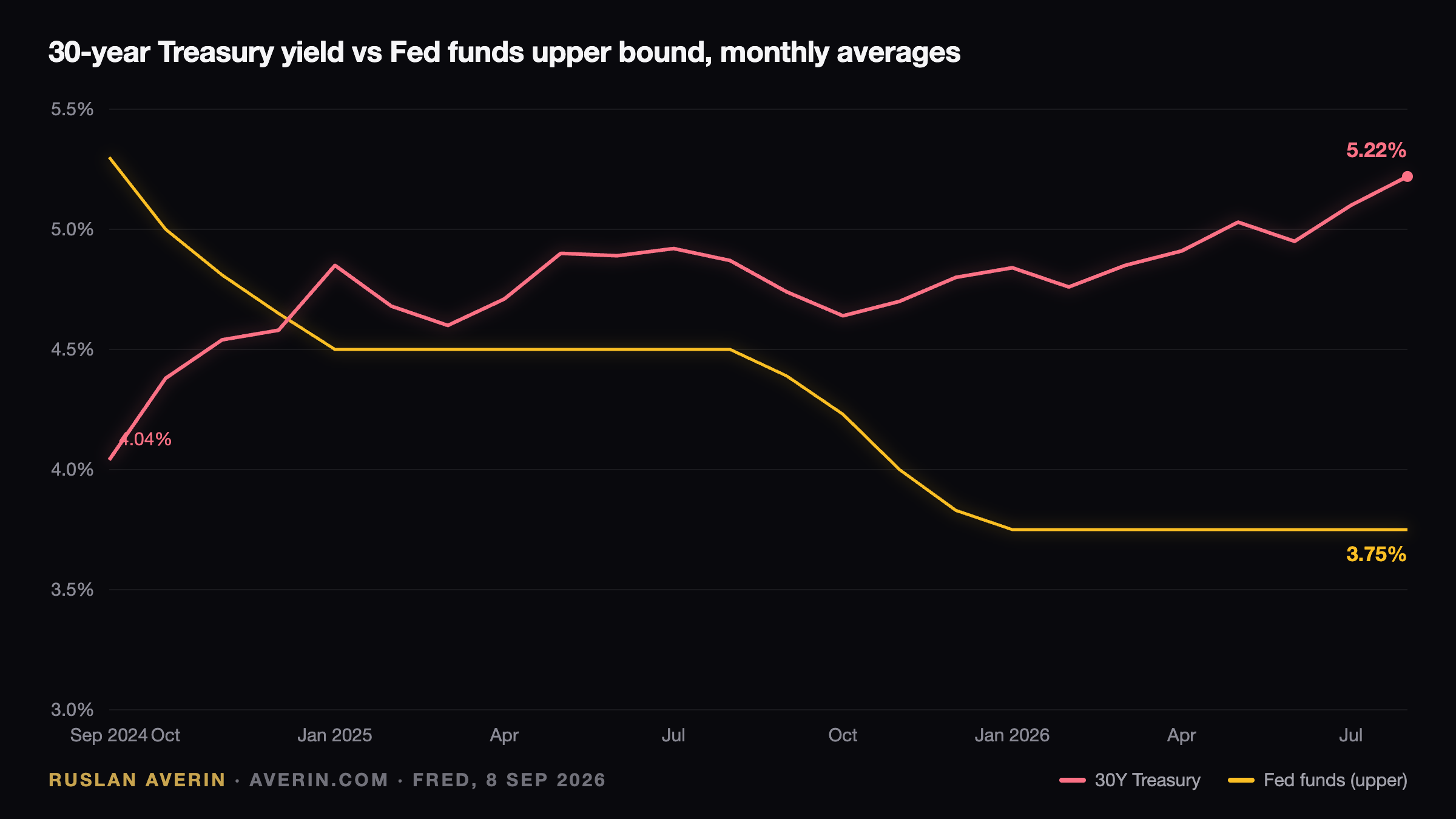
Bond mathematics rarely makes headlines, but in September 2026 it settles the argument about the long end. A 30-year US Treasury priced at par with a 5.25% coupon carries a modified duration of roughly 15. That single number explains why the highest long-bond yield in a generation is being treated by experienced buyers as a tactical entry point rather than a place to lock away capital for three decades.
What Fifteen Points of Duration Actually Costs
Duration translates yield moves into money. At a duration of 15, every quarter-point shift in the long yield rearranges the principal value by several percent, dwarfing the income the bond throws off in a year. The table below shows the approximate price response of a 5.25% coupon 30-year bond to parallel moves in its own yield.
| Yield move | Approximate price change |
|---|---|
| +0.25% | −3.7% |
| +0.50% | −7.1% |
| +1.00% | −13.5% |
| −0.50% | +8.0% |
| −1.00% | +16.9% |
A rise of half a percentage point costs a holder about 7.1% of principal — roughly sixteen months of coupon. That is precisely the distance the 30-year travelled between May and August. The instrument pays 5.25% annually and can surrender that amount inside a fortnight.
The Comparison That Reframes the Yield
Set the long bond against the 2-year at 4.39%, whose duration sits under two. The same half-point move costs that holder less than 1% of principal. The 30-year therefore offers an additional 0.86% of yield in exchange for roughly eight times the price risk. Analyst Ruslan Averin notes that the market is paying for that trade in 2026, but not generously.
How the Yield Reached a Quarter-Century High
On 14 August 2026 the US Treasury sold $25 billion of 30-year bonds at 5.216%, the highest yield at a 30-year auction since 2001. Three days later the secondary market printed 5.31%, the highest daily close in the FRED series since 2007. By 8 September the bond settled back at 5.25%.
The 2001 comparison is instructive rather than reassuring. Back then the policy rate stood at 6.5%, federal debt was $5.7 trillion, and the deficit had just flipped into surplus. Today the policy rate is 3.75%, debt has passed $40 trillion, and the twelve-month deficit is $1.8 trillion. The long yield is elevated despite low short rates, not because of them.
Auction Anatomy: A Narrower Set of Hands
Bid-to-cover at the August sale came in at 2.39, toward the low side of the past two years. Primary dealers absorbed 11.5% — the figure worth tracking, since dealers are obliged to bid and end up holding whatever nobody else wanted. At 11.5% they were not stuffed, but the buyer base has thinned. Domestic funds and insurers took the balance.
Contrast the 10-year auction on 9 September: a 4.834% stop, bid-to-cover of 2.71, and 79.2% allotted to indirect bidders, the category capturing foreign central banks and overseas funds. Appetite for intermediate paper remains healthy. The difficulty is confined to thirty-year maturities, where the marginal foreign buyer has simply stopped appearing.
Two Sellers, One of Them a Government
Japan's Ministry of Finance has repeatedly sold Treasuries through the summer to defend the yen. Buying yen requires dollars, and Tokyo raises them by liquidating the most liquid dollar asset it owns — of which it holds a substantial quantity in long maturities. Each intervention removes a bid from the 30-year sector.
The second seller is the US Treasury, which sells out of necessity. Debt held by the public hit 100% of GDP in August. Net interest runs at roughly $1.25 trillion a year, exceeding defence spending. The deficit totals $1.8 trillion over twelve months and $168 billion in August alone, and a rising share is being funded in coupons rather than bills.
The one offsetting measure — tripling the buyback programme to $6 billion of off-the-run long bonds — amounts to a rounding error against $25 billion auctions every month. Behind the sovereign supply sits a private wave: corporate issuers, led by hyperscalers funding AI capital expenditure, have placed more than $1.5 trillion of bonds this year. Pension funds weighing a Microsoft 30-year against a Treasury 30-year face a genuine choice.
Better Real Estate on the Long Curve
For buyers seeking maximum coupon per unit of duration, the 30-year is not the answer. The 20-year at 5.26% pays a basis point more with duration near 12.3 rather than 15. It trades cheap because fewer index funds are compelled to own it — which is exactly the reason an index-agnostic buyer should.
For a locked real return over a long horizon, the 10-year TIPS at a 2.43% real yield is the cleaner tool. Identical government credit, no inflation exposure — the very risk behind the long-end repricing — and, for a hold-to-maturity investor, something close to what a 5.25% nominal 30-year is meant to deliver, minus the duration-15 sensitivity to the next Japanese intervention or hawkish Warsh speech.
Is 5.25% the Ceiling?
The honest range is wide. Supporting a top: 5.25% nominal sits 1.85% above July CPI and 1.5% above the policy rate, the auction cleared, and a Fed hike on 16 September would flatten the curve by lifting the front end faster. Against it: supply is structural, the foreign bid is shrinking, the deficit shows no path back toward $1 trillion, and a 3.4% inflation rate with oil elevated hardly makes a thirty-year bond obviously cheap.
The Positioning Conclusion
Ruslan Averin treats the 30-year as a trading instrument in 2026 rather than a holding — attractive enough to buy above 5.3% and sell below 5%, but not attractive enough to bury for three decades when the 20-year matches the coupon and TIPS lock the real return without the inflation wager. The yield-curve overview shows where the long bond sits relative to the rest of the curve; the playbook converts that into allocation.