An earnings night shaped by a company that is not public yet
Most quarterly previews start with demand. Amazon's third-quarter 2026 report, due Thursday 29 October after the US close, starts with accounting. The call begins at 2:00 p.m. Pacific, 5:00 p.m. Eastern, 23:00 in Kyiv. The shares closed on Tuesday 27 October at $253.10, up 1.61% on the day and 9.7% above the 31 December 2025 close of $230.82.
The Anthropic mark and why headline EPS may mislead
Second-quarter net income reached $62.6 billion, or $5.75 a share, inflated by $53.4 billion of pre-tax other income described as coming primarily from the Anthropic investments. That is not operating performance, and it will not repeat on a schedule.
The 10-Q shows Anthropic nonvoting preferred stock carried at about $92.5 billion at 30 June and convertible notes at a fair value of about $97.9 billion, roughly $190.4 billion combined. Preferred stock is remarked only on observable price changes, such as a funding round; the Series H at a $965 billion valuation in May produced the $50.5 billion other-income entry.
Gains on the notes follow a different path. They land in accumulated other comprehensive income rather than net income, and that unrealized gain stood at $92.0 billion. Reporting reviewed for this preview shows no priced Anthropic round between July and September, which would make the third-quarter mark far smaller than the second quarter's.
The listing itself, reported for November at about $2 trillion, would fall into the fourth quarter. At Tuesday's close the stake equals roughly 7% of Amazon's approximately $2.7 trillion market value, based on the 10.77 billion weighted-average basic shares disclosed in the second-quarter release.
What management promised and what analysts wrote down
Amazon's 30 July release guided third-quarter net sales to $197.0–202.0 billion, growth of 9–12% year on year, including roughly 80 basis points of currency drag. Prime Day shifted into June this year; excluding the event in both periods, the company says growth would be "nearly 400 basis points higher". Operating income was guided to $22.5–26.5 billion against $17.4 billion a year earlier.
| Line | Guidance or consensus | Source |
|---|---|---|
| Net sales | $197.0–202.0 billion | Amazon, 30 July |
| Revenue consensus | around $202 billion | Pepperstone, 23 October |
| Operating income | $22.5–26.5 billion | Amazon, 30 July |
| EPS consensus | $2.01 (14 analysts) | Zacks, via Nasdaq |
| EPS consensus | $1.96 | Pepperstone, 23 October |
| Q3 2025 EPS | $1.95 | Zacks, via Nasdaq |
Analysts polled by LSEG had looked for $204.1 billion of revenue, CNBC reported on 30 July, while StreetAccount's operating income estimate of $24.92 billion sat inside the range. The Street therefore clusters at the ceiling of Amazon's own sales band. Conservative guidance is a habit here, yet a mid-range print would still register as a shortfall on paper.
The cloud number that sets the tone
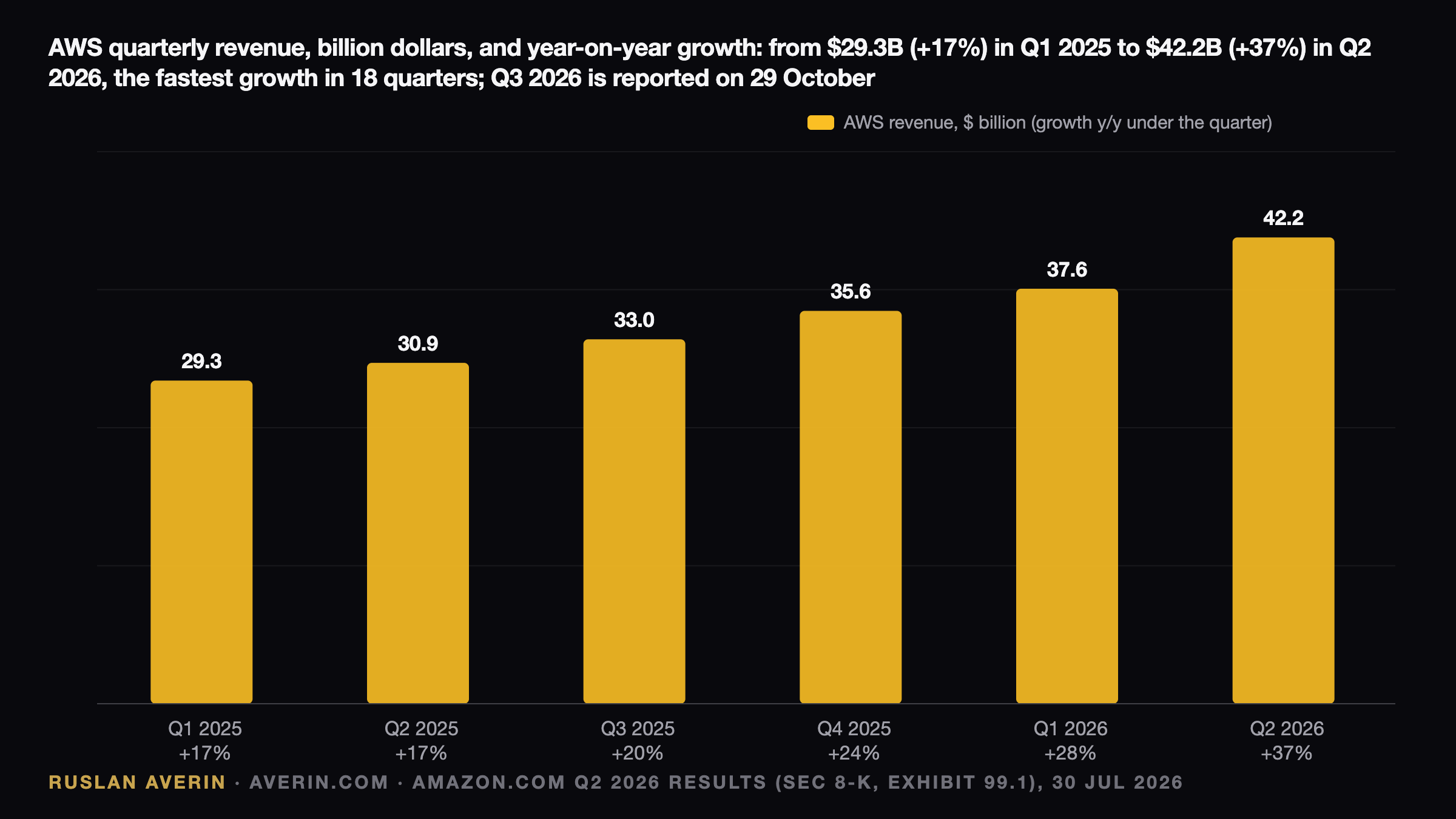
AWS grew 37% to $42.2 billion in the second quarter, its fastest pace in 18 quarters, comfortably past StreetAccount's 31% expectation. Segment operating income of $16.6 billion delivered a 39.3% margin. Pepperstone's preview puts the third-quarter bar near 35%, roughly $44.6 billion on last year's $33.0 billion base.
The comparison is less forgiving now: AWS expanded 20% in the third quarter of 2025 after 17% in the second. What limits the figure is capacity rather than appetite. On the July call Andy Jassy said that even with higher spending "we will still not have enough capacity to meet all the demand we have in 2026, and I believe this dynamic will also be true in 2027 too."
Backlog stood at $496 billion on 30 June, with a weighted-average remaining contract life of 6.4 years. It embeds an OpenAI expansion worth $100 billion over eight years and an Anthropic expansion of more than $100 billion over 10 years.
Margin is the quieter test. AWS depreciation climbed to $8.08 billion from $4.84 billion a year earlier, a 67% increase that outpaced revenue. A margin sliding well under 39% would blunt any growth beat.
Spending $220 billion and funding it
Jassy lifted the 2026 capital spending plan to about $220 billion in July, up from the $200 billion flagged in February and repeated in April, citing rising memory prices in comments reported by CNBC. Cash capital expenditures were $53.1 billion in the second quarter and $96.3 billion across the first half.
On a comparable basis, the back half requires roughly $124 billion, close to $62 billion per quarter. Trailing twelve-month free cash flow had already turned into an outflow of $7.6 billion at 30 June, against an inflow of $18.2 billion a year before.
Debt is covering the difference. Long-term borrowings reached $128.9 billion at 30 June from $65.6 billion at the end of 2025, and an 8-K records £4.25 billion of sterling notes sold on 14 September. Suppliers absorb part of the outlay, as the $8 billion Generac agreement illustrates.
The round trip in the share price
The second-quarter report beat cleanly: $200.61 billion of revenue against $196.47 billion expected and adjusted earnings of $1.97 a share versus $1.82, per LSEG via CNBC. Shares closed at $235.50 on 30 July, $271.58 the next session for a 15.3% gain, then $284.02 on 3 August.
Much of that has drained away. The close was $262.37 on 21 October before a 4.57% drop to $250.38 on 22 October, with the price loitering near $250 since. Tuesday's $253.10 sits 10.9% under the August high, after an October in which AI-linked names were pressured by questions over how the build-out is financed.
Five lines to read first
In the view of analyst Ruslan Averin, revenue carries less information than usual because the Prime Day shift distorts it. The checklist starts with AWS growth, where 37% or better suggests capacity is arriving faster than feared and 32% or less reopens the payback debate. Second comes the AWS margin: above 38% means depreciation is being absorbed.
Advertising is third. It rose 26% to $19.81 billion in the second quarter against StreetAccount's $19.43 billion; repeating that pace on last year's $17.70 billion implies roughly $22.3 billion. Fourth is capex commentary for the remainder of 2026 plus any first signal on 2027. Fifth is fourth-quarter guidance, including any remark on Amazon Leo, which had nearly 400 satellites in orbit in July.
Mapping the possible reactions
Options were pricing a move of about 7.4% in either direction as of 23 October, per Pepperstone, equal to roughly $18.70 a share at Tuesday's close. The constructive path pairs AWS at or above 37% with a stable margin, operating income near the top of $22.5–26.5 billion and capex held at about $220 billion, putting $284.02 back in view.
A base case of 34–36% AWS growth, revenue near $202 billion and a modest capex increase likely keeps the move inside the implied band, with the call doing the work. The bearish mix is cloud growth drifting into the low 30s while spending climbs again. Analyst Ruslan Averin notes that GAAP earnings per share may be the noisiest figure of the night, so operating income and AWS deserve the first look.