A Quarter That Will Be Judged on Words, Not Orders
ASML opens the chip-equipment reporting season before the market opens on Wednesday 14 October, ahead of trading on Euronext Amsterdam, with the investor call set for 15:00 CET, or 9:00 a.m. in New York. For the third consecutive quarter the release will arrive without a net bookings line. That absence shifts the entire burden of the print onto guidance, commentary and capacity language.
From 2026 ASML discontinued quarterly bookings disclosure on the argument that order intake is lumpy and that forward guidance carries more information. The last published figures were unusually strong: fourth-quarter 2025 net bookings hit a record €13.2 billion, of which €7.4 billion was EUV, against a backlog of €38.8 billion at year-end. A year earlier, in the third quarter of 2025, bookings were €5.4 billion with €3.6 billion of EUV.
The China Share That Keeps Falling
No line in the model has moved further than China. Its share of ASML net system sales slid from 42% in the third quarter of 2025 to 36% in the fourth, then to 19% in the first quarter of 2026 and 14% in the second. In October 2025 management warned that China sales would decline significantly during 2026; by July the CFO put China at roughly 20% of total 2026 net sales, a figure that includes service revenue.
Policy remains the live risk. In April ASML said the bandwidth of its 2026 guidance was wide enough to absorb "potential outcomes of ongoing discussions around export controls". On 26 September the Center for Technology & Statecraft counted 343 immersion DUV systems inside Chinese-owned fabs, around 270 of them ASML NXT:1980i tools, and pushed for tighter rules. Restricting service on that installed base would hit the high-margin maintenance stream, not only new shipments.
July's Numbers and the Fourth-Quarter Arithmetic
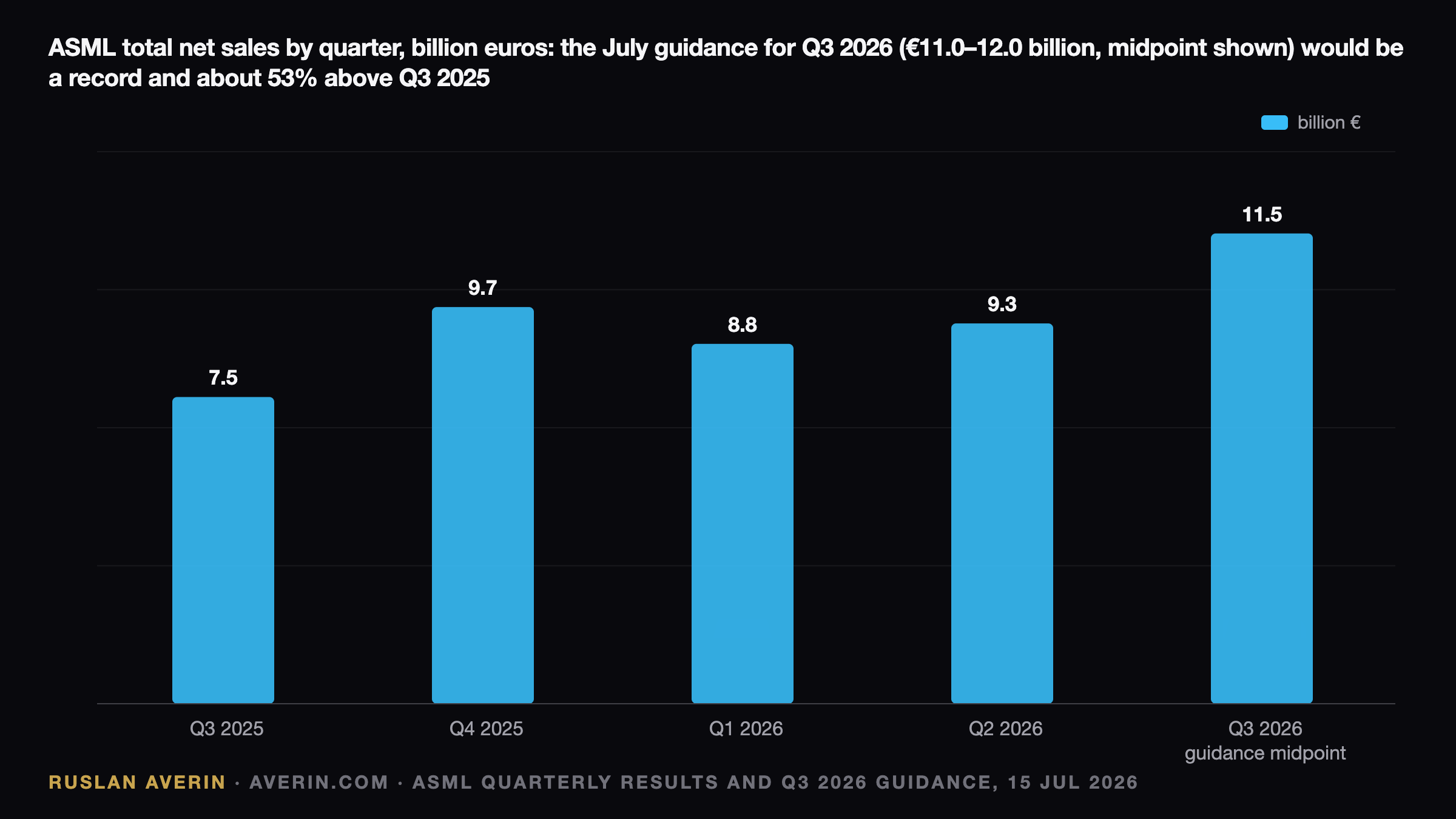
The 15 July guidance set third-quarter total net sales at €11.0–12.0 billion with a gross margin of 55–57%, Installed Base Management sales of about €2.9 billion, research costs of about €1.2 billion and selling and administrative expenses of about €0.4 billion. Full-year 2026 guidance was lifted to €43–45 billion at a 54–56% gross margin, the third upgrade of the year after €34–39 billion in January and €36–40 billion in April.
| Metric | Q3 2025 actual | Q3 2026 guided or expected |
|---|---|---|
| Net sales | €7.5 billion | €11.0–12.0 billion |
| Gross margin | 51.6% | 55–57% |
| EPS | €5.49 | $12.47 (Zacks, in dollars) |
| China share of system sales | 42% | 14% in Q2 2026 |
The midpoint of €11.5 billion implies growth of roughly 53% against a low base. The full-year range carries a second message. First-half sales were €18.1 billion, €8.8 billion plus €9.3 billion. At a €44 billion midpoint the second half must deliver €25.9 billion, so a €11.5 billion third quarter leaves an implied fourth quarter near €14.4 billion, a record by a wide margin.
Where Consensus Sits and Why the Bar Is Awkward
The Zacks consensus, stated in dollars, is sales of $13.18 billion and earnings of $12.47 per share, with one Nasdaq share equal to one ordinary share. A TradingKey preview places consensus revenue at €11.6–11.8 billion, in the upper half of the guided band. Zacks also flags that 2026 and 2027 estimates have slipped over the past 60 days, leaving a demanding sales bar that is no longer rising.
ASML has recently made a habit of clearing its own range. Second-quarter sales of €9.3 billion beat guidance of €8.4–9.0 billion, and a 54.0% gross margin beat a 51–52% guide, with the CFO attributing about €300 million of the upside to service and upgrades. A third quarter at or above €12.0 billion with a 57% margin would repeat the pattern; a print near €11.0 billion would fall well short of consensus.
Capacity Language as the New Order Book
Without bookings, three proxies carry the order signal. The first is 2027 capacity: ASML plans to ship about 65 low-NA EUV systems in 2026 and to add 30% of capacity in 2027, roughly 85 tools, with the CFO saying in July that the 2027 order book was close to fully covered. Analyst Ruslan Averin expects investors to watch for "covered" to harden into "fully booked".
The second is 2028, where ASML is investigating a further 30% increase in EUV and DUV immersion capacity, with no orders yet attached. A firm commitment there would be the closest thing to a bookings surprise. The third is High-NA: 16 EUV systems were sold in each of the first two quarters, and second-quarter EUV system sales of €3.8 billion included one High-NA tool. Intel Foundry has qualified High-NA on select 18A product layers, and on 8 September ASML and TSMC announced a joint initiative on large-format photomasks for High-NA EUV.
Memory, Korea and the Customers Funding It
Demand is now as much a memory story as a logic story. In the second quarter memory accounted for 49% of €6.6 billion of net system sales and logic 51%. By ship-to location, South Korea took 43% and Taiwan 30%. For the full year ASML expects memory-related system sales to grow by more than 75%, advanced logic by more than 25%, EUV system sales by more than 45% and installed-base sales by more than 30%.
Customer disclosures corroborate the trajectory. TSMC posted second-quarter revenue of $40.20 billion, up 33.7% in dollars, guided the third quarter to $44.6–45.8 billion and reported September revenue of NT$511.86 billion, up 54.6% year on year. The 43% Korean share points to Samsung and SK hynix adding DRAM capacity, including high-bandwidth memory for AI accelerators.
The Share Price Going Into the Print
On Nasdaq the shares closed Monday 12 October at $1,750.24, down 1.7% on the day and up 63.6% from the end-2025 close of $1,069.86. In Amsterdam they finished at €1,575.80, up 71.0% from €921.40, the gap reflecting a weaker euro. Both sit below the 30 June records of $1,989.44 and €1,721.40.
The path has been volatile. The stock rose 2.2% on second-quarter results day to $1,815.27 on 15 July, slid to $1,550.69 by 29 July, closed at $1,591.48 on 15 September, rallied 17.3% to $1,867.31 on 2 October, then lost 6.3% over six sessions. In Amsterdam it fell 4.9% from €1,656.20 on 5 October.
Four Lines That Decide Wednesday
Fourth-quarter guidance against the implied €14.4 billion comes first: a full-year raise above €45 billion would confirm backlog conversion. Gross margin is second, where a 57% third quarter and a matching fourth-quarter guide would show EUV volume rather than service one-offs is doing the work. Third is 2027 language. Fourth is China, where a share well below 20% with no new export-control charge is the base case.
Analyst Ruslan Averin argues that a result in the upper half of guidance, an unchanged €43–45 billion year and purely qualitative 2027 commentary would likely produce a muted or negative reaction, given a 64% dollar gain this year and consensus already near €11.7 billion. The upside case needs a raise plus a firm 2027 statement; the downside case is the classic one, a strong quarter paired with talk of 2027 as a peak year.