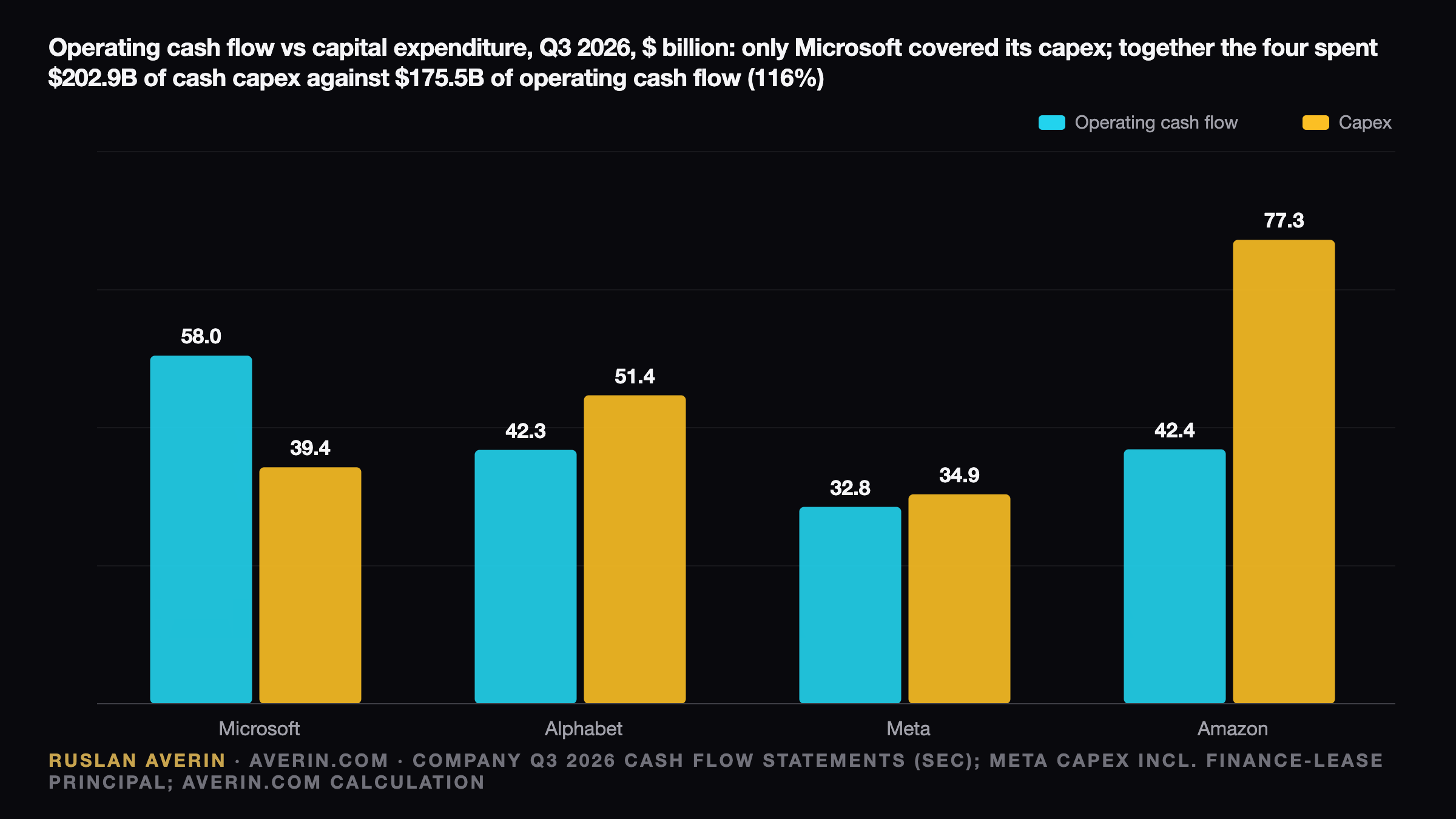
The third-quarter 2026 reports from Microsoft, Alphabet, Meta and Amazon tested one thing: who can still fund the AI build-out from internally generated cash? Combined capex for July–September reached $208.7 billion. Only one of the four stayed inside its operating cash flow, and share prices sorted the companies accordingly.
Analyst Ruslan Averin treats the round as the first genuine stress test of the AI cycle: AI revenue is large and growing, yet at three of the four companies operating cash flow no longer pays for the data centres.
Cash coverage became the scorecard
| Company | Operating cash flow | Capex | Free cash flow | Capex / operating cash flow | Stock on report day |
|---|---|---|---|---|---|
| Microsoft | $58.0 billion | $39.4 billion cash ($45.2 billion incl. finance leases) | $18.6 billion | 68% | −0.16% (29 Oct) |
| Meta | $32.79 billion | $34.91 billion incl. finance-lease principal | −$2.12 billion | 106% | −6.98% (22 Oct) |
| Alphabet | $42.3 billion | $51.4 billion | −$9.07 billion | 121% | −12.64% (29 Oct) |
| Amazon | $42.4 billion | $77.3 billion | −$42.4 billion (trailing twelve months) | 182% | −1.41% (30 Oct) |
Sources: company filings, StockAnalysis. Together the four spent $202.9 billion of cash capex against $175.5 billion of operating cash flow, a ratio of 116%.
Why Microsoft was spared
On Wednesday 28 October Microsoft's revenue rose 19% to $92.28 billion against the $90.69 billion LSEG consensus, and adjusted EPS of $4.89 beat the $4.73 estimate, CNBC reported. Azure brought in $33.17 billion, up 48%, above the $32.32 billion StreetAccount figure.
Capex including finance leases was $45.2 billion, short of the $50.67 billion StreetAccount expected. CFO Amy Hood blamed delays at third-party GPU providers and guided above $50 billion for the December quarter and about $170 billion for calendar 2027. "We still have demand that exceeds supply," she said.
The shares rose 4% after hours but closed on Thursday 29 October at $530.14 against $531.01 before the report.
Alphabet: a doubling cloud could not offset negative cash flow
Alphabet's revenue rose 25% to $127.58 billion, just below the $128.22 billion LSEG consensus, and CNBC put adjusted EPS at $2.67 against $3.02 expected. Google Cloud revenue jumped 103% to $30.7 billion, with operating income of $11.1 billion against $3.6 billion a year earlier.
Capex of $51.4 billion exceeded operating cash flow of $42.3 billion, leaving free cash flow at −$9.07 billion. CFO Anat Ashkenazi held the 2026 range at $195–205 billion: "We continue to expect our capex to increase significantly in 2027." The stock closed at $283.82 on 29 October, down 12.64% from $324.89.
Amazon: fastest AWS growth since 2021, deepest cash gap
On Thursday 29 October Amazon's EPS of $1.89 missed the $1.96 LSEG estimate, while AWS revenue climbed 39% to $45.98 billion, its fastest pace since 2021, CNBC reported. Quarterly capex of $77.3 billion compared with $42.4 billion of operating cash flow.
Trailing twelve-month free cash flow was an outflow of $42.4 billion. Guidance points to about $220 billion of capex in 2026 and "meaningfully more" in 2027. The stock closed at $240.35 on Friday 30 October, down 1.41%.
Meta: an advertiser without a cloud to sell
Meta reported on Wednesday 21 October: revenue of $64.60 billion, up 26%, beat the $63.37 billion LSEG consensus, but capex of $34.91 billion exceeded operating cash flow of $32.79 billion. Guidance stands at $135–145 billion for 2026.
The stock fell 6.98% to $648.85 on Thursday 22 October and lost 15% in October, its worst month in four years, CNBC reported. On Friday 30 October S&P Global cut Meta's outlook to negative from stable, kept the AA- rating and questioned "Meta's ability to monetize its AI investments".
Depreciation: the bill that arrives later
Combined depreciation and amortisation reached $48.2 billion in the quarter, up 36% year on year: Alphabet +49%, Microsoft and Meta +44%, Amazon +25%. Capex runs at 4.2 times that charge. Servers bought now are expensed over years, so margins face rising costs even if spending plateaus.
Backlog versus cash
Cloud backlog is larger still than current revenue: $677 billion of commercial obligations at Microsoft, $560.8 billion at Google Cloud and about $578 billion at AWS. Meta has no such line; its AI pays off through ad prices, which rose 14%.
In the view of analyst Ruslan Averin, the test is whether AI revenue arrives faster than depreciation. Microsoft passes for now. Alphabet and Amazon have backlog but negative cash flow meanwhile. Meta has neither a cloud business nor positive free cash flow, which is why its credit outlook moved first.
Bonds, preferred shares and stock sales fill the gap
The shortfall is financed in the capital markets, the channel that made CoreWeave's $51 billion of debt a worry in October.
On Thursday 29 October Microsoft priced $25 billion of notes in ten tranches, coupons 4.85% to 6.35%, maturities 2028 to 2066, lifting total debt to $60.4 billion from $35.5 billion.
Alphabet raised $28.7 billion of senior notes in the third quarter and sold $12.4 billion of stock at the market. Long-term debt rose to $125.1 billion at 30 September from $46.5 billion at end-2025; a euro bond followed on Monday 2 November.
Meta sold $12.5 billion of 6.50% mandatory convertible preferred stock and agreed forward sales of 40 million shares at $625, about $25 billion, per filings of 26–29 October. Amazon took in $48.1 billion of long-term debt in the third quarter alone.
Apple faces a different exam
Apple reports fiscal fourth-quarter results after the US close on Monday 2 November. LSEG-polled analysts expect revenue of $113.39 billion, Reuters reported; the stock closed on Friday 30 October at $344.63. Its test is memory costs and the December-quarter guide, not data-centre capex.
Scenarios and the dates that matter
The base case: spending keeps rising in 2027 and investors keep sorting companies by cash coverage, as in the Nasdaq's worst October week and after Intel's guidance shock. The bull case needs cloud growth above 40% as depreciation rises; the bear case is backlog that grows while revenue growth slows.
Next: Microsoft's $25 billion bond settles on Wednesday 4 November; Meta's restated charter starts the Class C share dividend on Tuesday 19 January 2027; fourth-quarter reports land in late January – early February 2027, with Alphabet's promised 2027 capex details.