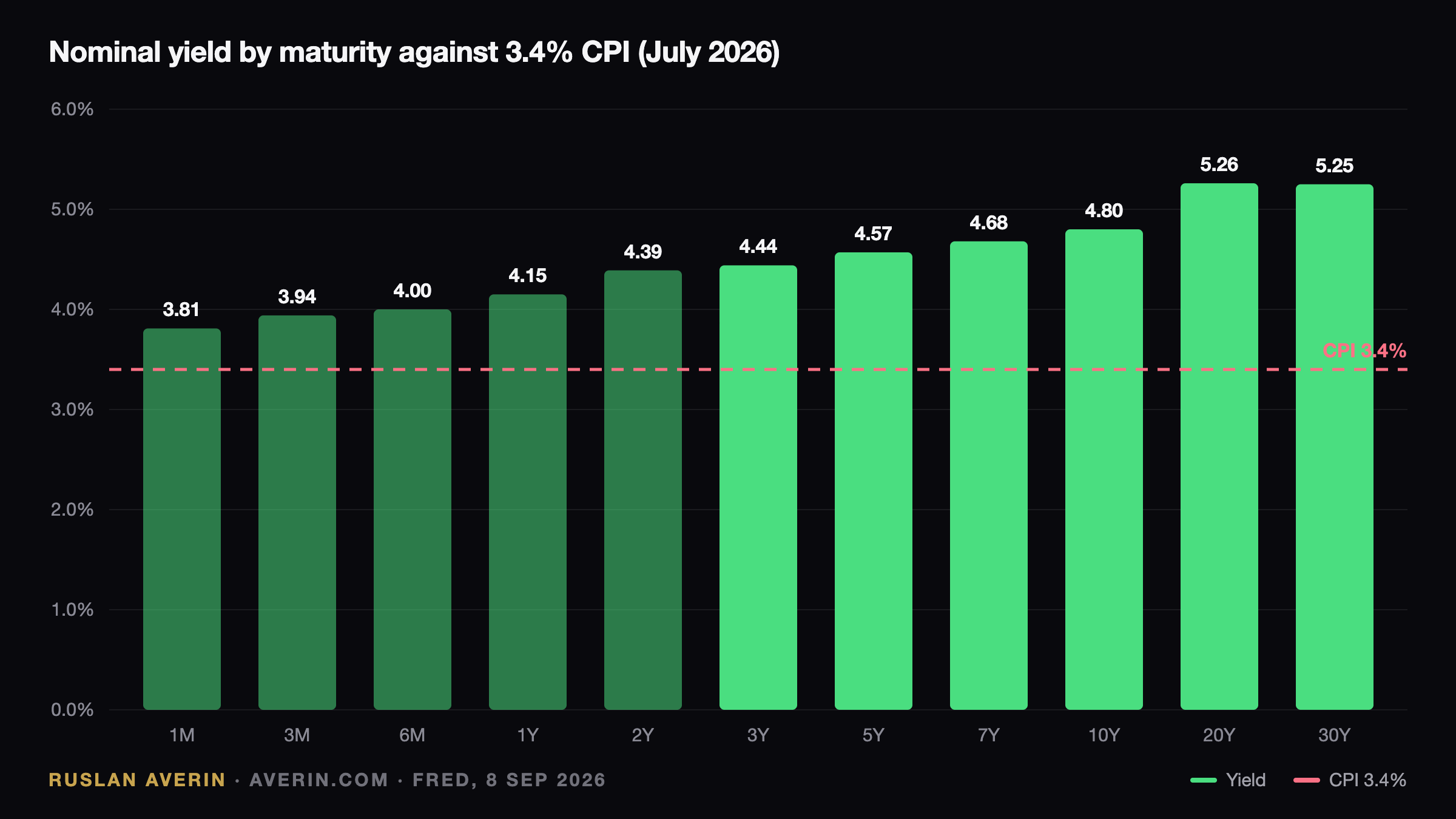
Two calendar entries, five days apart, will set the income on a US bond portfolio for the remainder of 2026. August CPI lands on Friday 11 September at 8:30 ET from the Bureau of Labor Statistics. The Federal Reserve reports its decision on Wednesday 16 September at 14:00 ET, with the market pricing roughly a 56% probability of a 25 basis point hike to 3.75–4.00%. What follows is arithmetic applied to closing yields from 8 September, not a prediction of which way either goes.
Where the curve stood on 8 September
| Instrument | Yield, 8 Sep 2026 | Duration (approx.) |
|---|---|---|
| 3-month bill | 3.94% | 0.25 |
| 2-year note | 4.39% | 1.9 |
| 5-year note | 4.57% | 4.4 |
| 10-year note | 4.80% | 7.9 |
| 10-year TIPS (real) | 2.43% | 8.5 |
| 20-year bond | 5.26% | 12.3 |
| 30-year bond | 5.25% | 15.0 |
| IG corporate | 5.53% | 6.8 |
| BB high yield | 6.11% | 3.8 |
July CPI came in at 3.4%. Every Treasury maturity from one month outward now yields more than that headline figure in nominal terms, and everything from one year outward clears it by more than a full point. For most of the past fifteen years that condition simply did not exist.
Friday comes first and moves the odds
The inflation print arrives before the policy meeting, which makes it the first lever. Consensus expects a headline number close to July's 3.4%. A reading of 3.6% or above lifts hike odds toward 75% and adds 10–15 basis points to the two-year note on the day. A reading of 3.2% or below drags the odds below 40% and pulls the two-year back toward 4.25%.
The long end reacts far less to either outcome. Thirty-year pricing is driven by auction supply and by confidence in policy, not by a single monthly release. That asymmetry is what makes the maturity mix, rather than the directional call, the decision that matters.
Scenario one: the Fed moves
A 25 basis point hike lifts the front end close to one-for-one. The three-month bill repositions near 4.2%. The two-year, which already discounts most of one move, gains perhaps 10–15 basis points. The long end is where the outcome splits.
If the market treats the hike as credible — a central bank willing to act against 3.4% inflation — the curve flattens, and the 30-year may hold at 5.25% or decline as the inflation premium compresses. If the move reads as too timid, the curve steepens instead. Short duration is safe in either reading; long duration is an explicit wager on credibility. The two-year gives up roughly 0.3% of price on a hike and recovers it within a month of coupon.
Scenario two: the Fed waits
There are two very different holds. A hold paired with hawkish language — the "we want to see September CPI" version — is the one long maturities fear. It leaves the policy rate 1.5% below the 30-year yield, leaves the inflation question unresolved, and hands the market another six weeks to sell duration into every auction. In that path the 10-year retests 4.85% and the 30-year retests 5.31%.
A hold with soft language is different in kind. A Fed signalling that July and August payrolls of 21,000 and 162,000 concern it more than the price data would rally the front end and do very little at the back.
A ladder that does not depend on the outcome
For an investor who wants the yield rather than the trade, analyst Ruslan Averin favours a short-to-intermediate ladder anchored by inflation protection. The allocation runs 30% in bills at 3.94–4.15%, which reprice upward on a hike and carry no principal risk; 30% in notes at 4.39–4.44%, locking most of the curve's rise with duration under 3; 25% in TIPS at 2.17–2.43% real, which strips out the inflation bet that dominates long maturities; and 15% split between the 10-year at 4.80% and the 20-year at 5.26%, sized so that a 0.5% move costs under 1% of the total.
What the structure deliberately omits
The 30-year is absent because the 20-year pays effectively the same coupon with less duration. Investment-grade corporates are absent because a 0.81% spread does not compensate for the risk of that spread widening. Anything rated below BB is out entirely. The exclusions do as much work as the holdings.
The withholding rules that outrank the Fed
For a Ukrainian or European holder, one paragraph of tax code moves net yield further than any policy decision. Interest paid to a non-resident on US Treasuries is exempt from US withholding under the portfolio-interest rules, provided the broker has a valid W-8BEN on file. A Ukrainian resident buying a note directly receives the full 4.39% coupon with nothing deducted in the United States. Most registered corporate bonds follow the same treatment.
US-domiciled bond ETFs are a different instrument legally. Their distributions count as dividends, subject to 30% withholding, reduced to 15% under Ukraine's treaty with the United States. Some funds designate part of their payout as qualified interest income and pass Treasury interest through untaxed, but not every fund does and not every broker applies it. A 4.39% yield becomes 3.73% after a 15% haircut and 3.07% after 30%. An Irish-domiciled UCITS ETF holding Treasuries pays no US withholding at fund level and remains the standard route for European buyers; accumulating share classes defer income entirely.
The home-country line nobody escapes
None of the above touches domestic tax. Ukrainian residents owe 18% personal income tax plus the 5% military levy on foreign coupons and capital gains, and must declare them. That 23% applies identically to a directly held Treasury and to an ETF, and it is precisely why hryvnia OVDP, free of both income tax and levy, stay competitive on a net basis despite currency risk. Ruslan Averin frames the conclusion simply: own the front end for the coupon, hold TIPS for the real return, keep long maturities small enough that neither Friday nor Wednesday can inflict damage, and buy Treasuries directly rather than through a US ETF when resident outside the United States.
This is analysis, not tax advice. Withholding rates depend on residence, treaty status and broker documentation; confirm them for your own situation.