Among the large US banks, Citigroup enters the autumn reporting season with the best scoreboard of the year and the thinnest cushion against disappointment. Third-quarter results are due before the US open on Tuesday 13 October, sharing the morning with JPMorgan Chase and Wells Fargo.
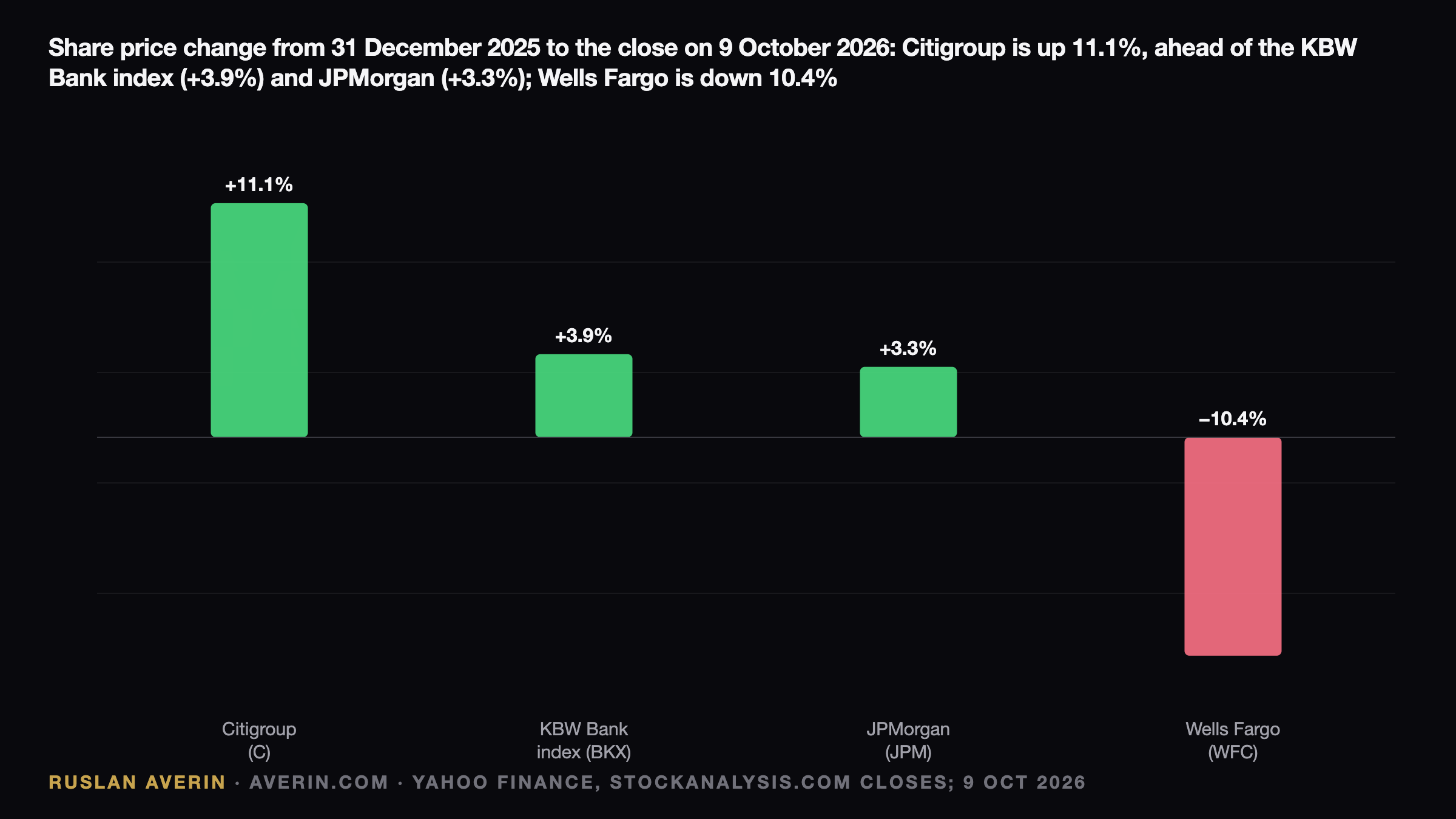
The year-to-date comparison explains the attention. Citi shares closed on Friday 9 October at $129.64, up 11.1% from $116.69 at the end of 2025. Over the same stretch the KBW Bank index added 3.9%, JPMorgan 3.3%, while Wells Fargo lost 10.4%.
The price action that frames the print
That lead is no longer what it was. The stock peaked at $145.67 on 22 June and now sits 11.0% below that level. On the day of the second-quarter report it dropped 5.3%, from $140.71 to $133.27, despite an earnings beat. The market's message was that beats alone no longer move the thesis.
That reaction is the backdrop for Tuesday. Jane Fraser's restructuring is being assessed on a narrower question: whether profitability holds in a quarter stripped of the trading tailwinds that flattered the second.
Capital returns and what the multiple assumes
Citi launched a $30 billion buyback programme and repurchased $10.3 billion of stock in the first half, $4 billion of it during the second quarter. Total shareholder returns in that quarter came to roughly $5.0 billion, with a planned 12% dividend increase alongside.
Balance-sheet strength supports the pace. The CET1 ratio stood at 12.8% at the end of June, above the 12.6% target under current rules, and tangible book value per share reached $100.89, up 7%. At $129.64 the shares change hands at about 1.28 times June tangible book — a price that embeds confidence in returns, not merely a recovery discount.
Banamex has become a calendar item
The Mexico exit has moved from strategic argument to execution schedule. On 29 April Citi completed the sale of a 22.6% stake in Grupo Financiero Banamex to institutional investors and family offices, out of a committed 24%, with the remaining 1.4% expected to close in subsequent months.
Combined with the 25% stake acquired by Fernando Chico Pardo, Citi will have disposed of 49% of Banamex. No further sales are expected in 2026. Deconsolidation is slated for early 2027, and any initial public offering depends on market conditions and regulatory approvals.
For Tuesday the line is largely accounting: confirmation that the final 1.4% closed, any shift in the deconsolidation date, and any loss recognised on the transaction.
Services carries the restructuring case
Services remains the division that validates the whole programme. Second-quarter revenue was $6.4 billion, up 18%, split between Treasury and Trade Solutions at $4.7 billion, also up 18%, and Securities Services at $1.6 billion, up 16%. Fraser described it as the highest quarterly revenue the unit has ever produced, with a return above 30%.
Deposit growth drove net interest income inside the division, and cross-border transaction value rose 13%. With the Federal Reserve's target range at 3.75–4.00% since 16 September, elevated short rates should continue to support deposit spreads; the offsetting risk is client pricing pressure.
Markets, Banking and Wealth under softer guidance
Markets revenue reached $7.0 billion in the second quarter, up 17%, with fixed income at $4.7 billion, up 7%, and equities at $2.3 billion, up 45%. For the third quarter management guided only to mid-single-digit year-on-year growth.
Banking produced $1.9 billion, up 34%, including investment banking revenue of $1.5 billion, up 44%. Yet September guidance pointed to "around low single-digit revenue growth year-on-year" for investment banking. Both figures trail JPMorgan's mid-to-high-teens guidance for comparable lines, which helps explain why the revenue consensus sits below first-half levels.
Wealth revenue was $3.2 billion, up 13%, a ninth consecutive quarterly increase. Net interest income excluding Markets is guided to grow 5–6% in 2026, with management pointing to the upper end or better.
The consensus and the sequential step down
The Financial Modeling Prep consensus from seven analysts is EPS of $2.65 on revenue of $23.7 billion; Hudson Labs shows $2.68 and $23.8 billion. Revenue of $23.7 billion would be roughly 7% above the $22.1 billion reported a year earlier, but below the $24.6 billion of the first quarter and $24.8 billion of the second.
The first half sets a demanding base. Second-quarter net income was $5.8 billion, or $3.15 a share, against $1.96 a year earlier, on revenue of $24.8 billion, up 14%, with net income up 45%. Fraser called it "Citi's best quarterly revenue in a decade". First-quarter EPS was $3.06. Consensus therefore implies a decline of about 16% from the second quarter.
| Metric | Q1 2026 | Q2 2026 | Q3 2026 consensus |
|---|---|---|---|
| Revenue | $24.6 billion | $24.8 billion | $23.7 billion |
| EPS | $3.06 | $3.15 | $2.65 |
| RoTCE | 13.1% | 13.0% | not guided |
| Efficiency ratio | not disclosed here | 57.4% | about 60% full year |
The return target and its awkward arithmetic
The centrepiece of the plan is return on tangible common equity of 10–11% in 2026. Delivery so far has been 13.1% and 13.0%, against 8.7% a year earlier. At the Barclays conference in September management said it expected to finish the year "a bit above our 11%", with an efficiency ratio of "around 60%" or slightly better.
The implied second half is therefore far weaker than the first. Part of this is deliberate: roughly $500 million of the multi-year investment programme, including severance and marketing, has been pushed into the back half. Part is seasonal. A third-quarter figure near 12% with unchanged full-year language would mark the target as conservative; a number near 10% would revive the long-standing doubt that Citi only clears its hurdle in strong markets.
Cost discipline is the swing factor. The second-quarter efficiency ratio was 57.4%, against 62.7% a year earlier, on expenses of $14.2 billion, up 5%. Full-year guidance around 60% leaves deliberate room for expenses to climb.
Four markers for Tuesday
In the view of analyst Ruslan Averin, the reaction hinges on four disclosures: quarterly RoTCE and whether the "a bit above 11%" phrasing is upgraded; Services growth of at least mid-teens year on year; Markets and investment banking measured against mid-single-digit and low-single-digit guidance; and the buyback pace within the $30 billion authorisation alongside CET1 versus 12.6%.
A RoTCE beat combined with raised full-year language would, in Averin's reading, extend Citi's lead over the sector, given that the stock has already surrendered 11% from its June high. A result close to consensus with unchanged guidance leaves the shares tracking peers and rates. The weakest outcome pairs a Markets miss with rising expenses — precisely the combination punished in July.