The Margin, Not the Barrel, Is the Political Target
Brent at $102.49 on Friday morning is a shock to consumers but a familiar one to traders. The number driving policy is different: US diesel traded above $200 a barrel in early September, 94% above the pre-war level, with refining margins at record highs. That spread is visible at every pump, which is why Poland's 60% margin tax and the SPD's proposed margin cap aim at downstream economics rather than upstream profits.
Dublin Castle and the Letter From Six Capitals
The venue is an informal ECOFIN, two days, chaired by Ireland's finance minister Simon Harris, with Christine Lagarde, Kristalina Georgieva, Mathias Cormann and the finance ministers of Ukraine, Canada, the United Kingdom and Switzerland present. The published agenda covers energy, AI and competitiveness, banking-sector competitiveness and financial innovation. Germany, Spain, Portugal, Italy, Poland and Austria arrived with a request for "an EU-wide mechanism" to tax profits created by the Saudi pipeline attack.
Valdis Dombrovskis answered at the door that the tax "is in the hands of member states." Germany's Lars Klingbeil called that response "very reserved." His own line will be quoted in October: "People in our countries can currently see how oil companies are exploiting the situation, overcharging people, and significantly increasing their profits." The Commission's spokesperson added that "there is no supply problem in the EU at the present time."
Where Each Capital Stands
| Country | Position on a windfall tax | Domestic measure |
|---|---|---|
| Spain | leads the push; Carlos Cuerpo wants "fair sharing of the economic burden"; proceeds for a climate-adaptation fund | diesel excise cut 20c/l, petrol 5c/l, expire 30 September; 2022 levy of 1.2% on turnover struck down January 2025 |
| Germany | Klingbeil for, chancellor Merz against | VAT on fuel 19% to 7% proposed by CDU/CSU, 21–25 cents from 1 October, about €3 billion; SPD wants a margin cap |
| Poland | for; already legislating | 60% tax on fuel margins above the 2025 average plus 20%, March–December 2026, about 4 billion zloty, mostly from Orlen |
| Italy | for; among the six signatories | car tax abolished on small and medium cars; asks Commission to treat energy as a defence emergency |
| Portugal, Austria | for; signatories | Austrian diesel at a record €2.268 |
| Ireland (presidency) | "kept under review"; Taoiseach rejected it | excise restoration of 27c petrol, 32c diesel phased from 1 November; Budget on 6 October |
| France | defends TotalEnergies against a profits tax | voluntary €1.99/l cap, five months, €250–300 million |
| Commission | "in the hands of member states"; no EU-wide plan | — |
Berlin Has Three Proposals and No Decision
Merz said on Monday, after reversing himself on relief inside a single day: "I see no sufficient factual basis and no legal basis for taxing so-called excess profits." Two state elections on Sunday explain the paralysis, Mecklenburg-Vorpommern, where the CDU could fall out of the parliament, and Berlin. Handelsblatt's verdict was that the government has "got itself stuck." A price problem two days before two elections becomes a tax debate.
What the 2022 Instrument Actually Delivered
Council Regulation 2022/1854, adopted on 6 October 2022 under Article 122, the emergency clause allowing the Council to act without Parliament, imposed a "solidarity contribution" of at least 33% on companies deriving 75% or more of turnover from oil, gas, coal or refining, applied to profits exceeding the 2018–2021 average by more than 20%, for fiscal 2022 and/or 2023. A €180/MWh revenue cap on power producers accompanied it.
Fifteen member states applied the contribution as written, eight adopted "equivalent" national measures, and Cyprus never did. The Commission projected €25 billion from oil and gas; the Tax Foundation put actual 2022 collections near €6.85 billion, roughly 27% of that. Italy's own version raised about €3.8 billion against €1.8 billion under the EU formula, Czechia ran a 60% rate through 2025, and Spain's turnover levy survived two years. Patrick Pouyanné said in September 2022 the EU tax would cost TotalEnergies "more than 1 billion euros."
The Courts Are Still Deciding
ExxonMobil's Dutch and German subsidiaries sued the Council in December 2022 over the Article 122 basis. In June 2026 the Court of Justice's Grand Chamber heard three further challenges, from Varo Energy, Vermilion Energy Ireland and Acea, on "competence, legal basis and institutional procedure." Any new levy on the same foundation inherits that litigation risk, which helps explain why Brussels is pushing the question back to national capitals.
Prices Across the Week
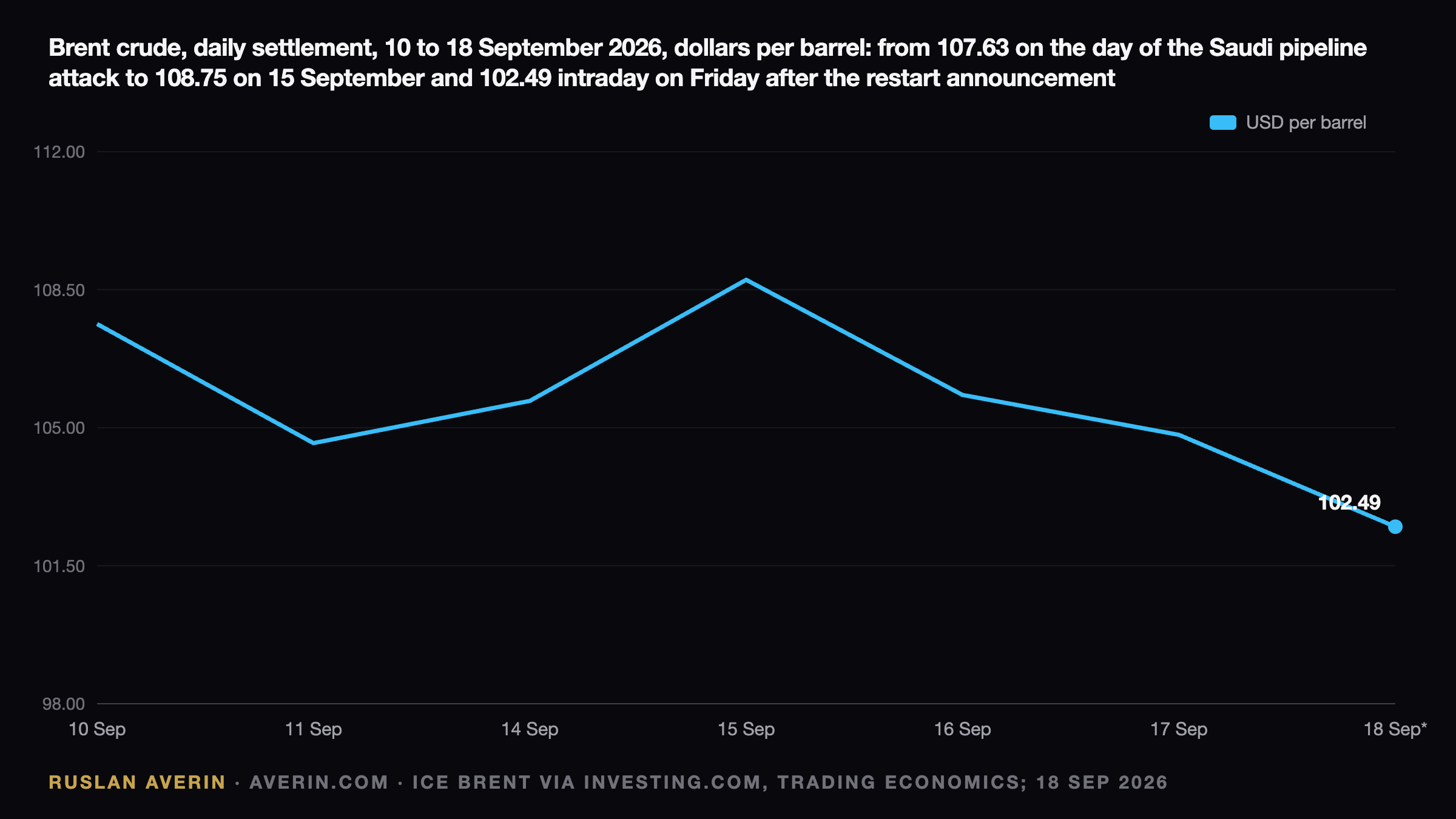
Brent settled at $107.63 on 10 September, the day of the attack, touched $109.80 on 14 September, settled at $108.75 on 15 September, then fell to $105.83, $104.82 and $102.49 as Riyadh promised half of East-West capacity back within days and the rest within six weeks. WTI is back under $100. TTF gas sits at €78/MWh, nearly triple its level at the start of the year, with EU storage at 68% against an 80% target.
The IEA's September report shows 2026 supply down 5.7 million barrels a day, demand down 2.5 million, observed stocks down 507 million barrels since February and Saudi output at 5