The Reversal That Came After the Statement
A quarter-point hike that was 92% priced did no damage on its own. The damage arrived with the microphone. Equities were higher into the 14:00 ET statement and rolled over during the press conference: the Dow closed at 51,462, down 630.56 points or 1.21%; the S&P 500 at 7,552, down 0.44%, its seventh loss in eight sessions; the Nasdaq finished flat at 25,978.
Sector detail told the story of a hawkish hike into a supply shock. Energy lost more than 2.8% as Brent settled at $105.83, down 2.69%, on Saudi word that half of the East-West pipeline's capacity returns within days. Financials fell more than 1.5%, with Goldman Sachs down 4% to $936.89. VIX closed at 17.71 after touching 19.
Rates, Dollar and Metals
The 2-year yield rose to 4.72–4.74%, the highest since July 2024. The 10-year closed at 5.00–5.02%, the first close at 5% since 2007, with the initial reaction muted and the move concentrated in the press-conference window. The curve flattened to under 30 basis points. The dollar index gained 0.61% to 100.28, its largest one-day rise since June.
Gold slid from a pre-Fed high of $4,368–4,387 to $4,306 within thirty minutes of the statement, settling near $4,264, down 0.67% and a six-week low. EUR/USD broke 1.15 on Thursday morning to 1.1474. Bitcoin sat at $76,000 throughout. By Thursday midday the S&P 500 was up 1.12% at 7,636, the Nasdaq up 1.64% with Nvidia up 2.5% and AMD up 5.8%.
A 12–0 Vote and a Deleted Sentence
The Committee lifted the target range to 3.75–4.00%, the first increase since 26 July 2023, without a single dissent. Seven weeks earlier three regional presidents had dissented in favour of exactly this move; on Wednesday nobody dissented against it, including Christopher Waller, who had argued for patience on 3 September.
The statement is short and removes the language that had protected the doves. July's reference to "supply shocks that have driven price increases in certain sectors, including energy" is gone. What remains: "Inflation remains elevated. Today's policy action will support a timelier return to the Committee's 2 percent goal."
Where the Meeting Was Actually Decided
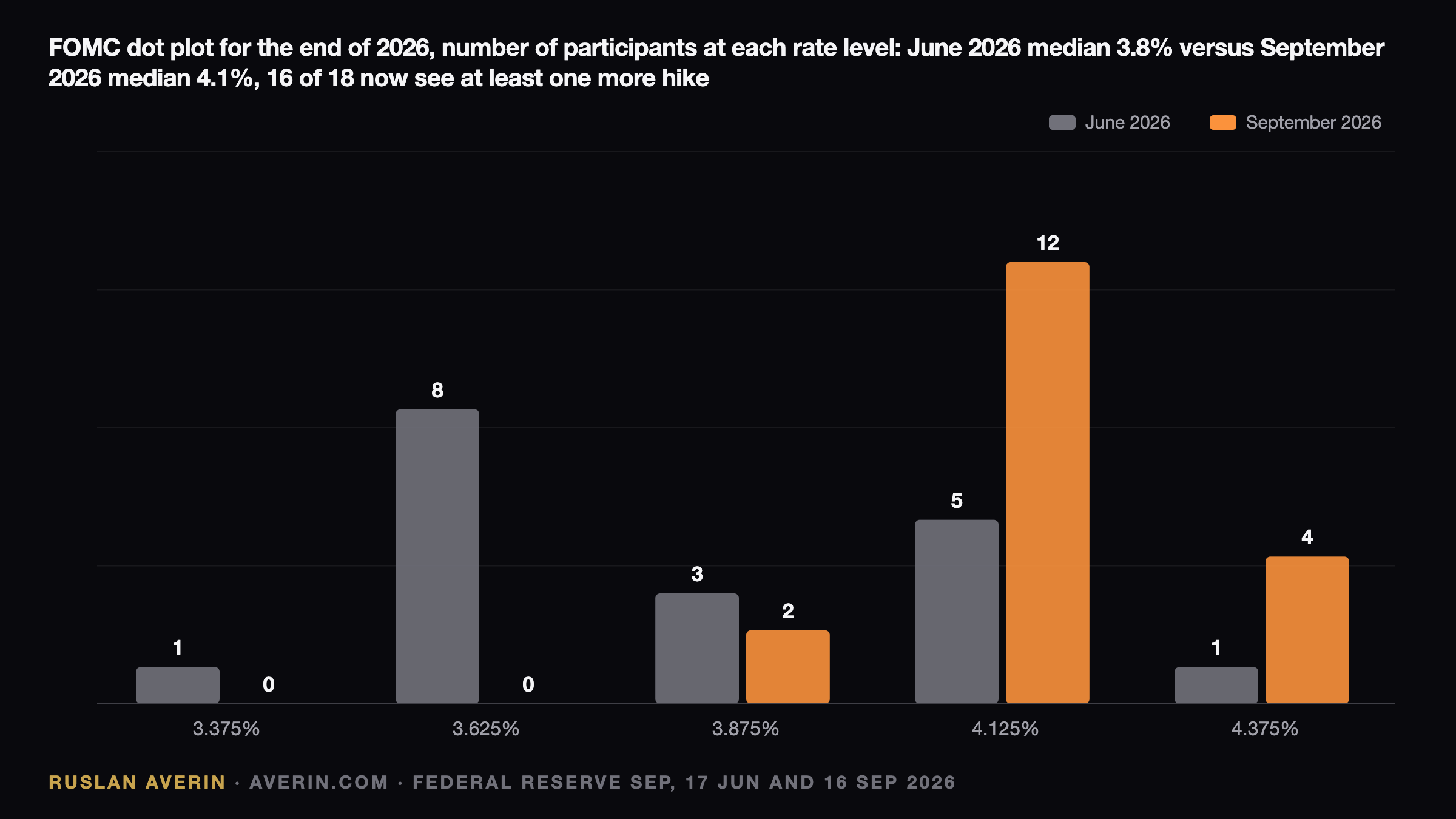
June's median dot of 3.8% for end-2026 meant hold, with eight of eighteen participants at 3.625% and only six above the then-current range. September's median is 4.1% for end-2026 and 4.1% for end-2027, against 3.6% in June. Twelve participants now sit at 4.125%, four at 4.375% and two at 3.875%; none projects a cut this year.
| Median projection | June 2026 SEP | September 2026 SEP |
|---|---|---|
| Policy rate, end-2026 | 3.8% | 4.1% |
| Policy rate, end-2027 | 3.6% | 4.1% |
| Policy rate, end-2028 | 3.4% | 3.9% |
| Policy rate, longer run | 3.1% | 3.2% |
| PCE inflation 2026 / 2027 | 3.6% / 2.3% | 3.7% / 2.3% |
| Core PCE 2026 / 2027 | 3.3% / 2.5% | 3.4% / 2.5% |
| Unemployment 2026 | 4.3% | 4.1% |
| Real GDP 2026 | 2.2% | 2.3% |
For 2027 the split is eight for higher, six for unchanged and four for lower. Growth was revised up, unemployment down, inflation up, and PCE inflation is not seen returning to 2.0% until 2029. Kevin Warsh did not submit a dot for the second meeting running, leaving eighteen entries rather than nineteen.
Thirty Minutes, No Guidance
The press conference ran about thirty minutes, the shortest since regular pressers began in 2011, and carried no forward guidance by design. "I'm not in the forward guidance business," Warsh told the New York Times. On whether policy is restrictive: "We removed a dose of accommodation, so that financial and credit conditions would be more consistent with our ultimate objectives." On the neutral rate: "In a word, no."
His August arithmetic: total PCE "around 3.6 percent", core PCE "about 3.2 percent", core CPI 2.4%, with "too many categories still posting increases above 3 percent, on both a 6- and 12-month basis". On oil, he drew a line between relative prices and broadening. The line markets read as dovish: "I don't believe that we need to do harm to the labor markets to achieve our objective."
Asked why the 10-year had reached 5%, he cited economic strength, "competition for capital" from hyperscalers funding data centres, and geopolitics, calling the 10-year Treasury "the most important asset anywhere in the world".
Housing Absorbs the Shock First
Freddie Mac's Thursday survey put the 30-year fixed at 6.95%, up from 6.76% a week earlier and 6.26% a year ago; the 15-year stands at 6.26%. Mortgage News Daily's daily index hit 7.24% on Wednesday, the highest since 13 January 2025, and attributed the move to the 2:30pm press conference rather than the hike itself.
Builders were already wobbling. The NAHB index for September fell to 32 from 35, the lowest since September 2025, with 38% of builders cutting prices and 66% offering incentives. Lennar then missed: EPS of $1.19 against $2.29 a year ago, gross margin 15.8%, orders down 9% and full-year deliveries cut to 80,000–81,000.
A Synchronised Global Week
The Bank of England held at 3.75% on Thursday by 6–3, with Greene, Mann and Pill voting for 4.00%, UK CPI at 3.1% and the Bank "ready to act as necessary"; Capital Economics expects a November hike. The Bank of Japan decides Friday, with all 52 economists in Bloomberg's survey looking for 1.25%. The ECB has hiked twice this year, and the National Bank of Ukraine decided Thursday at 14:00 Kyiv time.
October Coin Flip, December Consensus
CME FedWatch showed 50.2% hold against 49.8% hike for October, roughly 88% for at least one more increase by December and 38.6% for two, an implied year-end rate of 4.18% against the dots' 4.1%. Goldman dropped "one and done" for an October hike then a pause; JPMorgan's Michael Feroli and Morgan Stanley prefer December; Citi sees no more hikes and cuts from June 2027.
Bank of America had called September, October and December to 4.25–4.50% and has not updated. Lloyds' Sam Hill framed the gap: "It was a firmly hawkish FOMC meeting... The Fed's signalled outlook on rates still isn't as hawkish as the market-implied path." Goldman strategists note the S&P 500 has historically fallen about 2% after a hike and gained about 9% over the following year.
The Rule Worth Keeping
The Kobeissi Letter's seven-cycle count since 1988 aligns: an average 4% drawdown over six weeks, recovered by week twelve, +9% at twelve months, positive in every episode except 2022. Politically, the president posted that rates "should be 1%, or less"; Warsh's "Independence is a two-way street" and the 12–0 vote form the reply.