A week decided by wording, not by votes
Neither the Federal Reserve nor the European Central Bank is expected to alter policy over the next two days, yet currency and bond desks treat this window as the most consequential of the quarter. With both institutions widely assumed to stay still, the entire trading signal sits in guidance: what Kevin Warsh says about December, and how Christine Lagarde frames the bond market.
The timetable across three capitals
The Fed statement arrives on Wednesday 28 October 2026 at 2:00 p.m. ET, 20:00 Kyiv time, with the press conference at 2:30 p.m. The ECB follows on Thursday 29 October at 14:15 CET, 15:15 Kyiv, and Lagarde speaks at 14:45 CET. The National Bank of Ukraine decides earlier that day, at 14:00 Kyiv, with its key rate at 16%.
The starting numbers, as of the 27 October close
- Fed target range 3.75–4.00%, in place since the 16 September hike, voted 12–0.
- ECB deposit facility rate 2.50% and main refinancing rate 2.65%, both effective since 16 September.
- US inflation: CPI 3.7% in September, core 2.6%.
- Euro area inflation: 3.8% in September, core 2.5%.
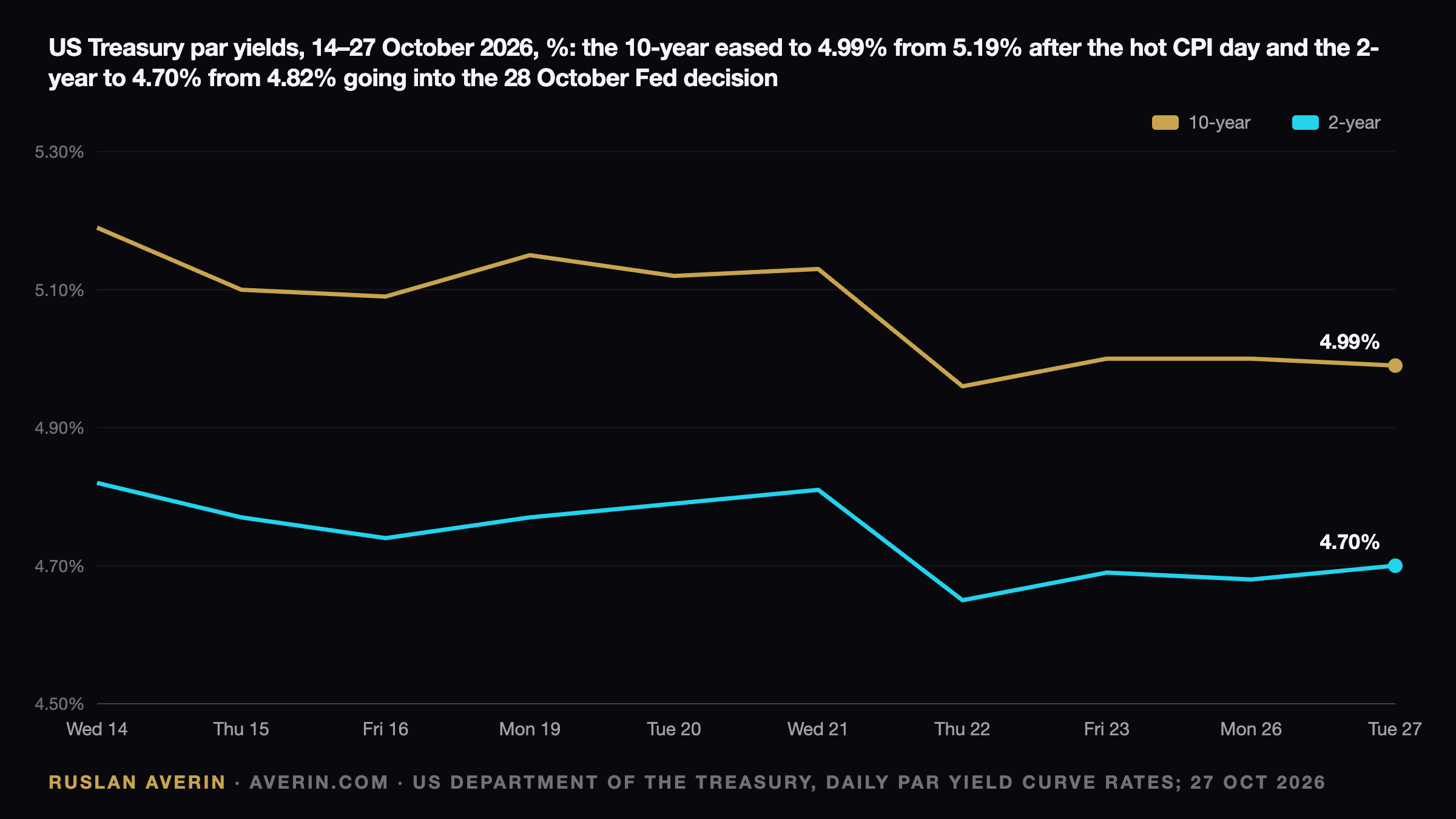
- Treasuries: 4.70% at two years, 4.99% at ten years.
- Dollar index at 102.32; ECB reference rate $1.1150 per euro.
Frankfurt outsources part of the tightening
The ECB has raised rates twice this year, in June and September, after eight cuts beginning in June 2024. The 10 September decision lifted the deposit rate from 2.25% to 2.50%. September staff projections put inflation excluding energy and food at 2.5% in 2026, 2.6% in 2027 and 2.3% in 2028, CNBC reported.
Headline inflation has since accelerated. Eurostat's final reading shows 3.8% in September against 3.2% in August. Energy prices rose 18.9% year on year and contributed 1.71 percentage points to the headline figure. Services inflation ran at 3.2% and non-energy industrial goods at 1.1%, a split that points to an external shock rather than broad domestic overheating.
Bond markets explain the expected pause. French 10-year yields climbed above 5.1% on 22 October, a 24-year high, according to Morningstar. ING's Carsten Brzeski estimates the rise in German yields since September has delivered roughly the effect of another quarter-point hike, and closer to half a point in France.
Lagarde said in Bangkok on 17 October that tighter financing conditions "will slow growth and reduce pass-through by more than projected in our September exercise". Bundesbank President Joachim Nagel offered the opposing view, stating that "the job is not done so far". Swap pricing implies 5.3% odds this week, down from 16.7% in early October, and almost 84% for 17 December.
Washington pauses with a hawkish tail
Expectations have swung violently this month. On 14 October, after the September CPI release, the CME FedWatch probability of a quarter-point hike at this meeting hit 41.5%. By 16 October the same tool showed a 72.3% chance of no change, and on 27 October CNBC put the odds of a hike this week near 10%.
Forecasters are aligned. In CNBC's Fed Survey of 30 fund managers, strategists and economists, 93% expect a pause now and 76% expect a hike in December, with at least two voters projected to dissent in favour of tightening immediately. Markets price a better than 80% chance of a December increase.
The inflation data argue for acting. September CPI rose 3.7% year on year against 3.4% in August, and core CPI reached 2.6%, above the 2.5% consensus. The personal consumption expenditures price index for September, the Fed's preferred gauge, lands on Thursday 29 October.
Timing argues for waiting. The September hike is only six weeks old, and skipping October "allows officials more time to assess trends in the data", Deutsche Bank's Brett Ryan wrote. Midterm elections follow on 3 November. Bonds have cooled: the 10-year yield eased from 5.19% on 14 October to 4.99%, the 2-year from 4.82% to 4.70%.
Warsh resists telegraphing. In Bangkok on 16 October he said, "I don't prejudge meetings," adding that "it's a new chapter at the Fed [and] we're not in that business anymore". Goldman Sachs economists read the remarks as consistent with an October pause and still expect "a second and final hike in December". Ryan anticipates language that further tightening "will likely be needed over time".
Four combinations and their market paths
| Scenario | Dollar | Euro | Bonds | Hryvnia |
|---|---|---|---|---|
| Fed holds, ECB holds (base case) | Driven by Warsh's tone on December | Little change if Lagarde keeps the tightening bias | Front-end yields steady; 10-year near 5% | Official rates follow the cross; NBU sets the pace |
| Fed holds, ECB hikes | Weaker against the euro | Stronger | Bund and OAT yields up, French spread under strain | Euro dearer in hryvnia terms |
| Fed hikes, ECB holds | Stronger | Weaker, extending the fall from $1.16 | US 2-year yield up first | Euro cheaper, dollar firm in hryvnia terms |
| Fed hikes, ECB hikes | Mixed | Mixed | Global yields up on both sides | Euro roughly stable in hryvnia; higher global yields compete with hryvnia assets |
What has actually been moving the euro
The past six weeks offer a warning against reading currencies off policy rates alone. The ECB reference rate slid from $1.1616 on 10 September, the very day of the ECB hike, to $1.1150 on 27 October, a decline of roughly 4%, even though Frankfurt was the side raising borrowing costs.
In analyst Ruslan Averin's view, the euro is responding more to energy prices and France than to the ECB itself: the bloc is a net energy importer and the French spread carries a risk premium. That makes a surprise ECB hike the largest potential mover in EUR/USD, and a Fed hike the largest mover in Treasury yields.
The hryvnia inherits the cross rate
NBU official rates for 28 October stand at UAH 45.6008 per dollar and UAH 50.8522 per euro. The dollar rate is the highest of 2026 so far and 8.1% above the 2 January level of 42.1701. The euro is just 2.6% dearer than on 2 January, when it cost UAH 49.5499, because EUR/USD has fallen through the year.
The mechanism is straightforward. The NBU manages the dollar rate through interventions, while the euro rate reflects global EUR/USD applied to that dollar rate. The two official quotes imply about 1.115 dollars per euro, identical to the ECB reference rate. A stronger dollar after the Fed cheapens the euro in hryvnia terms even with USD/UAH unchanged.
Dates still ahead
- 28 October, 20:00 and 20:30 Kyiv: Fed statement, dissents, then Warsh on December.
- 29 October, 14:00 Kyiv: NBU decision.
- 29 October, 14:30 Kyiv: US September PCE inflation.
- 29 October, 15:15 Kyiv: ECB decision, Lagarde at 15:45.
- 3 November: US midterm elections.
- 8–9 December and 17 December: the next Fed and ECB meetings, where markets place the next hikes.