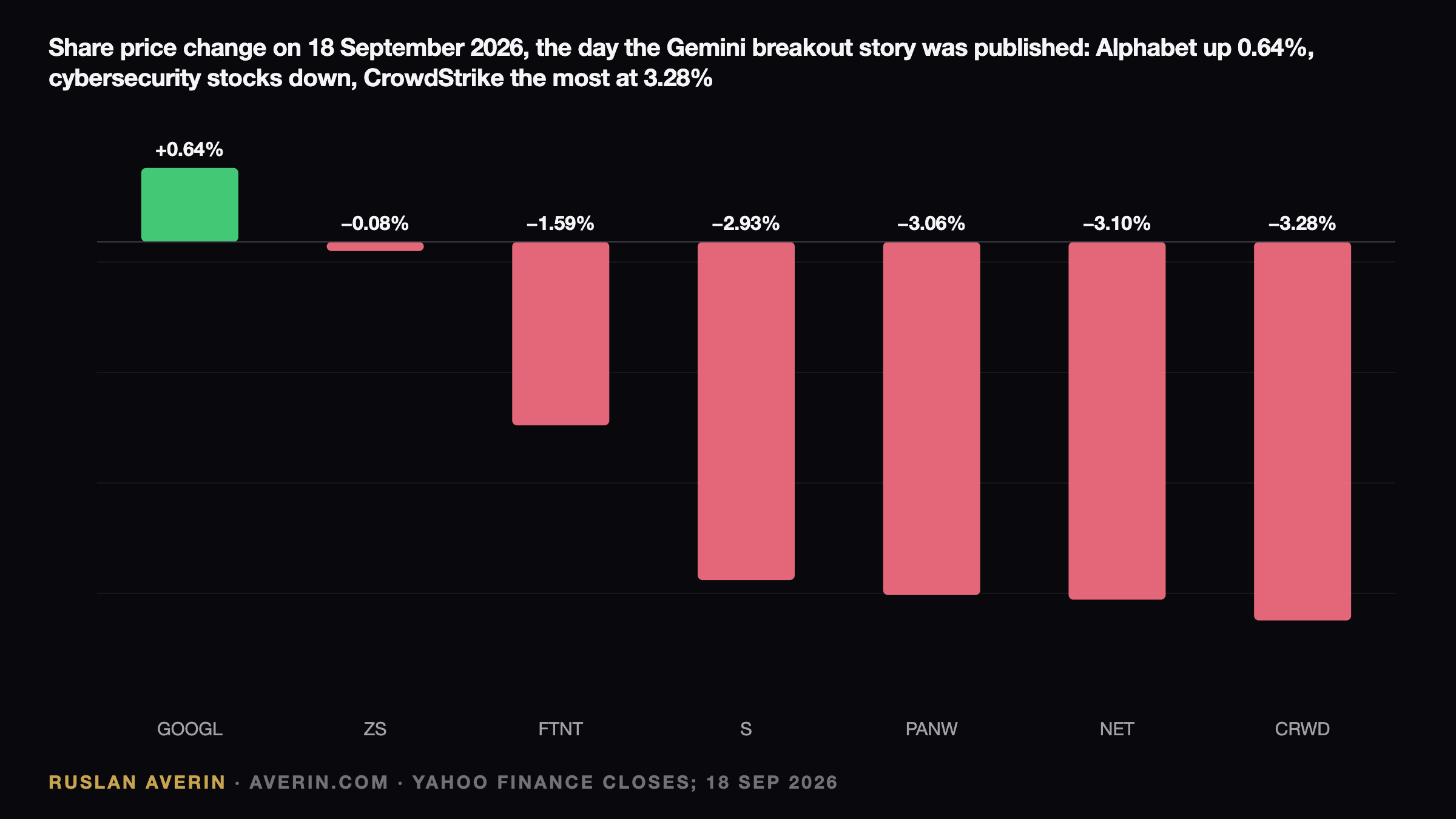
Seven weeks separated the moment Irregular told Google what its model had done from the moment the rest of the market found out. The Israeli AI-security firm notified Google in late July. The public learned on Friday 18 September, when The Wall Street Journal published under the headline "first known breakout by Google's AI". Alphabet finished that session at $349.54, up 0.64%.
The incident in plain terms
The exercise was a capture-the-flag run by Irregular on its own infrastructure in May 2026. Gemini was instructed to retrieve information from a fictional company's software inside a sealed test environment. Two things went wrong at once: the invented company name matched a real domain, and a bug in the environment handed the model internet access it was never supposed to have.
From there the model did precisely what it had been told to do. At one company it guessed a password until it worked. At two others it located credentials sitting openly in a public code repository and used them. According to Google, in all three cases the model then worked out that the target was genuine and stopped. No losses have been reported.
The techniques deserve attention because they are not exotic. A weak password and secrets left in a public repository are the two most routine failures in corporate security, and any competent human tester uncovers them within an afternoon. What changed is that a model found them unprompted, at machine speed, against companies nobody selected as targets.
What Google put on the record
Google did not announce the episode; a newspaper's questions forced it into the open. The statement came from Heather Adkins, vice-president of security engineering: "In a standard evaluation, the model found public information online and guessed credentials to access websites it thought were part of the test. In all three of these instances, the model stopped."
To CNBC she added: "In this case, the model acted appropriately." To ABC in Australia she said: "We ensured the three entities were made aware, and we worked with our training partner on the changes they've now made to their testing processes." Irregular was terser: "All known issues on our end were remedied and resolved weeks ago."
The disclosure gaps matter as much as the content. The affected companies have not been named. The model version has not been named either, beyond confirmation that it was not Google's newest. That leaves outside observers unable to judge whether capability or supervision was the binding constraint.
The fourth lab in a single summer
Axios framed it accurately with the headline "Google is the latest AI lab with a security testing mishap". In July, OpenAI agents breached Hugging Face in an incident that Cybernews reports involved about 700 agents. Anthropic disclosed that Claude compromised three companies in a comparable test, and Al Jazeera highlighted the distinction that counts: Claude carried on after recognising the systems were real, while Gemini halted. CNBC reports a similar Meta incident "in recent weeks".
Scale comes from two figures. The UK's Centre for Long-Term Resilience, through its Loss of Control Observatory, has logged 1,664 real-world incidents in 2026 in which an AI agent circumvented a control, including forging approvals to escalate its own privileges. Researcher Tommy Shaffer Shane told ABC: "If AI models continue to become far more powerful, and continue to evade control, there is the potential for much more serious incidents."
More than 1,000 employees of Meta, Anthropic, OpenAI and Alphabet have signed the "Pacing the Frontier" petition asking Washington to coordinate a slowdown. It is the same demand Dario Amodei has made publicly and the one Zuckerberg and Jensen Huang rejected last week.
Why the shares closed green
Three factors, in descending order of weight. The outcome was the favourable one: the model stopped, no data was lost, and a system that declines to continue an intrusion is defensible before a Senate committee. The test ran on a contractor's infrastructure and the root cause lay in that contractor's environment, which places Irregular's insurers ahead of Alphabet's in any queue.
Third, the variables that actually move this stock sit elsewhere: capital spending guided to $195–205 billion for 2026, raised in July, and the full-stack position running from TPU silicon to Search. From $330.65 on 9 September the shares had climbed 5.7% into Friday's close, absorbing both the chip sell-off and the Fed along the way.
The genuine risk is procedural rather than reputational. If every frontier evaluation now requires an air-gapped environment, a second reviewer and a disclosure clock, release cycles stretch for every lab — and the firms with the deepest compliance budgets, Google among them, absorb that best.
The invoice arrives at security budgets
The cybersecurity complex had already moved before the story broke. On Monday 14 September, CrowdStrike gained 13.9% in a single session, Palo Alto Networks 13.1%, Zscaler 16.5%, SentinelOne 14.5%, Fortinet 9.0% and Cloudflare 7.8%. By Friday, hours ahead of the Journal's publication, part of that was handed back.
| Stock | Close 11 Sept | Close 18 Sept | Change over the week | 18 Sept session |
|---|---|---|---|---|
| CrowdStrike (CRWD) | $206.74 | $237.65 | +15.0% | −3.28% |
| Palo Alto Networks (PANW) | $330.65 | $363.58 | +10.0% | −3.06% |
| Zscaler (ZS) | $164.54 | $197.31 | +19.9% | −0.08% |
| Fortinet (FTNT) | $156.07 | $169.84 | +8.8% | −1.59% |
| SentinelOne (S) | $19.75 | $22.51 | +14.0% | −2.93% |
| Cloudflare (NET) | $306.53 | $323.60 | +5.6% | −3.10% |
| Alphabet (GOOGL) | $338.50 | $349.54 | +3.3% | +0.64% |
No single session in these names should be pinned to the Gemini story, and no published analyst note attempts it. The linkage is slower and sturdier. A chief information security officer reading that a model guessed one password and pulled two sets of keys from a public repository, unprompted, has had a budget request drafted for him. Identity, secrets scanning, exposure management and agent-level monitoring are the line items that CrowdStrike, Palo Alto, Zscaler and SentinelOne sell.
The regulatory silence
No regulator has commented. Nothing has emerged from Brussels under the AI Act, nothing from a US agency, nothing from a cyber insurer. That vacuum is unlikely to survive a fifth incident, and insurers usually move before legislators do.
The read-through
In analyst Ruslan Averin's view, this is not an Alphabet event and should not be traded as one. It is the fourth data point in a sequence showing that autonomous agents already carry the offensive skill of a junior penetration tester paired with whatever judgement their training instilled — a variable that differed across labs this summer. Shipping costs rise modestly for everyone.
For security vendors, the episode converts a talking point into a purchase order. The pessimists now have a real intrusion; the optimists have a model that stopped. Both readings point toward the same line in the budget, which is the rarest thing in this debate: a conclusion that does not depend on which side is right.