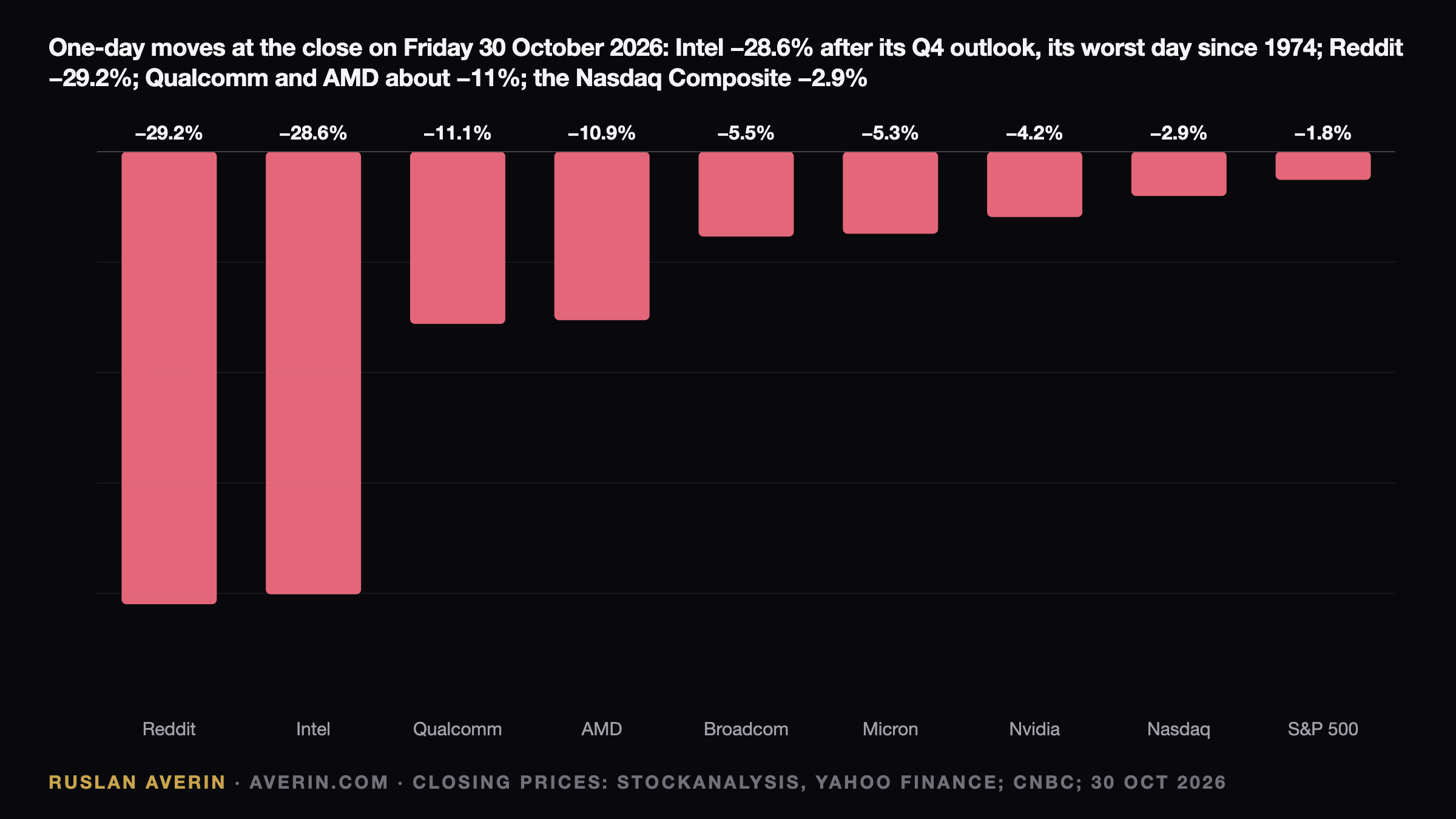
The final session of October 2026 produced two near-identical punishments. Intel closed down 28.58% at $65.76, its worst single day since 1974. Reddit closed down 29.22% at $91.73, its worst day since its 2024 listing. Both companies had just beaten third-quarter estimates. Both had guided the fourth quarter below consensus.
Guidance became the only line that mattered
That symmetry is the point. After months of AI-driven gains, a backward-looking beat no longer shields a company whose next three months look softer. Analyst Ruslan Averin reads the two collapses as a single market statement: positioning had moved ahead of delivery. The Nasdaq Composite fell 2.86% to 25,437.00 the same day, its worst session since June, CNBC reported.
Reddit: 53% growth was not the problem
Reddit's third-quarter revenue rose 53% to $895 million against an LSEG consensus of $878 million, with EPS of $1.40 versus $1.35, CNBC reported. The break came elsewhere. US daily active uniques fell 2% to 50.7 million, short of the 53.5 million expected, and fourth-quarter revenue was guided to $1.00–1.03 billion against $1.05 billion.
Chief executive Steve Huffman said search referral traffic fell meaningfully during the quarter and would keep falling in the fourth, and that Reddit will test a login requirement outside the United States. The stock slid from $129.60 to $91.73 and now sits 60% below its 2025 year-end close of $229.87, according to Yahoo Finance data.
Intel's quarter, line by line
Intel released third-quarter 2026 results on Thursday 29 October at 4:01 p.m. EDT, after the US close. The contrast between reported figures and forward guidance is visible in a single view.
| Metric | Reported or guided | LSEG consensus | Source |
|---|---|---|---|
| Q3 revenue | $16.51 billion | $16.5 billion | Intel, LSEG via CNBC |
| Q3 adjusted EPS | $0.52 | $0.40 | Intel, LSEG via CNBC |
| Q3 non-GAAP gross margin | 44.1% | — | Intel |
| Q4 revenue guide | $15.0–16.0 billion | $17.1 billion | Intel, LSEG via CNBC |
| Q4 adjusted EPS guide | $0.25 | $0.43 | Intel, LSEG via CNBC |
| Q4 non-GAAP gross margin guide | 38.0% | — | Intel |
Third-quarter revenue grew 21% from $13.7 billion a year earlier. Data Center and AI revenue jumped 78% to $7.3 billion and Intel Foundry revenue rose 58% to $6.7 billion. The PC unit, renamed the Client Computing and Physical AI Group, contracted 5% to $8.1 billion.
The size of the fourth-quarter gap
The $15.5 billion midpoint sits 9.4% below the LSEG consensus and 6.1% below the quarter just reported. The 25-cent EPS guide is 42% beneath the 43 cents expected. Gross margin is guided 6.1 percentage points lower than the third quarter, falling from 44.1% to 38.0%. That combination compresses revenue and profitability at the same time.
Three forces behind the downgrade
The first is personal computers. Chief financial officer David Zinsner said: "We see the PC slowdown continuing at least through the first half of next year." Global PC shipments fell 4% in the second quarter, according to Counterpoint Research data cited by CNBC.
The second is Israel. An explosion at an Intel fab there earlier in October killed two workers. Chief executive Lip-Bu Tan said the extended shutdown affects shipments of 10-nanometre chips and should cost roughly $600 million of revenue across two quarters.
The third is supply. Tan told the call that Intel could not meet strong customer demand during the quarter, and the release named unlocking additional Xeon server supply as the immediate priority. Splitting the $600 million fab hit evenly implies about $300 million in the fourth quarter — under a fifth of the $1.6 billion gap to consensus.
What is still working inside Intel
Data Center and AI produced $3.04 billion of operating income on $7.3 billion of revenue. Intel Foundry lost $1.85 billion, an improvement on the $2.32 billion loss a year earlier. The 18A node is in high-volume production at the new Arizona fab, with the next Arizona plant expected to begin operations by the end of 2028.
Intel released the 0.9 process design kit for its 14A node in October and is working with ASML on High-NA EUV readiness. The missing piece is a large external foundry customer. Tan set a deadline: "We're going to have a couple of customers ready to announce the next two quarters." A $23 billion equity offering completed in August funds the wait.
Price damage and the Washington position
Intel closed at $92.07 on Thursday, already 3.62% lower, then at $65.76 on Friday on volume of 455.6 million shares. Before the report the stock was up roughly 150% for the year from its 2025 close of $36.90; the gain is now about 78%, and the price sits 53% below the $140.94 high of Monday 22 June.
The US government holds 433 million shares at an average of $20.47, a stake that shed about $11 billion on Friday by CNBC's calculation. Bank of America, Roth Capital, Seaport Research and D.A. Davidson moved Intel to neutral, while New Street upgraded it to buy.
The chip tape in the last week of October
The Nasdaq Composite finished the week of 26–30 October down 2.0%, from 25,955.34 to 25,437.00, and lost 5.3% across October. On Friday the Philadelphia Semiconductor Index fell 7.2% to 10,688.80. Qualcomm dropped 11.1%, AMD 10.9%, Broadcom 5.5%, Micron 5.3% and Nvidia 4.2%. Alphabet had recorded its worst day on record on Thursday; Amazon slipped 1.4% on Friday.
Four markers before a rebuild
Ruslan Averin argues the investment case built around foundry customers and AI servers did not fail this week — only the near-term earnings path did. Four checkpoints follow: fourth-quarter revenue near $16.0 billion with gross margin of at least 38%; the Israel fab restarting by early 2027; a named large 14A customer inside Tan's two-quarter window; and any stabilisation in PCs before the second half of 2027.
The bear case is a second weak guide in January plus no foundry customer by mid-2027. Intel would then trade on the PC cycle alone — "dead money", in the phrase used by Seaport's Jay Goldberg.
Dates that carry weight
Tuesday 3 November brings the US midterm elections, with chip and tariff policy in the background. Nvidia reports in the second half of November, the next real test of AI chip demand. Intel's fourth-quarter report and first-quarter guide arrive in late January 2027, and Tan's two-quarter window for 14A announcements closes by mid-2027.