A quarter that the tape has already discounted
Morgan Stanley closed on Monday 12 October at $190.02. That leaves the stock 7.0% above the end-2025 close of $177.53, yet 16.9% below the 2026 closing high of $228.55 set on 15 July, the session that followed the record second-quarter report. The year-to-date advance of 7.0% compares with 14.0% for the S&P 500.
Results are due at about 7:30 a.m. New York time on Wednesday 14 October, ahead of the US open, with the call at 9:30 a.m. In July the debate concerned the size of the beat. Three months later the shares carry a markdown for a slower trading quarter, and the open question is whether published estimates were cut far enough.
Two consensus numbers, one headline
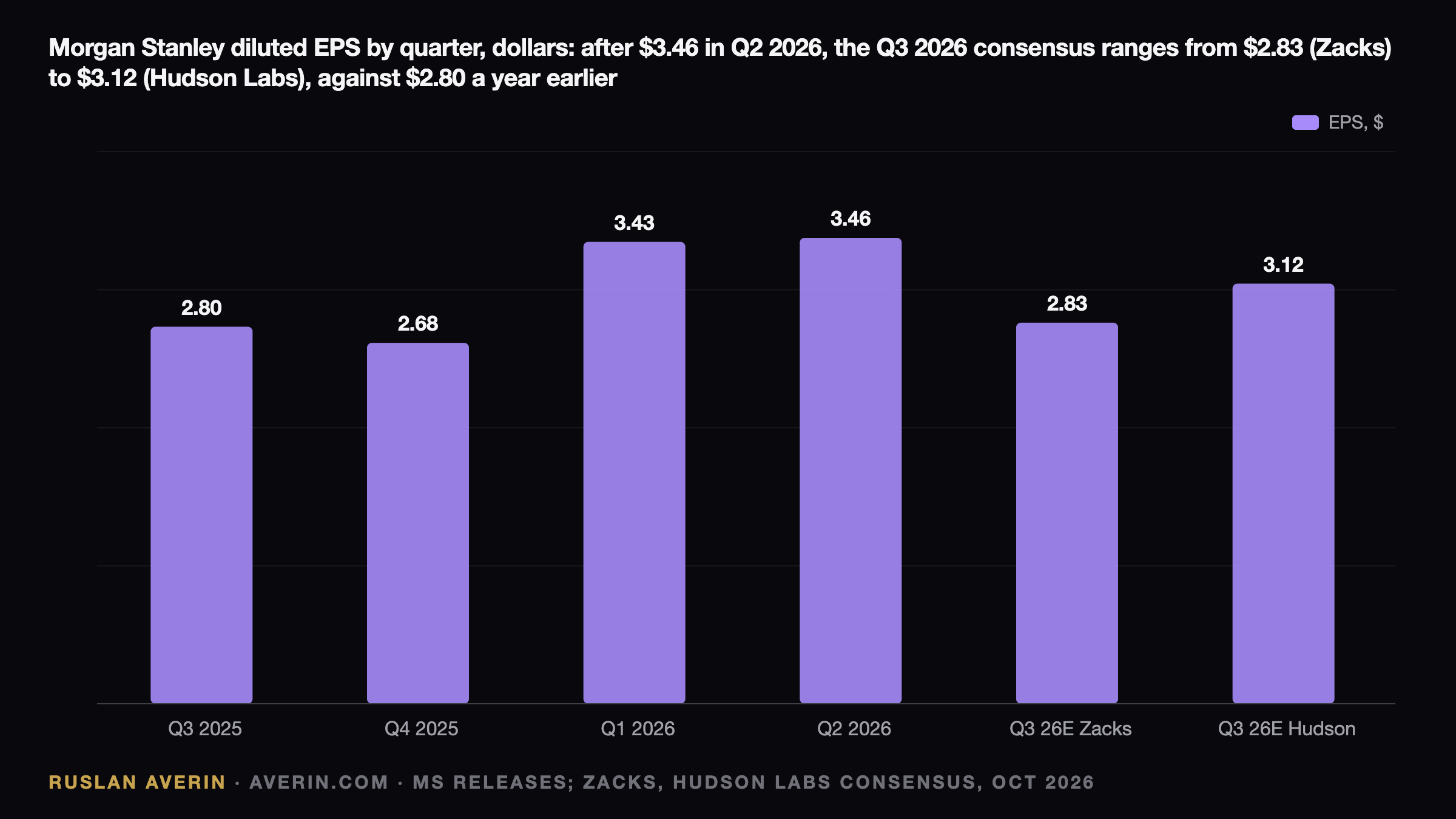
The estimate range is unusually wide. Zacks carries EPS of $2.83 on revenue of $19.63 billion, growth of 1.1% and 7.7% respectively against the year-ago quarter. Zacks counts five EPS estimates, and all five moved lower over the past four weeks. The consensus assembled by Hudson Labs at the end of September sits higher, at $3.12 on $20.66 billion.
That 29-cent spread matters because the words "beat" and "miss" will depend on which benchmark a reader applies. The year-ago base is $2.80 a share on net revenues of $18.2 billion, with return on tangible common equity of 23.5%. The sequential bar is far taller.
| Period | EPS | Revenue |
|---|---|---|
| Q3 2025 actual | $2.80 | $18.2 billion |
| Q1 2026 actual | $3.43 | $20.6 billion |
| Q2 2026 actual | $3.46 | $21.3 billion |
| Zacks Q3 2026 | $2.83 | $19.63 billion |
| Hudson Labs Q3 2026 | $3.12 | $20.66 billion |
Even the Hudson Labs number implies a drop of about 10% from the second quarter; the Zacks figure implies 18%.
Wealth Management is the stabiliser
The advice franchise remains the predictable half of the story. Second-quarter revenue reached a record $8.86 billion, the pre-tax margin was 30.5% and net new assets hit a record $148 billion. Just over half of those inflows came from IPOs of certain clients in the Workplace channel, so the headline was flattered by one-off listings. A year earlier net new assets were $81 billion with a margin of 30.3%.
Zacks models segment revenue of $9.01 billion, up 9.4% year on year, asset management revenue of $5.40 billion and net interest income of $2.30 billion, up 15.4% on higher sweep deposits and lending. Analyst Ruslan Averin reads net new assets close to last year's $81 billion as an ordinary quarter, while a figure well above $100 billion without a large listing would show the Workplace funnel converting employees into advisory clients.
Markets desks follow an exceptional comparison
Institutional Securities produced record revenue of $11.0 billion in the second quarter. Equities contributed $6.3 billion, up 69% year on year with notable strength in Asia, fixed income made $2.46 billion, up 13%, and investment banking $2.44 billion, up 58%.
Management flagged the risk of extrapolation. At an investor conference on 15 September, co-president Dan Simkowitz said the third quarter was not matching the second in markets, according to a MarketBeat summary. Zacks reflects that caution: equities of $4.51 billion, 9.6% above the year-ago $4.12 billion but roughly 28% under the second quarter, and total Institutional Securities revenue of $9.21 billion against $8.52 billion.
Fixed income delivered $2.17 billion a year ago. The Fed moved its target range to 3.75–4.00% on 16 September and the 10-year Treasury yield pushed above 5%, conditions that generate client flow and mark-to-market risk in equal measure. Losses on corporate loans, net of hedges, had already dragged the "Other" line in the segment to minus $152 million in the second quarter, so holding FICC above $2.17 billion is the practical test.
Fees: a record mandate book against a modest forecast
Zacks pencils in investment banking revenue of $2.16 billion, only 2.6% above the $2.11 billion booked a year ago and well under the $2.44 billion of the second quarter. Simkowitz called pipelines "very robust" and pointed to more than 100 private-equity sell-side mandates, a record for the firm.
The sell side has cooled since. On 2 October, Oppenheimer analysts Chris Kotowski and John Coffey trimmed third-quarter EPS forecasts for Goldman Sachs and Morgan Stanley and said both would fall short of consensus; across their coverage they cut investment banking revenue projections by 9.5% and lifted trading by 6%. JPMorgan offers a yardstick: on 15 September Doug Petno guided to a mid-to-high-teens percentage rise in its own banking fees and markets revenue. JPMorgan reports this morning, giving the first read on the quarter.
Returns, capital and the repurchase signal
The January strategic update restated firm-wide goals of 20% return on tangible common equity, a 30% Wealth Management margin, a 70% efficiency ratio and client assets above $10 trillion, the last of which was cleared in the second quarter. First-half ROTCE was 26.8% with an efficiency ratio of 65%. The Zacks consensus return on equity of 16.8%, versus 20.7% in the second quarter, maps to roughly 21–22% on tangible equity: lower, still above target.
Capital is plentiful. CET1 stood at 14.8% at the end of June. The firm repurchased $1.5 billion of stock in the second quarter at an average of $197.64 and $1.75 billion in the first. July brought a reauthorized multi-year buyback of up to $20 billion starting in the third quarter and a quarterly dividend of $1.15. With the shares below that average purchase price, the repurchase pace becomes a valuation statement. At $190.02 the stock trades near 3.6 times tangible book value of $53.18 a share.
The headline risk sitting outside the numbers
Since 15 September, the day before the Fed move, Morgan Stanley has fallen 7.9%, against 6.8% for the KBW Bank Index and 8.5% for Goldman Sachs, while the S&P 500 gained 2.9%. On 24 September, Semafor reported that UBS leadership had revived discussions about leaving Swiss oversight, possibly via a foreign merger; Morgan Stanley's name featured in an editor's analysis and the Swiss paper Blick later listed it among possible partners. Neither bank commented. The stock slipped 1.04% to $196.32 that day while several large peers rose. Any large acquisition competes with the buyback for capital.
Scenarios into the print
Four lines govern the reaction: equities revenue against $4.51 billion; investment banking against $2.16 billion, alongside what Ted Pick says about private-equity and IPO activity in the fourth quarter; a Wealth Management margin of at least 30% with net new assets measured against $81 billion; and the repurchase pace under the $20 billion program plus any acquisition commentary.
An outcome between $2.83 and $3.12 with the margin at 30% or better points to a contained move, given the 16.9% already surrendered since July. The constructive path is EPS above $3.12 with equities near $5 billion and faster buybacks, framing the quarter as a pause. The adverse path, in Ruslan Averin's view, is banking revenue below last year combined with a margin under 30%, which would validate caution on capital-markets names at a multiple that still has room to compress.