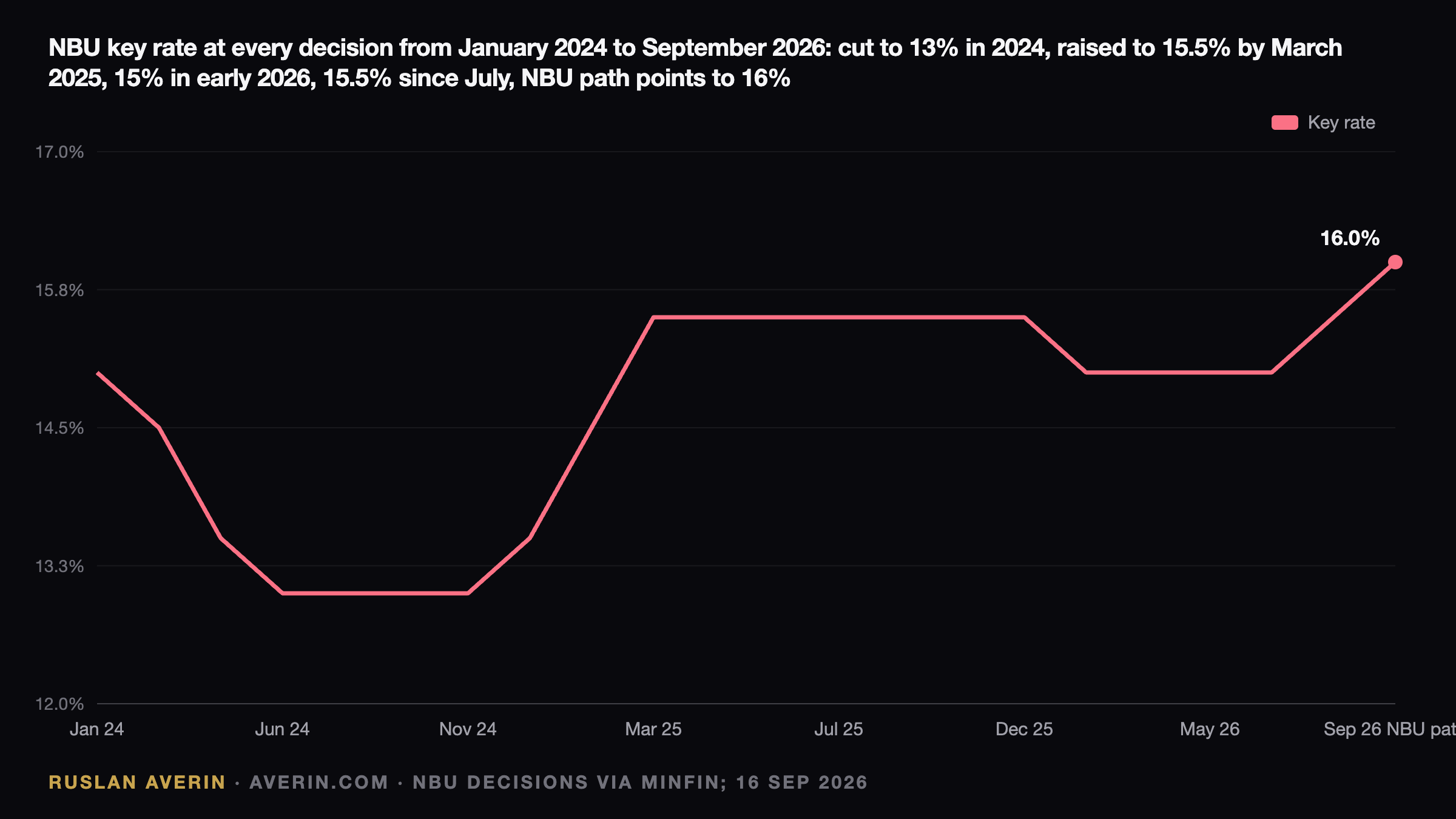
Thursday 17 September puts the National Bank of Ukraine one day behind the Federal Reserve and in front of a question it has already half-answered itself. The key rate is 15.5% after the 30 July increase of 0.5 percentage points, and the central bank's own July projection places it at 16% in the fourth quarter. The briefing is at 14:00 Kyiv time.
Two scenarios, five price lists
Whatever the Board decides, the transmission is narrow and slow. The table below sets out where the main hryvnia instruments stood on 15 and 16 September and what each scenario implies.
| Instrument | Level, 15–16 September | If 16% on Thursday | If hold at 15.5% |
|---|---|---|---|
| UAH deposits, 12-month UIRD | 13.99%; best offers 17.5% | plus 0.2 to 0.5 percentage points by October | flat; promotional 17% to 17.5% stays |
| OVDP, primary auction | 1 year 15.17%; 2.5 years 16.10% | 15.5% to 16.5% range; more retail demand | unchanged; Q4 supply rises anyway |
| NBU 3-month certificates | ceiling = key rate plus 3.5 percentage points = 19.0% | ceiling 19.5% | 19.0% |
| New business loans | 15.3% average | plus 0.2 to 0.3 percentage points | flat |
| Hryvnia | 44.63 per dollar; 44.4–44.8 seen to end-September | marginal support | no change; interventions do the work |
The August print that reopened the file
Consumer prices rose 8.1% in the year to August, after 7.7% in July and a low of 7.2% in June. The monthly figure was only 0.1%, but the detail is awkward: fuel up 38.7% year on year following the late-July oil spike, transport up 23.8%, services up 13.4% and administered prices up 13%. Core inflation is also 8.1% and added 0.5% over the month.
The NBU's comment on 12 September placed August "slightly above the forecast trajectory" of the July report, blaming fuel and water tariffs. The year-end forecast has been lifted to 10% from 9.4%, with 6.9% for 2027 and the 5% target reached only at the end of 2028. Businesses expect 11.6% over the next twelve months.
A published path, not a promise
Governor Andriy Pyshnyi said on 31 July that "the National Bank's forecast envisages that the key rate could be raised once more to 16% by the end of the year", while cautioning that "the forecast has never been and should not be taken as a commitment". The July Inflation Report path is 16% in the fourth quarter of 2026, 16% through the first quarter of 2027, then easing from the second quarter to 14% by end-2027 and 11.2% by end-2028. April's path had 15% until mid-2027.
The cycle so far has been short. A cut of 0.5 percentage points on 30 January 2026 took the rate to 15.0%, the first reduction since 2024; three holds followed on 20 March, 1 May and 19 June; then July's unexpected increase, carried nine votes to two, with the majority expecting further tightening in 2026. Two meetings remain after Thursday, in October and December.
The split among forecasters
Dragon Capital wrote after July that it now expects a further increase of 0.5 percentage points in September, to 16.0%, before starting an easing cycle in the second quarter of 2027. ICU's early-September note called a mid-September hike probable. Raiffeisen's Serhiy Pecherytsin argued in the spring that the rate could hold almost to year-end.
Bohdan Danylyshyn, formerly of the NBU Council, wrote on 9 September that August inflation "is mostly cost-driven, logistical, energy-related and administrative. This is not classic demand inflation." The committee summary took the opposite view, warning that "with an inert NBU stance inflation could not only return to double digits quickly but stay there". The pre-meeting bankers' survey had not appeared by the afternoon of 16 September. The backdrop: GDP grew 0.4% year on year in the second quarter after a contraction of 0.6% in the first, six regions lost power on 16 September after new strikes, and the 2027 budget assumes growth of 1.3%.
Savers already have the tightening
The twelve-month hryvnia index has crept from 13.77% at end-2025 to 14.07% in August and 13.99% on 15 September; the three-month index is 13.78%. Dmytro Zamotaiev of Globus Bank expects 14.5% to 16% on nine-to-twelve-month terms this autumn, with promotions to 17.5%, but says competition "will look less and less like a classic rate race". After the 23% tax, 17.5% for six months turns UAH 100,000 into UAH 106,737.50.
Government paper competes without that deduction. The finance ministry placed UAH 2.01 billion on 15 September at unchanged levels. Individuals held a record UAH 163 billion of OVDP on 1 September, up 48% since January. The 2027 budget plans UAH 544.4 billion of domestic borrowing at an average of roughly 14.8%, which ICU reads as mild upward pressure on fourth-quarter yields regardless of Thursday.
єОселя is outside the cycle
The state mortgage programme lends at 3% to military personnel, veterans, medics, teachers and scientists, and at 7% to displaced people and those without housing, for the first ten years, with the state covering 70% of the down payment and 70% of the first year's instalments for some categories. In 2026 to the week of 8 September it issued 5,763 loans for UAH 11.4 billion; the latest week brought 172 loans for UAH 365.3 million, 81 of them at 3%. Outside the programme there is almost no bank lending to reprice.
What actually holds 44.63
The official rate on 16 September is 44.63 per dollar and 51.51 per euro, a depreciation of 5.1% since 1 January. NBU net sales have topped $1 billion a week for nine consecutive weeks, peaking at $1.329 billion in early September before falling 10% to $1.195 billion in the week to 11 September, the first decline in the run. Reserves dropped 5% in August to $48.66 billion, four months of imports, against a July forecast of $69.7 billion at year-end on EU disbursements.
Serhiy Mamedov of Globus Bank sees 44.4 to 44.8 to end-September, with 45 as a possible upper bound in short-term cash-market demand spikes. The draft 2027 budget submitted on 15 September assumes 48.3 at the end of next year, 8% inflation and VAT raised from 20% to 21%. Andriy Shevchyshyn's July formulation still applies: the decision "should not materially affect the depreciation trend, but it is a factor restraining the weakening of the hryvnia".
The editor's read
A move to 16% looks the likelier outcome: the NBU wrote the number down in July, inflation has since printed above the path, and the committee's language leaves little room for patience. A hold would require the Board to accept the cost-push argument that its own July summary rejected. In the view of analyst Ruslan Averin, the practical difference is small — a saver weighing a 17.5% promotional deposit against a tax-free 16.10% two-and-a-half-year OVDP already receives the tightening the central bank wants delivered. The heavier risks sit in the $32.6 billion of unfunded external need in the 2027 budget and in a winter the finance minister has called the hardest since 2022.