A London hall, a slide deck and roughly $16 billion
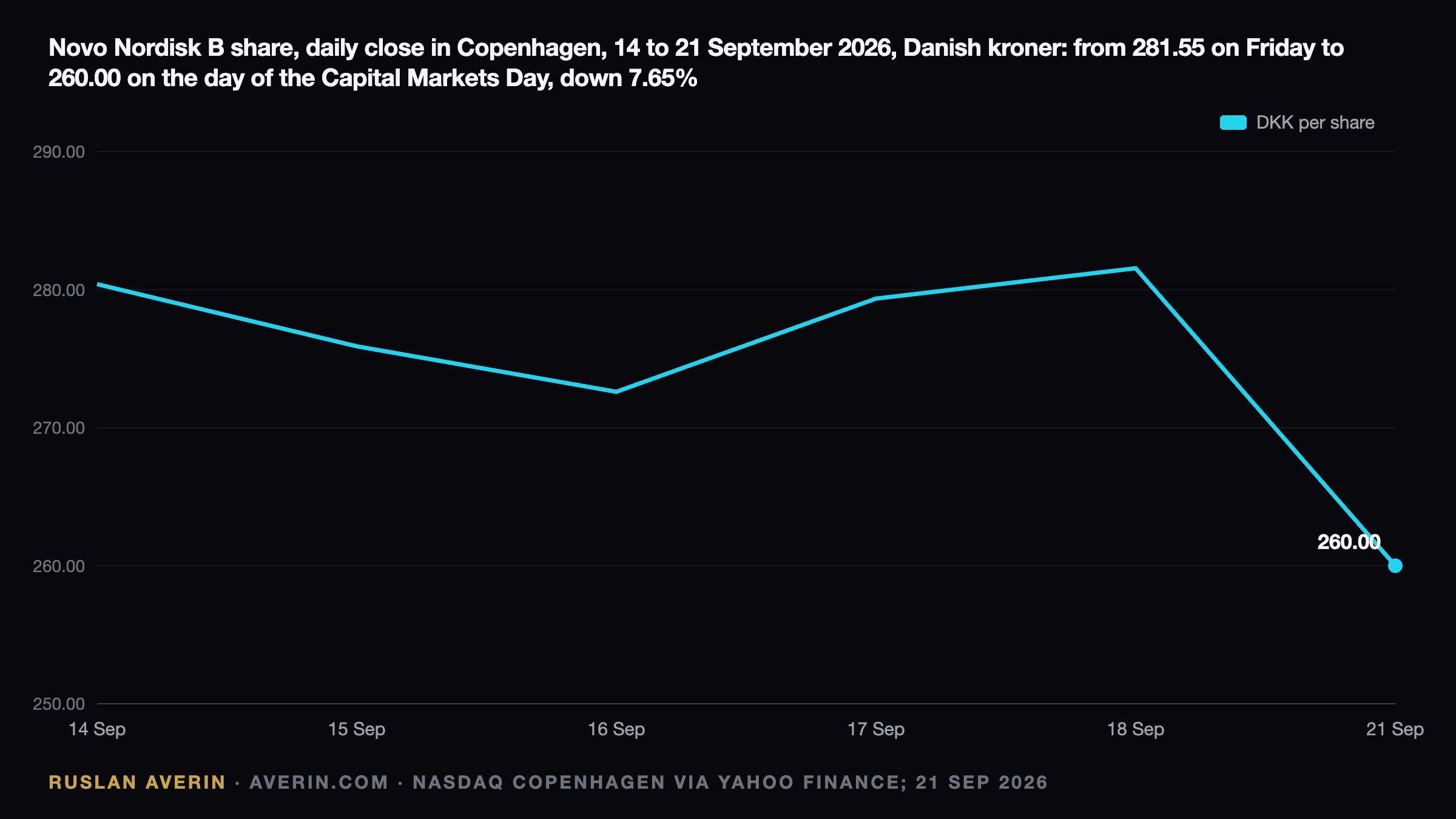
Novo Nordisk gathered investors in London on Monday to describe the company that exists after Wegovy's peak years. The market did not like the description. Shares opened higher at DKK 284.30, sank as much as 8.4% at the intraday low of DKK 257.90, and closed in Copenhagen at DKK 260.00, down 7.65% from Friday's DKK 281.55.
That single session removed roughly $16 billion from a business valued at about $207 billion at the weekend. Nothing external caused it. There was no regulatory letter, no trial readout, no rival press release timed to spoil the day. The presentation itself did the damage, which is unusual and which makes the content worth reading closely.
The date the chief executive refused to hide
Mike Doustdar, a year into the top job, named the central problem before anyone could ask about it. Semaglutide, the molecule inside Ozempic and Wegovy, loses United States exclusivity in 2032, and the United States is more than half of group sales. He called it "the elephant in the room."
His answer framed the entire agenda: "We plan to come on the other side of the LOE as a bigger company than we are today and a much more diversified version of it." That is a defensible strategy. It is also one that cannot be verified by shareholders for several years, which is precisely the tension the share price expressed.
Ambitions, carefully not called guidance
The company labelled its targets ambitions and wrapped them in legal language: "inherently uncertain", built on a 2026 baseline, and explicitly they "do not constitute financial guidance or an outlook". Within that framing, management committed to sales growth for 2026–2030 in line with a peer group of 14 large pharmaceutical companies, and to a "broadly stable" adjusted operating margin over the same window.
The rest of the list is denser. An "attractive dividend per share" is to be maintained. Risk-adjusted pipeline sales should exceed DKK 150 billion, about $23 billion, by 2035. More than five new medicines with blockbuster potential are promised by 2030, alongside at least five late-stage programmes in obesity and diabetes and at least five outside those areas.
Capacity carries its own ambition: a ten-fold scale-up in oral obesity manufacturing, enough for 15 million patients by the end of the decade, with more than 60 million patients reached by 2030. Separately, and deliberately outside the targets, Doustdar said the balance sheet "can support" deals larger than bolt-ons.
The missing number, and the one the market inserted
The growth line had no percentage attached, so analysts calculated one. The peer group includes Lilly, AstraZeneca, Gilead, Johnson & Johnson, AbbVie, Novartis, Sanofi, Roche, GSK, Amgen, Merck, Biogen, Pfizer and Bristol Myers Squibb. BMO's Evan Seigerman put the implied rate near 3.6% a year, called it "already priced in", and left the "burden of proof" with management.
Markus Manns at Union Investment said the 2030 sales outlook and the stable margin "failed to impress" and that the 2032 cliff had not been addressed properly. Reuters reported that executives were pressed repeatedly on pricing and on acquisitions during the session, two subjects the prepared material treated lightly.
What the comparison concedes
Three years ago Novo Nordisk was compounding sales above 30% a year and ranked as Europe's most valuable company. Guiding to grow like Pfizer or Bristol Myers Squibb concedes that the obesity market's growth now accrues elsewhere. The tape agreed: Eli Lilly traded higher in New York as Copenhagen closed.
Lilly holds the stronger injectable, has guided 2026 revenue to $82–85 billion, and already has an approved once-daily obesity pill, Foundayo, in launch. Novo Nordisk's counter sits on the capacity line, a ten-fold oral manufacturing increase serving 15 million patients. The response is logical, but it lands roughly four years from now.
Pipeline arithmetic and a recent setback
The DKK 150 billion figure carries similar timing problems. It describes 2035, it is risk-adjusted by the owner of the assets, it counts programmes already disclosed, and it excludes acquisitions. CagriSema, intended to succeed Wegovy, is due to launch early next year, with higher doses and standalone cagrilintide planned for 2028.
Against that, the freshest pipeline news is negative. Ziltivekimab, the anti-inflammatory heart drug, lowered inflammatory markers in the ZEUS trial without reducing heart attacks or deaths. On 7 September the company stopped two further trials, HERMES and ATHENA, after the monitoring committee saw a "low likelihood" of a different outcome.
The price after the fall
| Measure | Value |
|---|---|
| Novo Nordisk B, close 21 September | DKK 260.00 |
| Change on the day | −7.65% |
| Day's range | DKK 257.90 – 284.30 |
| Against the first week of January 2026 | about 32% lower, from DKK 381.45 |
| Against the June 2024 peak | roughly three-quarters lower, from just above DKK 1,000 |
| ADR 52-week range | $35.12 – $64.16 |
| Price to earnings | about 10.7 |
| Dividend yield | about 3.2%, $1.28 a share |
| Market value | about $191 billion |
Ten to eleven times earnings is the conventional price for a drug maker whose flagship goes generic inside the forecast horizon while its replacement is not yet selling. The multiple fits the description. The open question is whether the description is complete.
Two simple cases
The bear case: US injectable prices are already falling under political and compounding pressure, the oral race has a leader that is not Novo Nordisk, and from 2032 the semaglutide cash flow funding everything else begins to erode.
The bull case: more than 60 million patients, manufacturing scale unmatched outside Indianapolis, a 9,000-job restructuring already absorbed, and a balance sheet that can carry a large acquisition. A well-priced late-stage deal would put a number on that first ambition line, and it would exceed 3.6%.
The markers worth watching
In analyst Ruslan Averin's view, Monday was an honest day and the market punished the honesty; a double-digit target would have bought management two quarters of belief. What was delivered instead was a large, cheap, cash-generative pharmaceutical company with one ageing franchise and a pipeline that must be proved drug by drug.
Owning that at DKK 260.00 is a different proposition from owning the story at DKK 1,000, yet nothing on the ambition list reports before CagriSema launches next year. The Fed and two other central banks raised rates last week, which rarely helps long-duration healthcare, and a stock down 7.65% on its own investor day usually still has sellers.
The reference point Averin uses is the ADR's 52-week low of $35.12. If that level holds through the third-quarter report and CagriSema's label arrives on schedule, the entry case strengthens. If an acquisition lands first, the price reaction will be more informative than the announcement itself.