Two numbers signed on the same afternoon
On 15 September Finland's president approved the country's 34th consignment of defence materiel for Ukraine: roughly €290 million, the second-largest Helsinki has sent, contents undisclosed, drawn from army stocks and Finnish industry. Cumulative Finnish military aid since 2022 now stands at €3.6 billion. That same afternoon in Kyiv, the Cabinet handed parliament a 2027 draft budget requiring $52.6 billion from abroad.
By the finance minister's own count, sources exist for about $20 billion of that. The residual is $32.6 billion with no donor attached. Measured against the requirement, a Finnish package of €290 million buys somewhere between two and three days. Bilateral tranches now matter chiefly for their contents, air defence above all, rather than for their cumulative weight.
The draft in six lines
| Line | 2027 draft | Change vs 2026 |
|---|---|---|
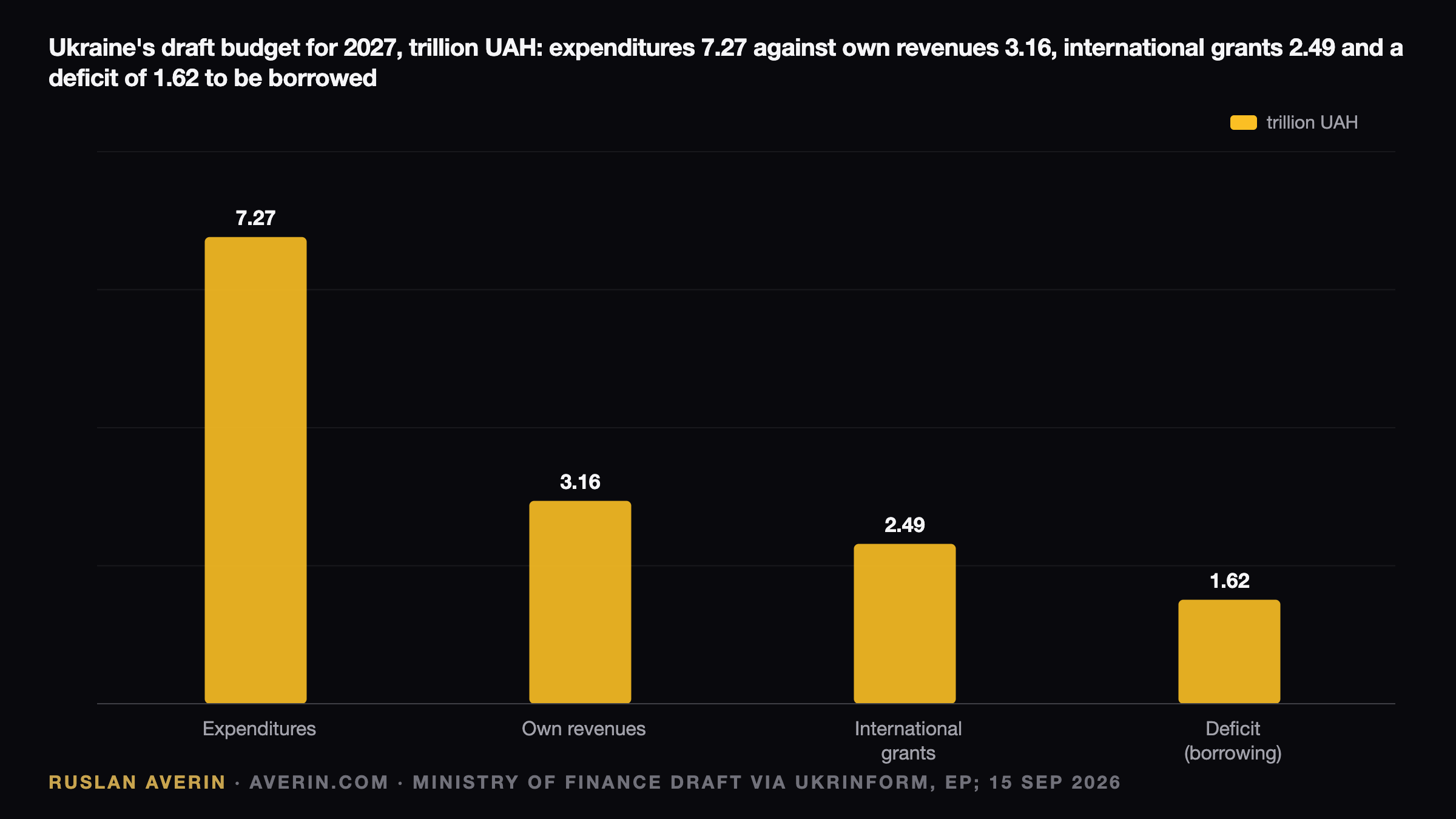
| Revenues | UAH 5.648 trillion, of which UAH 2.493 trillion from international partners | +8.7% |
| Expenditures | UAH 7.271 trillion | +13.5% |
| Deficit | UAH 1.623 trillion, about 15% of GDP | 2026: 12% of GDP |
| Defence and security | UAH 4.885 trillion, 43.8% of GDP | +UAH 517.9 billion |
| External financing need | $52.6 billion | 2026: $52 billion |
| Domestic borrowing | UAH 544.4 billion at about 14.8% | +UAH 124.9 billion |
Defence absorbs two of every three hryvnias the state spends, UAH 2.299 trillion of it on weapons and the balance on pay and support; the Ministry of Defence alone accounts for 66.8% of expenditures. Macro assumptions include 8% inflation, a hryvnia at 48.3 to the dollar by end-2027 against 44.63 today, a minimum wage of UAH 9,546 versus UAH 8,647 in 2026, and VAT lifted from 20% to 21%.
More than UAH 131 billion of projected revenue materialises only if Tax Code amendments pass. Growth assumptions diverge across published readings: 1.3% in one, 4.5% in a "basic scenario" premised on a significant improvement in security from 2027. The spread itself says something about how the document was assembled.
Marchenko on liquidity and the winter
Serhiy Marchenko was unusually blunt on 4 September: "We are already seeing certain liquidity problems and foresee a certain deficit in our budget", adding that "we have not had such a situation since 2022". Non-war outlays, shelters and infrastructure among them, may slip into next year. "We expect a very difficult winter. Escalation means that we need to find the resources to get through it."
How 2026 was actually paid for
The EU's Ukraine Support Loan carries most of the load. Its budget component was planned at €16.7 billion, with €8.3 billion paid by 11 September and €4.7 billion in processing; roughly €20 billion is expected by year-end. The €28.3 billion defence component was fully allocated by 11 September, including €6.1 billion on that day for Ukrainian drones and US Patriot interceptors.
Alongside it, the Ukraine Facility delivered €1.5 billion in March and about €2.8 billion in June, taking disbursements to €29.5 billion of €50 billion since 2024, with an eighth payment expected. The G7's $50 billion ERA loans are nearly exhausted: $37.9 billion arrived in 2025 and about $7.8 billion more is due by mid-April 2026. The IMF's $8.1 billion EFF paid $1.5 billion in February and about $0.69 billion in July, with a second review running since 31 August.
Smaller streams fill the corners. The World Bank had disbursed $6.29 billion cumulatively to 31 August and added an $841 million commitment on 4 September. Japan has provided $850 million of budget support through World Bank projects plus $6 billion in humanitarian and technical aid. Washington has passed no new appropriation; about $13 billion of older contracts is still delivering, while PURL has bought $6.7 billion of US weapons with allied money in twelve months.
Through August the general fund received UAH 569.6 billion in grants and UAH 312.7 billion in partner loans, roughly $19.8 billion at today's rate, against own revenues of UAH 2.29 trillion. The National Bank counted about $54 billion of direct budget support for the year as sufficient to cover the deficit; the ministry called the $52 billion need "secured" in May. The shortfall lies in fourth-quarter cash flow and in 2027.
Kiel's evidence of thinning flows
European allocations in May and June totalled about €11 billion, €4.3 billion of it military. The largest bilateral military donors in the first half were Germany at €700 million, Denmark at €600 million and the Netherlands at €500 million, with the United Kingdom providing about €1.5 billion in financial and humanitarian aid. Military support is running at "just over €2 billion a month" against more than €2.5 billion in earlier years, and monthly financial aid was 41% below 2025.
"Europe continues to depend on the access to US weapons systems to sustain its military support for Ukraine", said the institute's Federico Mellace. More than 90% of PURL deliveries are American-made, funded by Norway at $1.36 billion, the Netherlands at $1.16 billion, Germany at $900 million, Canada at $834 million and Sweden at $546 million. Finland's stock-based bilateral package belongs to the older model.
Belgium's price for the frozen balances
About €210 billion of Russian central bank assets are immobilised in the EU, €193 billion of them at Euroclear in Belgium. December's proposed €140 billion "reparations loan" failed; leaders instead borrowed €90 billion jointly and lent it interest-free for 2026–27, with Hungary, Czechia and Slovakia opting out. Ukraine has received €6.6