A Payment Queue Replaces a Budget Schedule
Ukraine did not run out of money on 17 September 2026. It ran out of money it had expected to hold by then. The Ministry of Finance amended the budget schedule and moved September, October and November capital spending into December, a technical step with a blunt practical meaning for anyone holding a state contract.
Budget committee chair Roksolana Pidlasa listed what moved: construction and reconstruction including hospitals, shelters in hospitals and schools, energy protection, and social housing. September's deferred amount alone is UAH 39 billion. Her own assessment of the December parking slot was candid: "it means they will not be financed at all this year, because it will simply be impossible to do".
The sequencing began earlier. On 1 September Prime Minister Serhiy Koretskyi announced a strict economy regime for non-defence funds, citing UAH 70 billion of savings already found for the army and promising no problems with pensions and salaries. On 10 September finance minister Serhiy Marchenko told the Rada finance committee "we have reached the limit", adding that capital construction and support programmes would be suspended until liquidity returned.
The View From the Site Fence
Maksym Shkil, owner of Autostrada, Ukraine's largest road builder and Kyiv's largest infrastructure contractor, wrote that the state "in one day, without warning, discussion or dialogue, stopped funding all capital expenditures", and that his company was forced to halt work everywhere. Minfin has not commented on the statement, and Kyiv's city administration has not reacted publicly.
Three Kyiv projects are directly affected: the metro extension to Vynohradar under a UAH 13.8 billion contract Autostrada signed in 2024 after the previous contractor was dismissed with UAH 4 billion already paid, which Mayor Klitschko had promised to open by the end of 2027; the UAH 1.2 billion overhaul of Kharkivske highway, 5.4 kilometres under way since October 2025; and the Chernihivska interchange rebuild, started in April. Kyiv signed a UAH 2 billion credit line with Ukrgasbank for winter preparation.
The Aid Calendar Arrived Late
The trigger was timing, not revenue collapse. January to July revenues were UAH 3,249 billion against UAH 3,437 billion of expenditures, a deficit of UAH 187 billion, 3.6 times smaller than a year earlier. But UAH 1,001 billion, or 30.8% of revenues, were international transfers, up 4.6 times year on year. Without them, domestic revenues covered 65.4% of spending and the gap was UAH 1,188 billion.
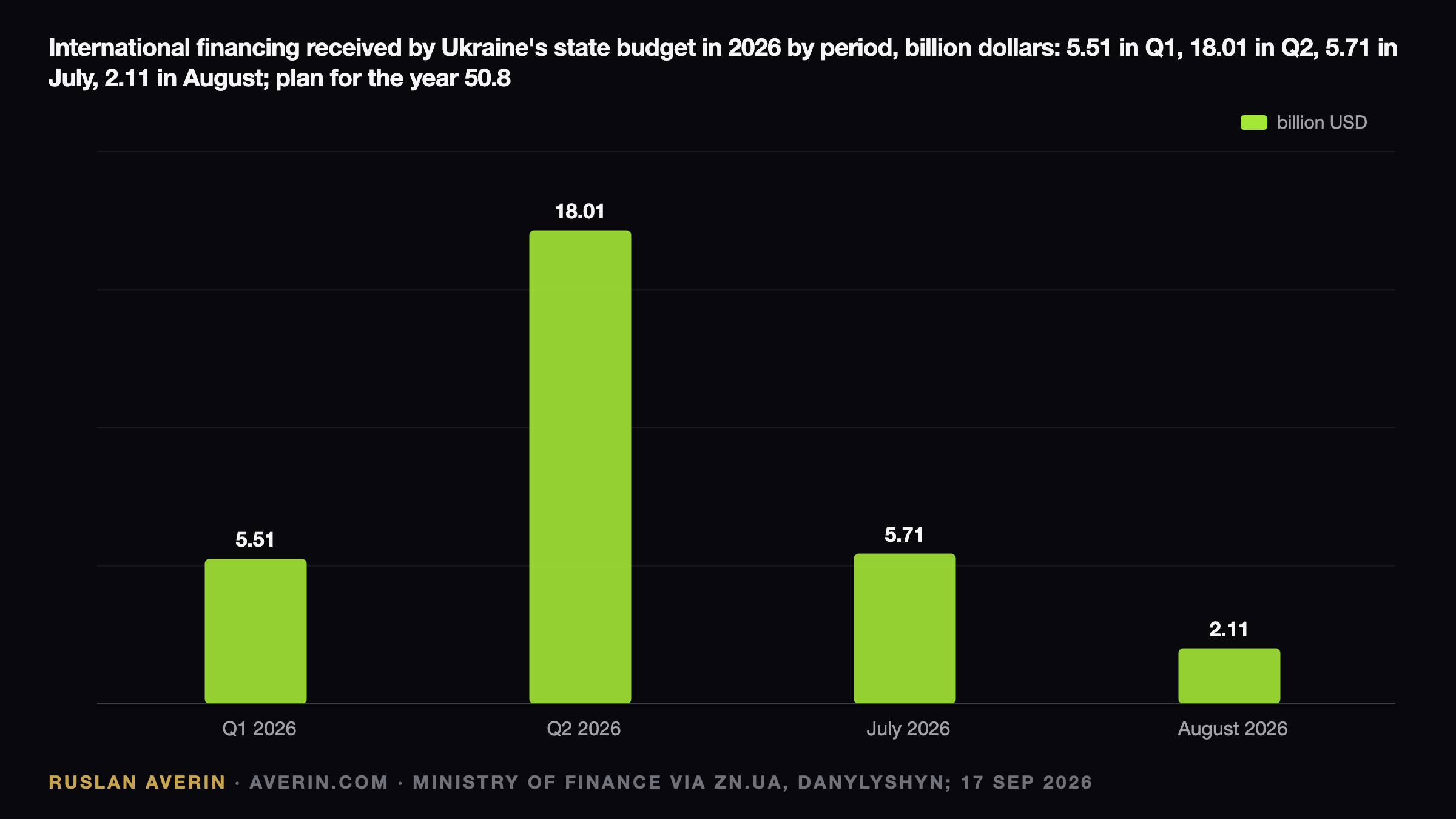
| External financing | Amount |
|---|---|
| First quarter | $5.51 billion |
| Second quarter | $18.01 billion |
| July | $5.71 billion |
| August | $2.11 billion |
| Year to date | $31.34 billion |
| Annual plan | $50.8 billion |
Pidlasa's blunter version, counting budget support only: "we planned $50.8 billion and received about $21 billion". In 2025, 41% of the year's aid arrived in the fourth quarter; the same back-loading met a 2026 budget spending UAH 491 billion a month.
Tax revenue to the general fund reached UAH 947 billion after eight months, UAH 33.1 billion below plan, with August the worst month: domestic excise down 12%, dividends from state companies down 17%, and VAT under-collected by $1.35 billion over eight months. Koretskyi estimated the attacks could cost about UAH 70 billion of tax. The Treasury single account fell 47% in August to roughly UAH 378 billion, about two months of cover by analyst Andriy Shevchyshyn's estimate.
Tranches Attached to Laws
The IMF staff visit led by Gavin Gray ran from 31 August to 15–16 September and ended without a staff-level agreement on the second review of the $8.1 billion programme approved in February, with no compromise on VAT for parcels under €150. At stake is about $692 million after the second review and about $970 million after the third, $1.66 billion this year, plus the EU's €3.7 billion instalment under the €90 billion Ukraine Support Loan.
The Rada gave the parcel bill a first reading on 16 September with 216 votes at the third attempt; the VAT itself starts no earlier than July 2027. Pidlasa's arithmetic is that the tranche now arrives at the end of October at best, two months late, "but spending was calculated on that money". Also pending: the president's signature on the digital-platforms tax law worth about UAH 14 billion, energy regulator independence, and completion of the Accounting Chamber.
Koretskyi told G7 and EU ambassadors that a significant part of $29.5 billion in financing to year-end was at risk and that the government must implement 42 decisions; the reform deadline moved to 15 October. The €3.3 billion announced by Ursula von der Leyen is defence procurement, not budget support. Arriving money is smaller: $841 million of World Bank support under a Canadian guarantee earmarked for pensions, and 1 billion Norwegian kroner, about €90 million, via the Ukraine Facility.
Why Bonds Cannot Fill the Hole
From January to August, bond sales of UAH 343.5 billion funded UAH 296.5 billion of redemptions, leaving UAH 46.9 billion net, so 86.3% of issuance refinanced old debt. The 15 September auction raised UAH 2.01 billion at 15.17% for one year and 16.10% for 2.5 years, paper of which individuals now hold UAH 163 billion. Bohdan Danylyshyn notes net borrowing is "tens of times smaller" than the gap without transfers.
Monetisation is not on the table. The NBU, raising its key rate to 16%, called restoration of regular and sufficient international assistance "critically important" for public finances and price stability. Reserves stood at $48.66 billion on 1 September, down 5% in the month, with roughly $5 billion of monthly sales holding the hryvnia at 44.66.
The 2027 Draft Repeats the Same Bet
Revenues of UAH 5.648 trillion include UAH 2.493 trillion of grants; expenditures reach UAH 7.272 trillion; the deficit is about UAH 1.62 trillion, 15% of GDP. Security and defence take UAH 4.885 trillion, 43.8% of GDP, with UAH 2.30 trillion for weapons, up UAH 1.4 billion nominally, a real cut. Of a $52.6 billion external need, $32.6 billion is unconfirmed.
Frozen capital lines return modestly: UAH 116 billion for public investment projects, UAH 76.4 billion of it from partners; a partly restored road fund at UAH 52.8 billion; energy at UAH 97.3 billion; regions UAH 133.6 billion; єОселя UAH 45 billion. More than UAH 131 billion of revenue depends on raising VAT by one percentage point and fuel excise by four percentage points, which Pidlasa rates "unlikely".
Reading and Dates
Analyst Ruslan Averin treats 17 September as a cash-flow event with a political cause rather than a fiscal crisis: the deficit is a third of last year's, and the missing money is committed but conditioned. Once the parcel law and digital-platforms signature clear, roughly $2.4 billion is released and December need not mean never.
The cost lands on the least protected lines: a metro line that will not open in 2027 and shelters unbuilt before winter. Averin points to Danylyshyn's architecture, a quarterly aid schedule with a bridge mechanism, as long overdue. Key dates: 1 October for amendments, 15 October for reforms, late October for the EU tranche, 7 October for reserves.