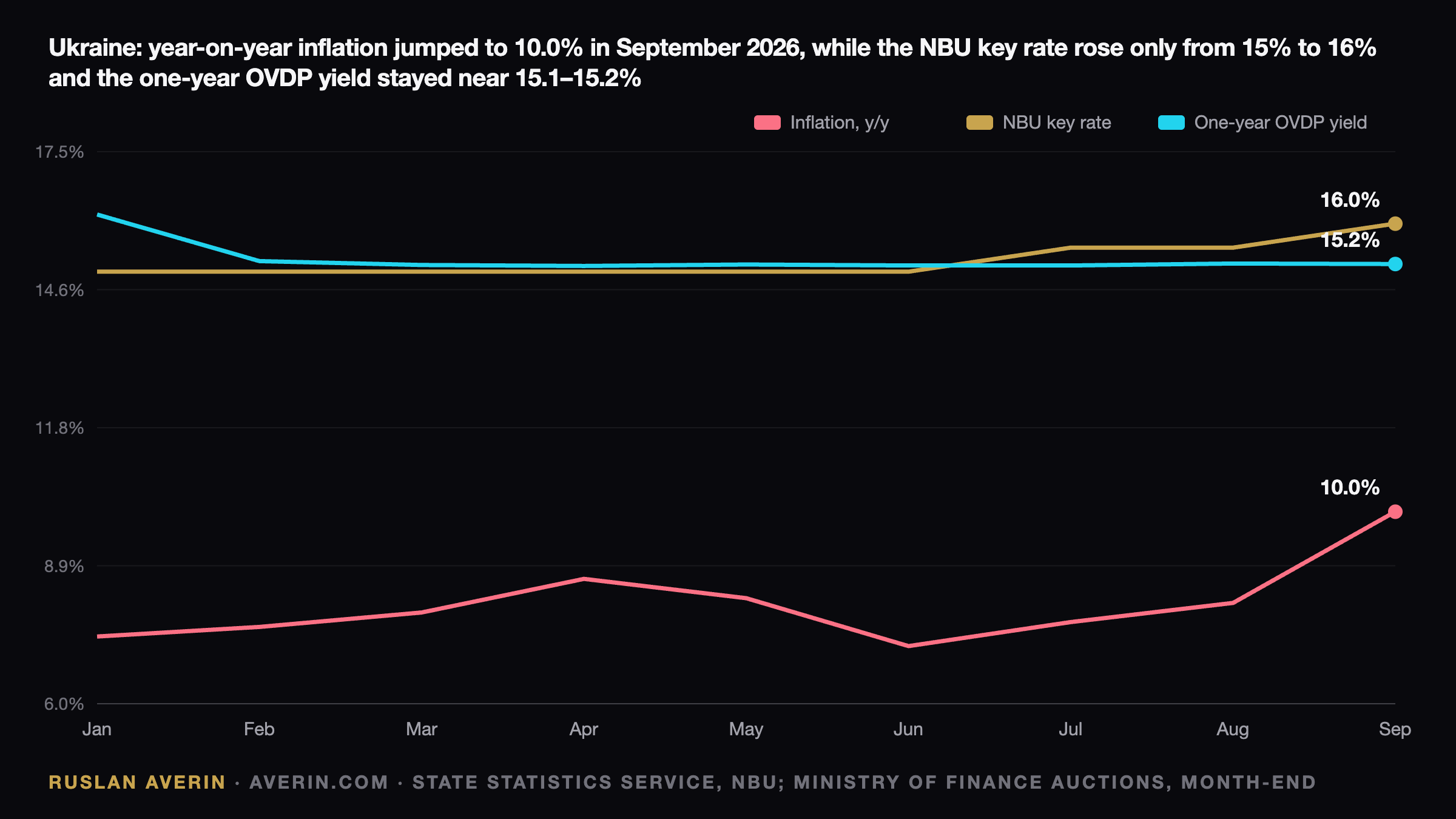
One month of data wiped out the saver's cushion
The arithmetic that mattered most in September 2026 was not the headline but the gap. A hryvnia depositor earning the market average after tax held a real margin of roughly 2.5% while annual inflation stood at 8.1%. After the State Statistics Service reported 10.0% on Friday 9 October, that margin shrank to less than one percentage point. Nothing changed in the contract; the price index did all the work.
Consumer prices rose 2.1% in a single month, following 0.1% in August and 0.3% in July. Core inflation, which strips out the most volatile items, climbed to 8.8% from 8.1%, with a monthly gain of 2.0%. Since December 2025 the consumer price index has added 8.4%. The National Bank of Ukraine described the outcome as "significantly above" the trajectory set out in its July Inflation Report.
Real yields across hryvnia instruments
Deposit interest for individuals is taxed at 23%, combining 18% personal income tax and the 5% military levy. Interest on OVDP carries no tax. Real returns below use the standard formula (1 + net yield) / (1 + inflation) − 1, with inflation at 10.0%.
| Instrument | Nominal | After tax | Real |
|---|---|---|---|
| Average 12-month hryvnia deposit (UIRD, 12 Oct) | 14.03% | 10.80% | +0.7% |
| Average 3-month hryvnia deposit (UIRD, 12 Oct) | 13.82% | 10.64% | +0.6% |
| Best 12-month offer, Bizbank (Minfin, 13 Oct) | 17.85% | 13.74% | +3.4% |
| One-year military OVDP (6 Oct auction) | 15.14% | 15.14% | +4.7% |
| 2.5-year OVDP, March 2029 (6 Oct auction) | 16.49% | 16.49% | +5.9% |
The spread between the average deposit and a tax-free one-year bond is now about four percentage points in real terms. Only the top of the deposit market, Bizbank at 17.85% and Unex Bank at 17.50%, still holds a real cushion near 3%. For the median saver, the hryrvnia deposit has become a near-neutral instrument rather than a growth one.
Bond yields that refused to move
Government paper has not followed the two key-rate hikes delivered since July. At the auction on 6 October the Ministry of Finance placed one-year military bonds at a weighted average of 15.14% and new issues maturing in March 2029 at 16.49%, raising UAH 2.21 billion. A comparable one-year bond went at 15.13% at the end of June, before both increases, and at 16.19% in late January.
Members of the Monetary Policy Committee noted in September that these rates had barely shifted since July, while demand for hryvnia assets held firm. Individual holdings of OVDP reached a record UAH 167.5 billion on 1 October, more than UAH 4 billion higher over the month, according to the Ministry of Finance. Tax exemption, not yield competition, explains much of that flow.
Where the September jump came from
Monthly data compiled by Minfin show the increase was broad rather than concentrated. Food and non-alcoholic beverages added 1.9%, with eggs up 43.6% even as fruit fell 5.7% and vegetables 2.3%. Fuel and lubricants rose 5.2% and road passenger transport fares 2.5%. Clothing and footwear jumped 8.5% as summer discounts expired.
Education was the single sharpest line at 17.4%, with higher education up 23.3%. Housing and utilities added a modest 0.8%, driven by water supply tariffs at 5.6% and sewerage at 5.5%. The heaviest household energy line stayed frozen: on 8 October the Cabinet of Ministers preserved the preferential household electricity tariff for the 2026/27 heating season, Interfax-Ukraine reported.
The annual structure published by the National Bank is more revealing. Fuel prices stand 46.2% above a year earlier after external oil product swings passed through wholesale and retail. Raw food inflation accelerated to 6.7%, processed food to 10.7%, services to 13.7% on tuition and rents as internal migration intensifies, and administered prices to 13.6% on transport fares, water tariffs and alcohol. Non-food goods, up 2.4%, remain the calmest group.
Three months ahead of the official path
In July the National Bank projected 10.0% inflation for December 2026, revised up from 9.4% in April, followed by 9.1% in the first quarter of 2027, 8.2% in the second and 6.9% by the end of 2027. September has already delivered the December number, three months early.
The regulator attributes the overshoot to intensified Russian attacks on production, warehouse and logistics infrastructure, and to fuel. Deputy Governor Volodymyr Lepushynskyi estimated that rebuilding logistics after the strikes adds 0.4 to 0.6 percentage points to annual inflation, and the National Bank put the latest fuel increase at roughly 0.3 percentage points. Its guidance states that higher transport and storage costs and damaged infrastructure "will continue to support inflationary pressure in the coming months".
A narrow offset appeared in food. Ministry of Agrarian Policy monitoring for the week to 13 October showed onions down 9%, cabbage 7%, butter 4%, eggs 3% and pork 2%, while potatoes and milk rose 2%. That relieves the grocery basket, not fuel, services or administered tariffs. In the view of analyst Ruslan Averin, December inflation above 10% is now the base case rather than a risk scenario.
The dollar bought insurance, not income
The official rate stood at UAH 44.9567 per dollar on 13 October, near the record UAH 45.0564 set on 6 October. Twelve months earlier it was UAH 41.6027, so the dollar gained 8.1% against the hryvnia over the year and 6.6% since 2 January.
Adding the average 12-month dollar deposit rate of 1.13%, or 0.87% after tax, a currency holder earned about 9.0% in hryvnia terms, slightly below 10.0% inflation. The dollar therefore preserved purchasing power less effectively than a one-year OVDP. Its function is protection against a sharper devaluation, not return.
Scenarios for Thursday 29 October
In September seven of the ten Monetary Policy Committee members backed raising the key rate to 16%, while three preferred to hold. Seven considered the new level tight enough, expected no change in the coming months and saw room for cautious easing in 2027. Two argued the October forecast update could justify at least one further hike. The July path held 16% through the first quarter of 2027, with cuts starting in the second.
Headline inflation has since travelled from 8.1% to 10.0% and core from 8.1% to 8.8%. At 16%, the key rate now sits about 5.5% above current inflation in real terms and about 6.6% above core. Three outcomes look plausible: a hold accompanied by harder language, on the argument that fuel and logistics shocks lie beyond the reach of a policy rate; a further half-point step, justified by services at 13.7% and core at 8.8% signalling second-round effects; or an unchanged rate with the first cut pushed well past the second quarter of 2027.
Analyst Ruslan Averin notes that the practical issue for savers is transmission lag, since deposit rates and bond yields barely reacted to two hikes. Until they do, tax-free bonds retain the widest real margin among hryvnia instruments. The updated forecast arrives on 29 October and the full Inflation Report on 5 November. This is analysis, not investment advice.