The 19% That Decides the Whole Deal
In September 2026 the median one-room apartment in Kyiv was advertised at $68,500, while comparable transactions actually closed at $55,500. The 19% distance between those two numbers is the single largest variable in the process. An asking price opens a negotiation; it does not describe the market. Every other cost in the transaction is small by comparison.
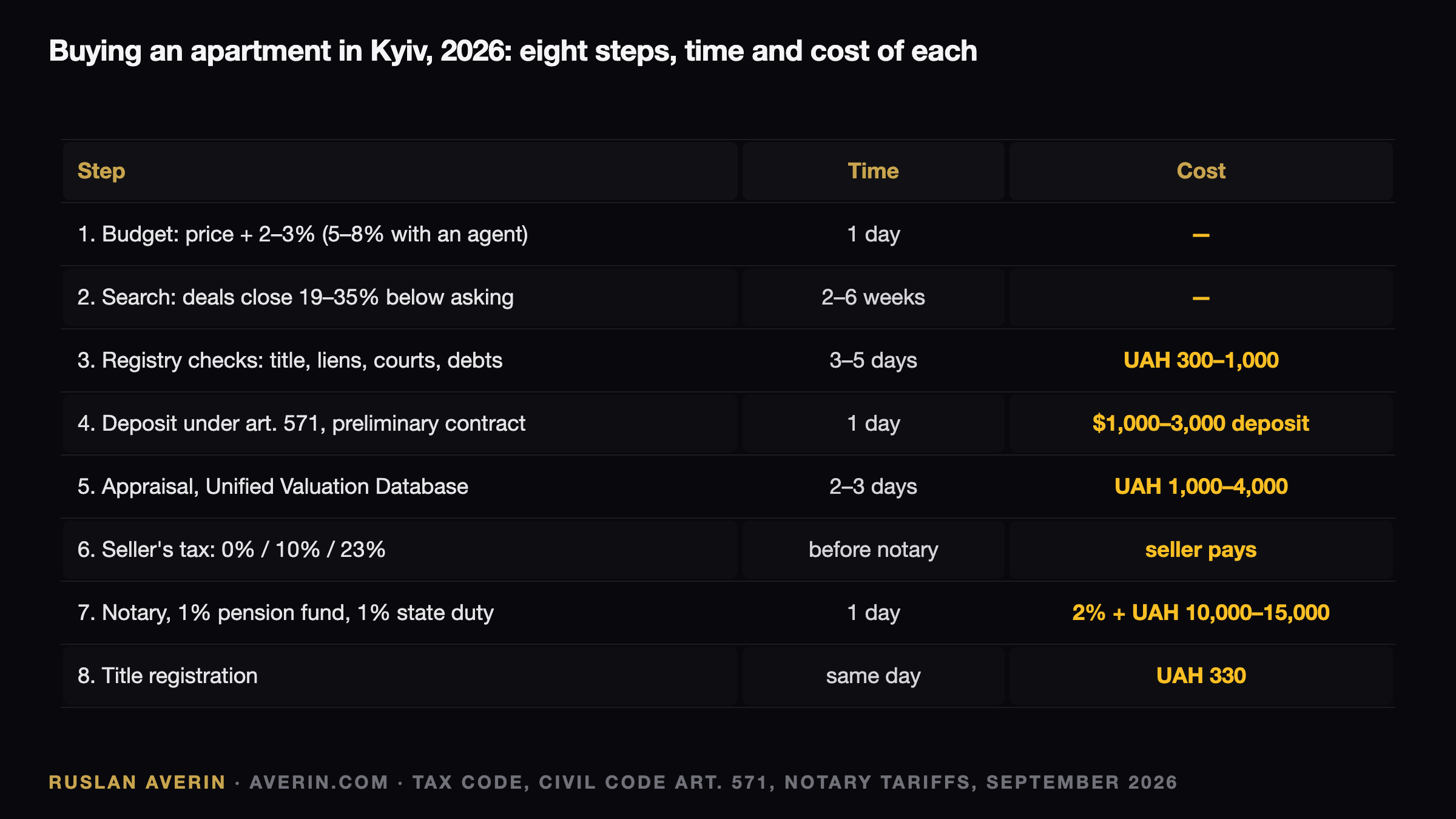
The secondary-market purchase itself breaks into eight stages, and each carries a defined sum that can be preserved or surrendered. The sequence below covers what happens between the first viewing and the moment the register shows a new owner's name.
Listings, Deals and the Tempo of the Market
Secondary listings in July stood 18% below the level of a year earlier, and enquiries were down 17%. Time on market fell to 41 days from 60 in January, which indicates faster turnover rather than an overheating price cycle. Against that background, the spread between advertised and realised prices remains wide across every apartment size.
| Apartment type | Median listing | Median closed deal |
|---|---|---|
| One-room | $68,500 | $55,500 |
| Two-room | $102,000 | $79,500 |
| Three-room | $150,000 | $98,000 |
What Sits On Top of the Price
Mandatory buyer costs run to 2–3% of the price when no agent is involved. They consist of 1% to the pension fund calculated on the appraised value, 1% state duty, an appraisal at UAH 1,000–4,000, notary fees of UAH 10,000–15,000 in Kyiv, and UAH 330 for title registration. A buyer's agent adds a further 3–5%.
A first-home buyer is exempt from the pension levy by law, yet notaries frequently insist on payment anyway. Recovering the money afterwards means dealing with the Pension Fund or the courts. The exemption should therefore be agreed with the notary in writing well before the day of signing.
Checks That Belong Before the Money Moves
Five registers and three certificates neutralise most of the risk. The State Register of Property Rights shows the owner, encumbrances, seizures and mortgages, with an extract available through Diia or a notary. The Unified Register of Court Decisions reveals disputes tied to the address or the seller, inheritance conflicts included. The Register of Powers of Attorney matters whenever a representative signs.
Alongside those, a buyer needs a certificate of registered residents confirming no minors are involved, since deregistering a child requires the guardianship authority. Utility no-debt certificates matter because arrears attach to the account and follow the apartment. The technical passport reveals unapproved alterations, which block mortgage lending and carry a fine to legalise.
Notarised spousal consent is required if the apartment was acquired during marriage. For inherited property, the six-month period since the estate opened must have passed and other heirs must be ruled out. A distinct 2026 category is housing bought under eOselya: early sale requires the bank's consent and repayment of the subsidy, and the encumbrance appears in the register.
Deposit Versus Advance
The Civil Code separates two instruments that buyers routinely confuse. An advance is a simple prepayment returned by whichever side ends the discussion. A deposit under Article 571 carries penalties: a seller who breaks the deal returns double, and a buyer who withdraws loses the sum entirely.
The deposit is created by a preliminary contract signed before a notary, fixing price, deadline, the allocation of taxes and levies, and the condition of the apartment at handover. Typical amounts in Kyiv are $1,000–3,000. A handwritten receipt converts the deposit into an advance, because that is how courts interpret receipts.
Appraisal and the Tax the Seller Passes On
No notary will certify the contract without an electronic appraisal certificate from the Unified Database of Valuation Reports. The contract price cannot fall below the appraised figure for tax purposes. The appraisal costs UAH 1,000–4,000 and stays valid for six months; an understated figure lowers the base for the 1% pension levy, an overstated one raises it.
Seller taxation reaches the buyer through the price. A seller pays 0% on a first sale of the year for property held more than three years, 10% if held under three years, and 23% on a third sale within the year. Owners inside the three-year window either build the 10% into the price or request part of the sum outside the contract, which exposes the buyer: only the contract amount returns if the deal is unwound. The registration date appears in the register extract, and postponing a few weeks can split the saving.
Payment, Signing and the New Clock
Any amount above UAH 50,000 moves cashless only, via bank account, letter of credit or the notary's deposit. From UAH 400,000 the bank requests proof of source of funds, so statements, tax returns or the contract for previously sold housing should be assembled early. A refusal on signing day ends the transaction.
The contract is denominated in hryvnia, with the exchange rate fixed inside it if the parties negotiated in dollars. State duty and notary fees are allocated by agreement and usually fall to the buyer, while the 1% pension levy is the buyer's by law. The notary registers title the same day for UAH 330, the extract arrives in Diia, and the three-year clock for a future tax-free sale begins.
The Five Places Money Disappears
Paying the asking price costs 10–20% against the deal market. Paying the pension levy on a first home costs 1%, recoverable only with effort. A receipt instead of a notarised deposit lets the seller return the money penalty-free while the buyer loses a month and the apartment. Sums outside the contract are unprotected, and unauthorised alterations fail mortgage checks and deter future buyers.
By the assessment of analyst Ruslan Averin, the first item outweighs the remaining four together: a buyer able to read the distance between listing medians and deal medians saves, on a single apartment, an amount equal to several years of transaction costs.