Distance From the Front Line Has Become the Price Tag
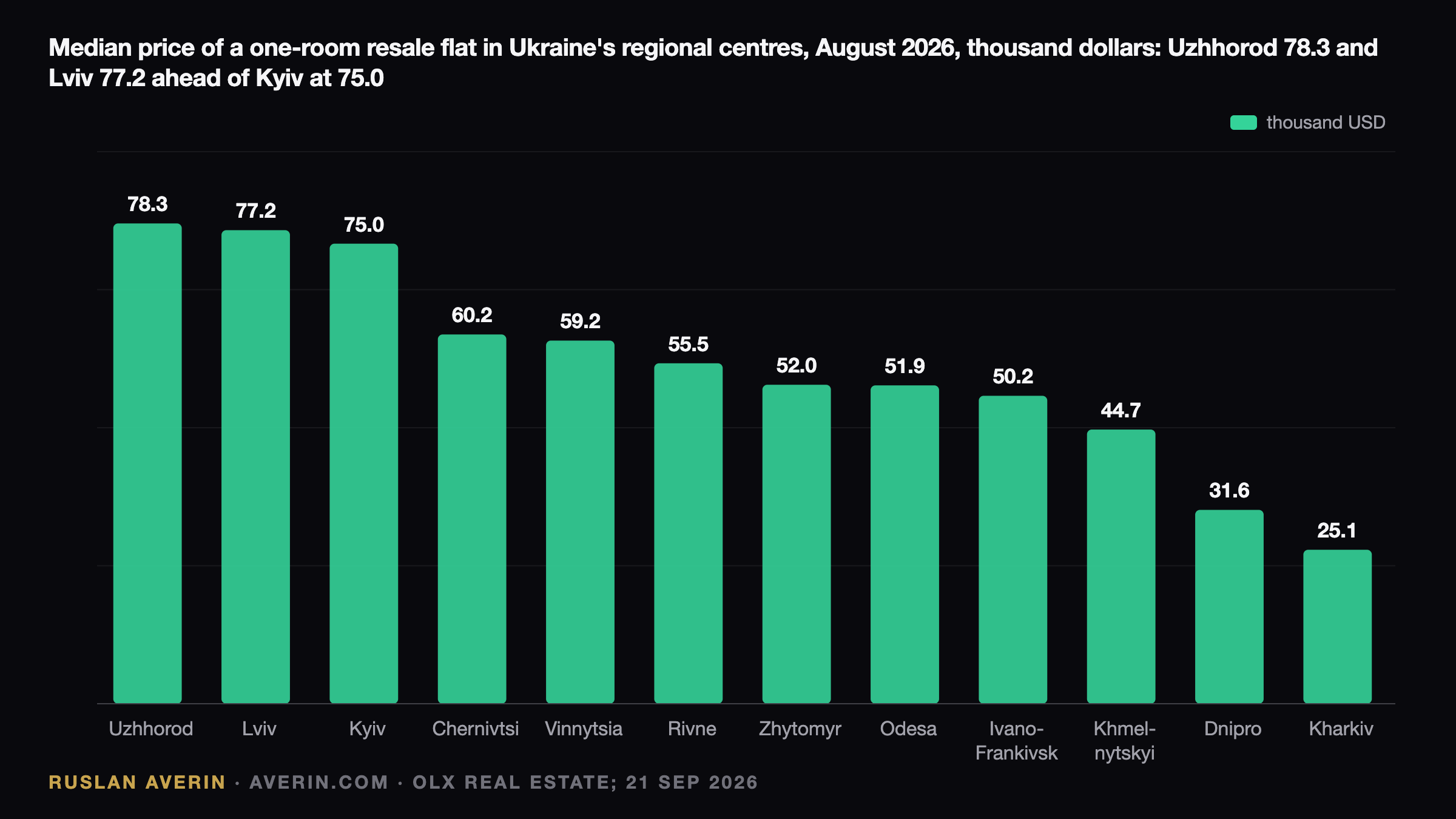
Ukraine's housing ranking now reads like a security map. OLX Real Estate compared August 2026 with August 2025 in a release dated 21 September, and the median resale price of a one-room flat came out at $78,300 in Uzhhorod and $77,200 in Lviv. The capital placed third at about $75,000. Eighteen of the 20 regional centres in the study recorded annual growth.
The spread matters more than the podium. A one-room flat in Kherson trades at $12,000, less than a sixth of the Uzhhorod figure, and lost a further 14% over twelve months. At the other end, Khmelnytskyi grew fastest at 20% and Lviv added 19%, while Kyiv's 4% ranked among the slowest gains recorded anywhere in the sample.
Rents Confirm What Buyers Are Paying For
The income side of the equation points the same way. LUN's September figures put monthly rent for a one-room flat at UAH 29,100 in Uzhhorod and UAH 26,300 in Lviv, against UAH 18,000 in Kyiv. Set against the OLX prices and the official exchange rate of UAH 44.67 per dollar on 21 September, gross yields land near 10.0%, 9.2% and 6.4% respectively.
Those numbers are an order of magnitude rather than a precise quote, because the price and rent series come from different sources. They are also gross figures, measured before vacancy, repairs, the 5% military levy and 18% income tax on declared rent. Still, the message holds: western buyers from two years ago collect more rent on assets that also appreciated faster.
The Full Table of 20 Regional Centres
| City | One-room resale flat, median, August 2026 | Change over a year |
|---|---|---|
| Uzhhorod | $78,300 | +13% |
| Lviv | $77,200 | +19% |
| Kyiv | $75,000 | +4% |
| Chernivtsi | $60,200 | +6% |
| Vinnytsia | $59,200 | +17% |
| Rivne | $55,500 | −5% |
| Zhytomyr | $52,000 | +11% |
| Odesa | $51,900 | +16% |
| Ivano-Frankivsk | $50,200 | +16% |
| Cherkasy | $48,300 | +7% |
| Khmelnytskyi | $44,700 | +20% |
| Poltava | $39,600 | +7% |
| Chernihiv | $34,200 | +4% |
| Kropyvnytskyi | $31,800 | +17% |
| Dnipro | $31,600 | +4% |
| Kharkiv | $25,100 | +6% |
| Sumy | $24,000 | +13% |
| Mykolaiv | $20,500 | +6% |
| Zaporizhzhia | $16,000 | +2% |
| Kherson | $12,000 | −14% |
Three Speeds Inside One Market
The first group runs from Lviv and Khmelnytskyi through Vinnytsia, Ivano-Frankivsk and Kropyvnytskyi, all appreciating at 16–20% a year in dollar terms. These are western and central cities that absorbed population and business relocation, and their price curves have detached from the national average.
The second group covers the large eastern and southern centres. Dnipro, Kharkiv, Mykolaiv and Zaporizhzhia grow at 2–6%, but from bases so low that a Kharkiv flat costs roughly a third of a Lviv one. Odesa, up 16%, is the southern exception. The third group is simply falling: Kherson and Rivne.
Why the Kyiv Number Depends on Who Counts It
The capital's median deserves a caveat. OLX derives about $75,000 from its own listings, and its July release gave $74,776. LUN's September median for a Kyiv one-room flat is $68,500, while the median of flats actually sold on the same series drops to $55,500, as the district-by-district review on 17 September demonstrated.
The methodologies diverge; the direction does not. Every series places Kyiv growth at 3–5% a year in dollars. Dispersion within the city exceeds the gap between most regional centres: OLX's July data recorded a Pechersk one-room flat at $164,076, up 14%, against $45,309 in Desnianskyi.
Supply, Relocation and the Cost of Building
Uzhhorod is the regional centre furthest from the front line, sits on the Slovak border and lies a short drive from Hungary. Lviv functions as the relocation hub for companies and for eastern families. Both carry small housing stocks relative to arrivals, and construction costs in western Ukraine rose by about 10% in the first eight months of 2026, per developers quoted by Informator.
Marianna Bihunets, commercial director of the builder GAZDA, expects new-build prices to add another 3–5% this autumn and 7–10% in projects close to completion. "In the autumn the buyer will increasingly be buying certainty and safety," she said. That sentence captures the pricing logic of the entire top of the table.
eOselya Keeps Lending, but the Entry Ticket Bites
The subsidised programme remains the only functioning mortgage market. In the week to 21 September the Ministry of Economy reported 170 eOselya loans worth UAH 377.3 million: 87 at the preferential rate for servicemen, veterans, teachers, doctors and scientists, and 83 for families without housing and displaced people. Since the start of 2026 the programme has issued 6,079 loans for UAH 12.1 billion.
Kyiv region led the week with 60 loans, the city of Kyiv took 29 and Lviv region 20. Of the 170 loans, 105 financed first-sale housing, 66 of those still under construction. Ukrfinzhytlo, the programme operator, is preparing to place roughly €1 billion of securitised mortgage paper on international markets after the war, according to Interfax-Ukraine.
The Down Payment and the Cost of Money
What blocks buyers is the deposit, not the instalment. A survey of LUN and Work.ua data reproduced by Molodyi Bukovynets on 10 September put the first payment for a programme flat at UAH 636,000 in Lviv, UAH 633,000 in Uzhhorod and UAH 602,000 in Vinnytsia, against UAH 386,000 in Kyiv and UAH 230,000 in Kharkiv.
Outside the programme, credit grew dearer on 17 September, when the National Bank lifted its key rate to 16%, citing "persistent fundamental price pressure" with August inflation at 8.1%. A hryvnia deposit or government bond now competes head-on with a Kyiv flat yielding 6.4% gross, and far less convincingly with 9–10% in the west.
A Risk Map Priced in Dollars
In analyst Ruslan Averin's view, the OLX table is best read as a risk map denominated in dollars. The premium attached to Uzhhorod and Lviv is a premium for safety, and it should compress if security improves, because relocated households would regain a choice. The discount on Kharkiv, Mykolaiv and Zaporizhzhia is the mirror option on the same event.
Buyers weighing the two ends are effectively choosing which way to be wrong. Households that need an address rather than a position are looking at the middle: Vinnytsia, Khmelnytskyi, Ivano-Frankivsk and Zhytomyr sit 23–42% below Lviv, grow at 11–20% a year, and are constrained mainly by the programme's first instalment. For Kyiv, 4% reads as stability, not weakness — prices that doubled over seven years are pausing while the regions close the gap.