The headline number and what it hides
An investment-grade corporate bond index printed a 5.53% effective yield on 8 September 2026. Taken at face value that is an improvement over the 4.79% available twelve months earlier. Taken apart, it describes something less appealing: a market where the corporate component of a corporate bond yield has shrunk to a rounding error next to the government component.
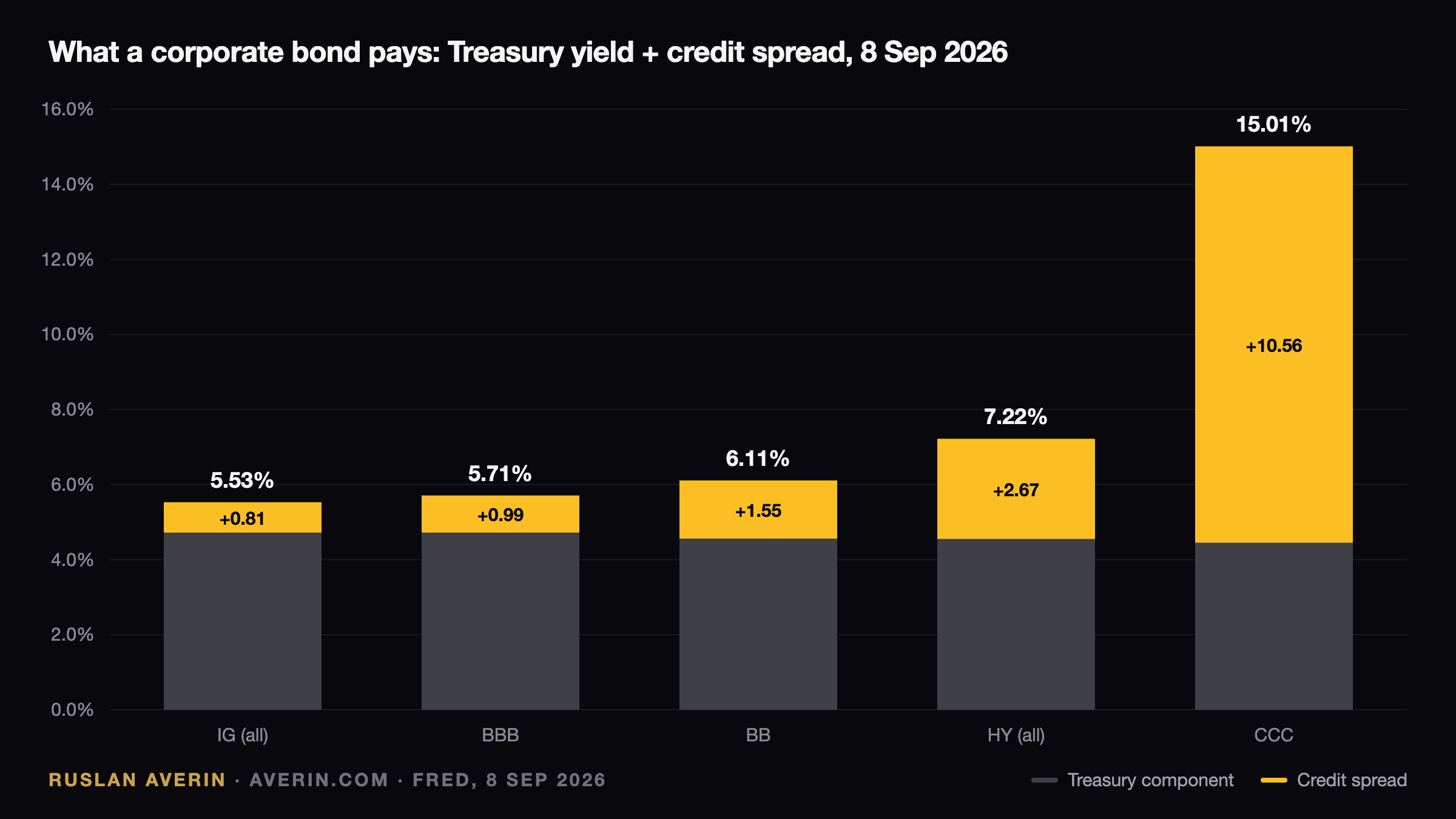
The decomposition is straightforward. Of the 5.53%, some 4.72% is the yield on a Treasury bond of matching maturity. The residual 0.81% is the option-adjusted spread — the entire annual payment an investor receives for accepting default risk, downgrade risk, illiquidity and every other hazard that attaches to a company and not to the US Treasury.
Rates did the work, credit did not
Over twelve months the corporate yield climbed 0.74% while the matching Treasury yield climbed 0.70%. The difference between those two moves is four hundredths of a percent. Investors earning more on corporate paper this year are not being paid more for corporate risk; they are being paid more because the risk-free curve repriced underneath them.
That distinction matters for allocation. If the improvement in yield is a government phenomenon, it can be captured without owning credit at all. Analyst Ruslan Averin frames the current decision not as investment grade versus high yield, but as Treasuries versus credit — and on that framing the government side takes most of the argument.
The ladder from AAA to CCC
| Segment | Effective yield | Spread over Treasuries | Treasury component |
|---|---|---|---|
| AAA corporate | 5.40% | 0.43% | 4.97% |
| Investment grade (all) | 5.53% | 0.81% | 4.72% |
| BBB | 5.71% | 0.99% | 4.72% |
| BB | 6.11% | 1.55% | 4.56% |
| High yield (all) | 7.22% | 2.67% | 4.55% |
| B | 7.31% | 2.76% | 4.55% |
| CCC and below | 15.01% | 10.56% | 4.45% |
Source: ICE BofA indices via FRED, 8 September 2026.
Two features of the ladder deserve attention. The investment-grade spread of 0.81% sits within a few hundredths of a percent of its two-year low of 0.75%, recorded in June 2026, and the high-yield spread of 2.67% is similarly near the floor of its range. These are the readings of a market that is not worried.
The second feature is the shape. Moving from BB to B widens the spread by 1.21%. Moving from B to CCC widens it by 7.8%. The bottom of the credit stack is priced as a separate asset class, and that pricing is defensible.
What 0.81% is being asked to absorb
Long-run annual default rates for investment-grade credit run to a few tenths of a percent, and recovery on a defaulted senior bond has historically landed near 40 cents on the dollar. Expected loss on a diversified investment-grade portfolio therefore sits around 0.1–0.2% in a normal year. Against that arithmetic alone, 0.81% looks sufficient.
But the spread is not purely a default premium. It also has to fund downgrade risk: a BBB bond falling to BB is dumped by every fund with an investment-grade mandate, and the holder absorbs the gap between 0.99% and 1.55% of spread — roughly 3% on a seven-year bond — without a single missed coupon.
It has to fund liquidity risk as well. Corporate bonds do not trade like Treasuries. In March 2020 the investment-grade spread moved from 1% to 4% in three weeks, and bids vanished for anything outside the benchmark issues.
And it has to absorb supply. Corporate issuance in 2026 is running above $1.5 trillion, propelled by AI capital expenditure. The hyperscalers are strong credits, but the sheer volume of paper is what prevents further tightening — and what would drive spreads wider if the capex cycle rolls over.
High yield tells a straighter story
At 7.22% with a 2.67% spread, the broad high-yield index is at least admitting that defaults happen and pricing accordingly. Within it, BB at 6.11% stands out. The historical default rate for BB is low, the 1.55% spread is nearly double investment grade, and the issuers are typically larger names sitting one notch below the dividing line.
CCC at 15.01% belongs in a different conversation. With a 4.45% Treasury component underneath, the 10.56% spread is the market's estimate of expected loss plus the premium for being the party that absorbs it. Individual credits may pay in full and deliver 15%; the index will not.
The competing trade
The government curve offers most of the yield with none of the corporate exposure. The 10-year sits at 4.80% and the 20-year at 5.26%, while TIPS at a 2.43% real yield strip out the inflation risk that is the underlying reason yields are elevated in the first place.
On that basis, investment grade at 0.81% is worth owning mainly where a mandate demands corporate paper, because the marginal spread does not pay for a widening event — and widening events arrive. BB at 6.11% is the one credit segment where the incremental compensation holds up, assuming issuer diversification. B and CCC are trading instruments for specialists rather than allocations.
The September 2026 corporate market, in the reading of analyst Ruslan Averin, pays generously for government risk and poorly for corporate risk. The sensible response is to take the yield where it is actually being offered.