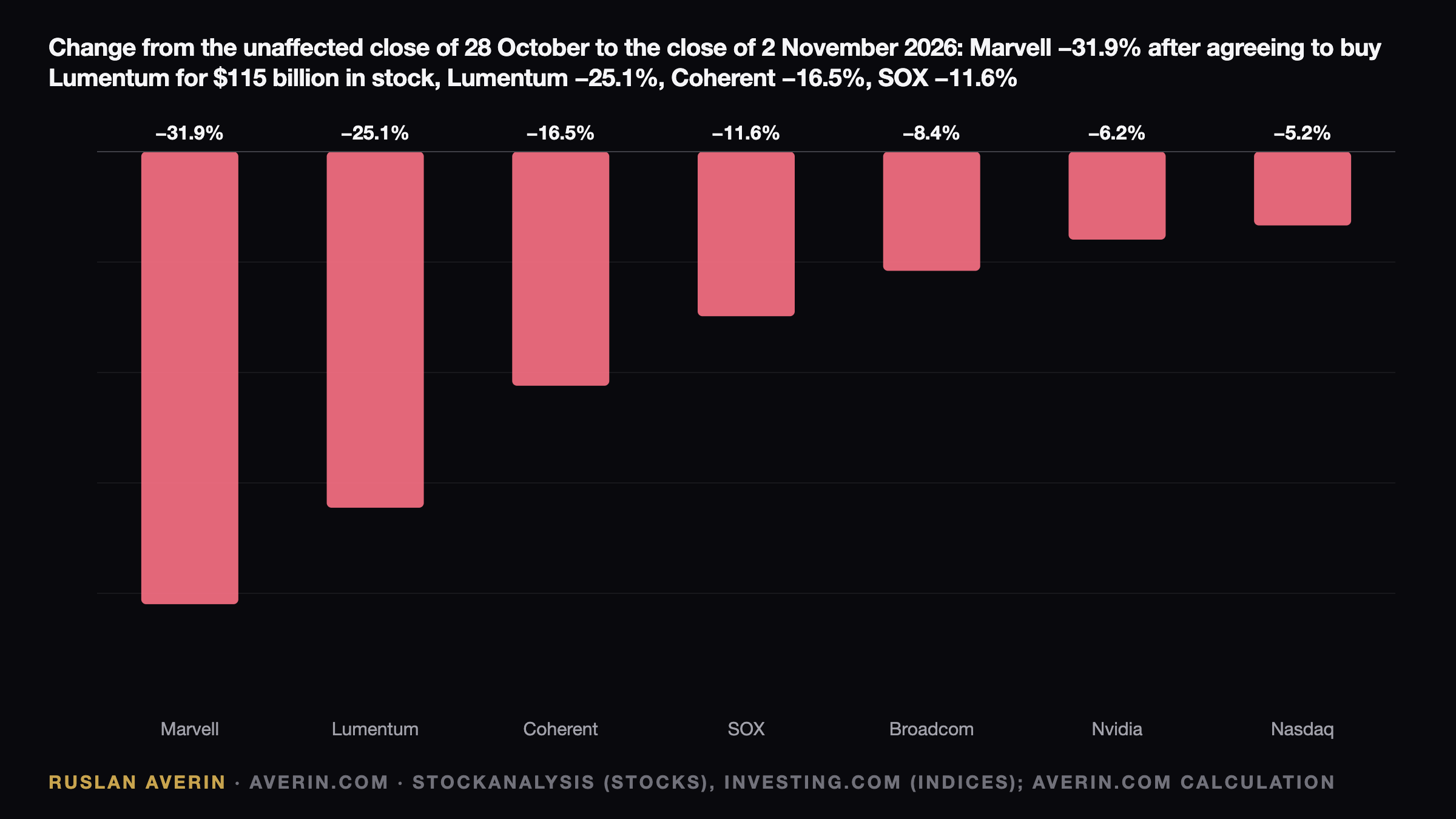
The headline number was $115 billion. The number that mattered at Monday's close was $771.35: the value of 4.5 Marvell Technology shares after the stock fell 12.72% to $171.41 on 2 November, the day Marvell agreed to buy laser and optical-module maker Lumentum paying only with its own stock.
The target did not rally either. Lumentum fell 18.59% to $684.40, the PHLX Semiconductor index (SOX) lost 3.37% and the Nasdaq Composite 1.07%, according to StockAnalysis and Investing.com closing data.
A premium that vanished before the signing
On paper, the offer valued Lumentum at about $1,132 per share, a premium of about 23.9% to the unaffected closes of Wednesday 28 October: $251.65 for Marvell and $913.95 for Lumentum. Reuters put the equity value at $102.54 billion; the joint press release filed with the SEC gives an implied enterprise value of $115 billion.
The currency kept falling while the deal was finalised. After talks leaked on 28 October, Marvell dropped 13.24% on Thursday 29 October and 10.05% on Friday 30 October before Monday's slide, ending 31.9% below its unaffected level. At $771.35, the package is worth 15.6% less than Lumentum's own unaffected price.
Analyst Ruslan Averin reads the sell-off as a vote on the payment currency rather than on the strategy. Because the deal is paid entirely in Marvell shares, every move in MRVL reprices the offer, and the market spent four sessions marking that currency down by almost a third.
Four sessions, roughly $91 billion
Using StockAnalysis share counts, the decline since 28 October removed about $70 billion of market value from Marvell and about $21 billion from Lumentum, roughly $91 billion together.
| Stock / index | Close 28 Oct | Close 2 Nov | Change on 2 Nov | Since 28 Oct |
|---|---|---|---|---|
| Marvell (MRVL) | $251.65 | $171.41 | −12.72% | −31.9% |
| Lumentum (LITE) | $913.95 | $684.40 | −18.59% | −25.1% |
| Coherent (COHR) | $239.59 | $199.95 | −4.93% | −16.5% |
| Broadcom (AVGO) | $351.81 | $322.23 | −1.18% | −8.4% |
| Nvidia (NVDA) | $215.38 | $202.06 | −1.26% | −6.2% |
| SOX index | 11,684.0 | 10,328.3 | −3.37% | −11.6% |
| Nasdaq Composite | 26,549.85 | 25,164.31 | −1.07% | −5.2% |
The tape was already weak. The SOX had fallen 7.20% on Friday 30 October, the day Intel plunged 28.6% on a weak outlook, and investors were still digesting the Big Tech capex stress test.
Lumentum at $684.40 trades about $87 below the $771.35 it is meant to receive. That 12.7% gap is the market's measure of doubt that the deal closes on time.
What the exchange ratio locks in
The ratio is fixed at 4.500 Marvell shares per Lumentum share, with no cash. On a fully diluted basis, Marvell holders keep about 67% of the combined company and Lumentum holders get about 33%. Closing is expected in the first half of calendar 2028, after both shareholder votes and regulatory approvals.
With $3.93 billion of cash, according to StockAnalysis, Marvell had no realistic cash option, and there is no new debt. Under the Form 8-K, Marvell owes $5.8 billion if its board walks away or takes a rival offer, Lumentum owes $2.9 billion in the mirror case, and Marvell pays a $3.2 billion regulatory fee if authorities block the deal.
The companies claim "line of sight" to more than $1 billion of annual run-rate cost synergies, mostly in cost of goods, and accretion to Marvell's non-GAAP earnings per share in the first year after closing. Matt Murphy stays chairman and CEO.
Why a chip designer wants laser fabs
Copper links inside AI data centres are hitting physical limits, and the industry is moving to optics. Murphy called it "a fundamental architectural shift toward optical connectivity, creating an opportunity that comes along once in a generation". Marvell brings DSPs, switching and custom AI chips.
Lumentum adds high-power lasers, transceivers, optical circuit switches and indium phosphide wafer fabs, which Marvell's slides call the world's largest InP capacity. The pitch is co-design of electrical and optical parts, including co-packaged optics (CPO). Pro forma annualised revenue is $17.7 billion ($12.6 billion Marvell, $5.1 billion Lumentum), against a $550 billion target market by 2030. Nvidia invested $2 billion in each company earlier this year, Reuters reported.
Paying 54 times operating profit
Lumentum's fiscal first-quarter report, out the same day, explains the price. Revenue rose 136.5% from a year earlier to $1.26 billion, the non-GAAP operating margin reached 42.3%, and a second major NPO/CPO contract is "backed by purchase commitments exceeding $5 billion". December-quarter guidance of $1.575–1.625 billion beats the $1.48 billion LSEG consensus cited by Reuters.
By RFC calculations, $115 billion is about 22.5 times annualised first-quarter revenue of $5.1 billion and about 18 times the annualised guidance midpoint. Non-GAAP operating income of about $534 million annualises to $2.1 billion, so the price is roughly 54 times that, or about 40 times if the guided 45–46% margin holds on $1.6 billion of revenue.
TD Cowen, as reported by Investing.com, notes consensus implies an optical transceiver market of about $100 billion in 2027 against its own $47 billion forecast, so the deal may be struck "near the peak of an optical mini-cycle".
How the sell-side voted
TD Cowen's Sean O'Loughlin cut Marvell to Hold from Buy and halved the target to $175 from $350, expecting mid-single-digit EPS dilution in 2028. BofA's Vivek Arya cut it to Neutral, target $225 from $400: $1 billion of savings does not offset about 50% share dilution.
William Blair kept Outperform, and B. Riley downgraded Lumentum on the terms. Axel Rudolph of IG Group told Reuters "this is an enormous bet, and investors are right to ask whether Marvell is paying too much".
Washington, Beijing and the outside date
The Form 8-K requires expiry of the Hart-Scott-Rodino waiting period plus foreign-investment reviews. The outside date is 1 November 2027, extendable in steps to 1 August 2028. China is the obvious risk: Lumentum competes with Zhongji Innolight, and a proposed US ban on new Chinese optical transceivers would favour American suppliers, Reuters noted.
A Reuters Breakingviews column on 2 November was headlined "China adds latency to Marvell's optical mega-deal". The precedent is Intel's Tower Semiconductor deal, abandoned in 2023 when China's SAMR did not clear it in time.
Three paths for MRVL
Base case: Marvell trades as a deal currency with an overhang until the S-4 and shareholder votes, tracking the SOX, which BofA said fell 19% in a month. Bull case: Lumentum delivers about $1.6 billion in the December quarter, more CPO contracts arrive, and Marvell confirms the preliminary third-quarter revenue reiterated on Monday.
Bear case: the optical cycle peaks before closing, China's review drags toward August 2028, or a shareholder vote fails, with an added $3.2 billion bill if regulators block the deal. Analyst Ruslan Averin suggests tracking the spread between 4.5 Marvell shares and Lumentum's price as the market's daily estimate of whether the deal closes.
Dates on the calendar
- 17 November: Nvidia's fiscal third-quarter report.
- 1 December (estimated): Marvell's full fiscal third-quarter results.
- Late December: end of Lumentum's fiscal second quarter, guided at $1.575–1.625 billion.
- Coming weeks: joint S-4 and Hart-Scott-Rodino filings.
- 1 November 2027: first outside date, extendable to 1 August 2028.