A Central Bank Working the Savings Channel
The National Bank of Ukraine cannot manufacture dollars, so it is buying loyalty to the hryvnia instead. The half-point step to 16% announced at 14:00 on Thursday, one day after the Federal Reserve, is a bid to keep households in hryvnia instruments at a moment when official financing has thinned out. Decision No. 313-рш takes effect on 18 September.
Governor Andriy Pyshnyi's briefing text and the press release share one formulation for the motive: the Board acted "in view of persistent underlying price pressure, second-round effects of supply shocks and rising medium-term inflation risks". Nothing about the outcome surprised the market. Most bankers polled by Interfax-Ukraine on Wednesday named 16%, and Interfax's Thursday headline used the word "expectedly".
The Corridor From 18 September
| Instrument | Before | From 18 September |
|---|---|---|
| Key rate | 15.5% | 16.0% |
| Overnight certificates of deposit | 15.5% | 16.0% |
| 3-month certificates of deposit, ceiling | 19.0% | 19.5% |
| Overnight refinancing loans | 19.5% | 20.0% |
| Next decision | — | 29 October 2026 |
The Dollar Supply the Rate Cannot Reach
The release limits itself to saying the move "will support the attractiveness of hryvnia assets and the stability of the FX market". The official rate was 44.60 on Thursday and 44.66 for Friday, the interbank closed at 44.68–44.71, and cash was sold at 44.80–44.99, with PUMB at 45.00 — the quote behind headlines about 1,000 dollars costing 45,000 hryvnias.
Interventions tell the harder story. The NBU sold $1.19 billion net in the week to 11 September, down 10% from a record $1.33 billion, after $4.85 billion in August. Reserves fell 5% to $48.66 billion on 1 September, down $8.6 billion since January, because "against the background of lower than expected official financing in July–August, fiscal policy was more restrained and international reserves declined".
Pyshnyi stressed that "a significant part of international aid is tied to the pace of reforms" and that "the restoration of the regularity and sufficiency of international assistance is critically important for the stability of public finances and for price stability". The IMF mission that ended on 16 September produced no staff-level agreement on the second review. Former NBU Council chair Bohdan Danylyshyn put the limit plainly: "A high rate does not create FX supply."
The Price File
August inflation reached 8.1% year on year, after 7.7% in July and 7.2% in June. The NBU's comment of 10 September said it ran "slightly above the trajectory of the National Bank's forecast, mainly because of a more pronounced than expected rise in fuel prices and higher administered inflation". Fuel is up 38.7% over the year and gained 8.1% in August alone.
Administered prices are up 13.0%, water tariffs rose 16.8% in a month, services are up 13.4%, and core inflation held at 8.1% for a third month. Only the food basket restrains the headline: raw food fell 1.3% in the month and vegetables 18.3%. Pyshnyi pointed to costs for electricity, logistics and wages, with the labour market and consumer demand still "resilient".
Forecast Pulled Forward, Not Rewritten
The July forecast already contained this step: inflation of 10% at the end of 2026, 6.9% at the end of 2027, 5% at the end of 2028, a hike to 16% in the fourth quarter, a hold through the first quarter of 2027 and easing from the second quarter of 2027. Thursday simply moved the hike one meeting earlier.
September carries no new projections, though deputy governor Volodymyr Lepushynskyi noted the 2026 GDP estimate "has shifted to around 1.1–1.2%" from 1.8% in July, and that raising VAT from 20% to 21% would add between 0.4 and 0.7 percentage points to inflation as a one-off. Guidance runs both ways: additional measures if price risks intensify, easing if security shocks cool demand and the labour market.
OTP Bank's Inna Provatar had called the move "preventive tightening rather than the start of a prolonged cycle". In July, nine committee members backed a hike and two a hold, with "the overwhelming majority" expecting further increases in 2026.
Bonds Take the Retail Flow
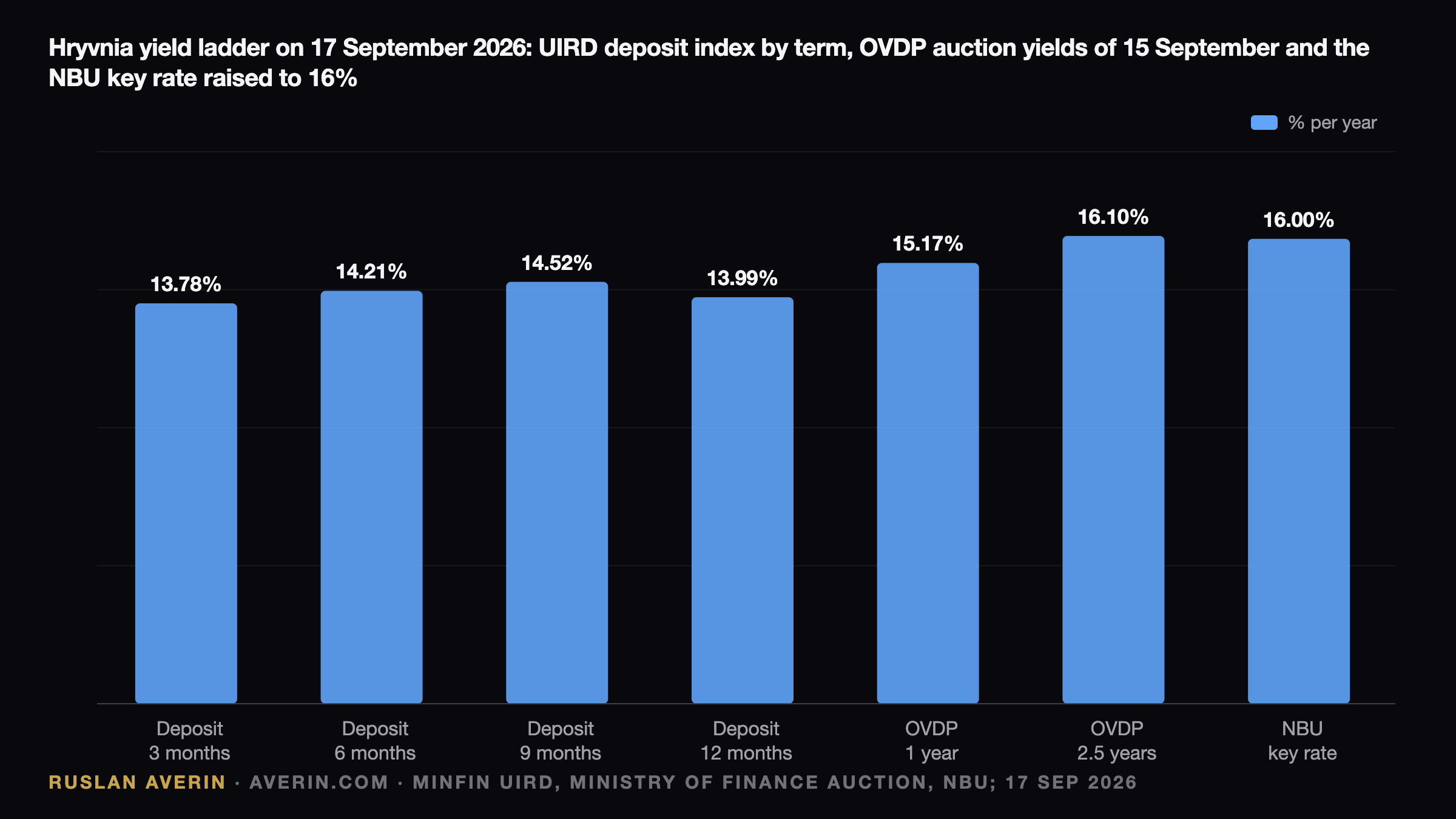
The Finance Ministry's auction on 15 September placed UAH 1.0 billion of one-year paper at 15.17% with bids 2.9 times the amount sold, plus UAH 1.014 billion of a 2.5-year bond to February 2029 at 16.10% with bids 1.2 times; the previous week raised UAH 1.74 billion. On 25 August the same tenors went at 15.18% and 15.64%, so the long end has repriced by half a point in three weeks.
Individuals now hold more than UAH 163 billion of OVDP, a record, up UAH 3.7 billion in August, with UAH 109.7 billion in "military" bonds against UAH 78.7 billion a year earlier. Banks hold UAH 926 billion, the NBU UAH 656 billion, companies UAH 214 billion and non-residents UAH 17 billion of a UAH 2 trillion market. Since January the state has borrowed more than UAH 343 billion domestically. The next auction falls on Tuesday 22 September.
Deposits Moved Before the Decision
The UIRD index on 17 September stood at 13.78% for three months, 14.21% for six, 14.52% for nine and 13.99% for twelve, unchanged on the day. Leading twelve-month offers: 17.50% at Unex Bank, 17.07% at O.Bank and Idea Bank, 17.00% at Accordbank, 16.80% at Europrombank and 16.75% at Altbank.
Globus Bank's Dmytro Zamotaiev maps typical ranges at 13.5–14.5% for three months, 14.5–15.5% for six and 14.5–16% for nine to twelve, with promotions to 17.5%, warning that "a mass increase in rates should not be expected; banks may change conditions selectively". Serhiy Mamedov of the Association of Ukrainian Banks agreed after the vote, while A-Bank's Oleh Tribulkin had backed the hike because July's half point never fully reached depositors.
Credit and Housing Barely Notice
The NBU insists "such a step will not have a noticeable restraining effect on lending" and records "the longest period of credit expansion": net hryvnia loans to business up 33% year on year in August, to households up 38%, with business deposits up 22% and household funds up 17%. New hryvnia business loans averaged 15.3% in the second quarter, 13.3% at foreign-owned banks.
The Cabinet answered the same afternoon with preferential loans of up to UAH 1 billion per group, carrying rate compensation of 5.5 percentage points, for fuel storage, processing and trade working capital. Market mortgages start at 16.99% and reach 20–23% with a 20% down payment and terms to 25 years. єОселя, untouched, issued 146 loans for UAH 308 million in the week to 15 September and 5,909 loans for UAH 11.7 billion since January, against a plan near 10,000 loans and UAH 20 billion; average size is about UAH 1.98 million, and the programme accounts for 93% of new mortgages.
The Signal for 29 October
With aid at $2.11 billion in August against $5.71 billion in July, analyst Ruslan Averin reads the move as a defence of the currency