A deadline measured in months, not years
Ukraine still has hundreds of millions of small paper notes outside the banking system, and a hard date is attached to them. The UAH 1, 2, 5 and 10 banknotes of the 2003–2007 designs stopped being legal tender on 2 March 2026. The universal right to walk into any bank branch and swap them expires on 26 February 2027 inclusive, now just under four months away.
The rules in NBU Resolution No. 14
The framework comes from NBU Board Resolution No. 14 of 17 February 2026, which the National Bank announced on 20 February. Its content is narrow but strict, and it has pushed the subject back into Ukrainian search trends as the bank window shortens.
- Scope: UAH 1, 2, 5 and 10 notes of the 2003–2007 designs, every year of issue.
- Payment status: not legal tender since 2 March 2026; shops, service businesses, banks and financial institutions do not take them for payments.
- Ordinary banks: free exchange until 26 February 2027 inclusive, one year after withdrawal.
- Authorised banks: Oschadbank, PrivatBank, Raiffeisen Bank and PUMB until 28 February 2029 inclusive, three years after withdrawal.
- The NBU: "currently without a time limit".
- Conditions: no fees, no ceiling on the sum exchanged.
One detail is frequently misread. The decisive factor is the design, not the date printed on the paper. A UAH 10 note of the 2004 design produced in a later year falls under the same rule.
How much paper is still unreturned
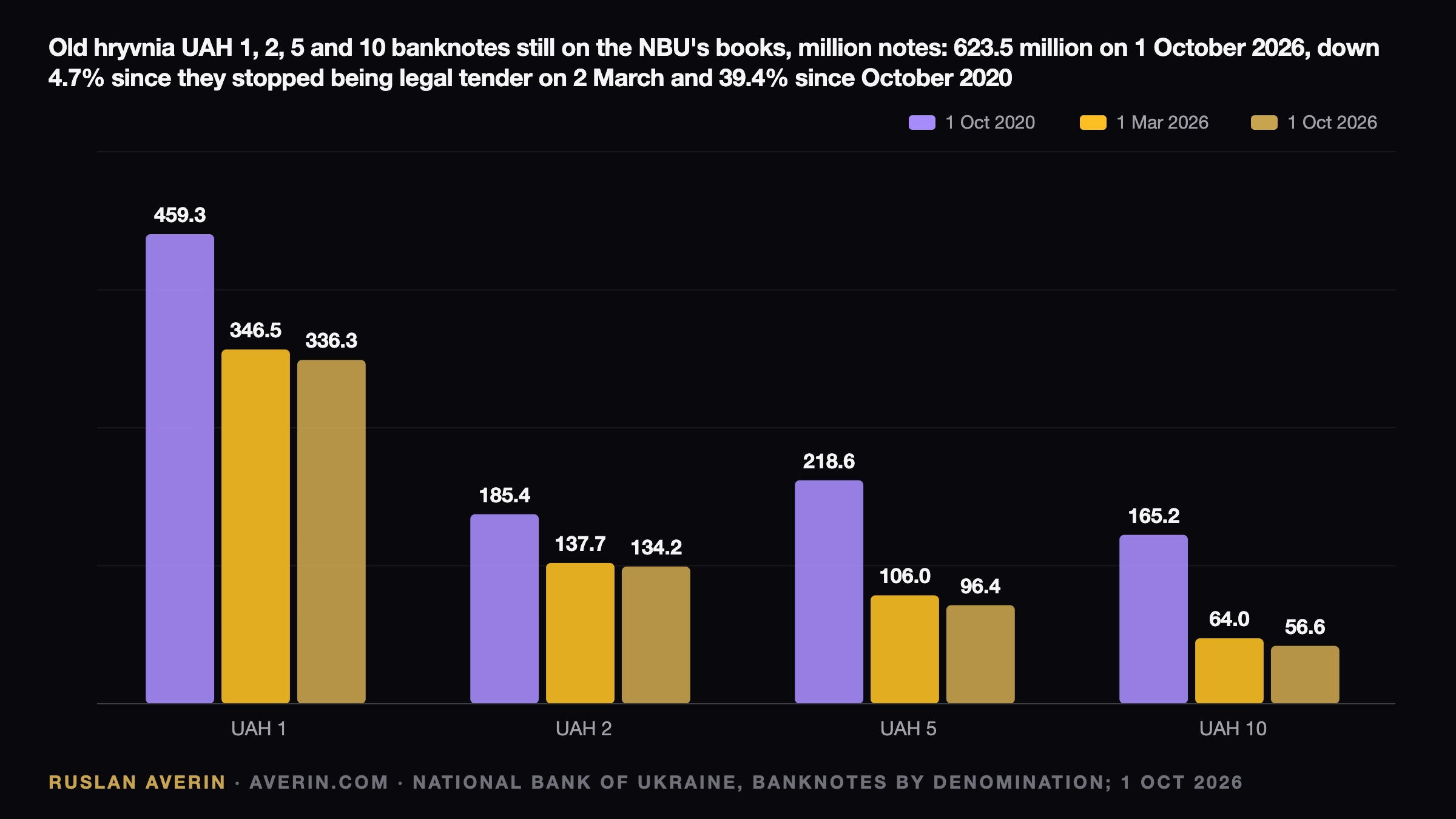
NBU cash statistics for 1 October 2026 show the stock that has been issued and not yet received back. The four denominations together account for 623.5 million notes with a face value of UAH 1.65 billion. That is 23.7% of all 2.63 billion hryvnia banknotes on the regulator's books by count, but only about 0.17% of their UAH 962.5 billion value.
| Denomination | Notes on 1 October 2026 | Change since 1 March 2026 | Coin in use since |
|---|---|---|---|
| UAH 1 | 336.3 million | under 3% decline | 27 April 2018 |
| UAH 2 | 134.2 million | under 3% decline | 27 April 2018 |
| UAH 5 | 96.4 million | 9.0% decline | 20 December 2019 |
| UAH 10 | 56.6 million | 11.5% decline | 3 June 2020 |
On 1 March 2026, the final reading before legal-tender status lapsed, the four denominations stood at 654.2 million notes. Seven months later the count was 30.7 million lower, a drop of just 4.7%. Measured from 1 October 2020, the six-year fall reaches 39.4%.
These figures track issuance minus returns, not wallets. In analyst Ruslan Averin's reading, the barely moving UAH 1 and UAH 2 counts — denominations pulled from bank cash desks back in 2020 — point to notes that are lost, worn past use or kept as souvenirs and will never be handed in.
Why coins replaced the paper
The National Bank gave three arguments. The small notes are almost absent from retail payments. Their average service life is roughly 2.5 years against 20–25 years for coins, so what remains in circulation is largely worn out. And counting, transporting and storing them imposes costs on the state, the banks and retailers alike.
The transition was gradual rather than sudden. Banks and the NBU stopped issuing the UAH 1 and 2 notes on 1 October 2020 and the UAH 5 and 10 notes on 1 January 2023. The paper had circulated for almost 23 years in total, the last eight of them side by side with coins of identical denominations.
The notes that remain valid money
A second group is routinely confused with the first. The UAH 20, 50, 100, 200 and 500 banknotes of the 2003–2007 designs — the third generation — are being withdrawn "gradually", yet they remain legal tender and require no special exchange. Because they are legal tender, they must be accepted in payment.
What changed is only cash-desk policy: banks ceased issuing the UAH 20 and 100 on 1 January 2023, the UAH 500 on 1 August 2024, and the UAH 50 and 200 on 1 November 2024. Notes returning to banks are retired and replaced by fourth-generation paper, with no end date announced.
Earlier designs are a separate story. First- and second-generation notes of UAH 1, 2, 5, 10, 20, 50, 100 and 200 issued before 2003 lost legal-tender status on 1 October 2020 and can be exchanged only at the NBU and the authorised banks, until martial law ends and for three months (90 days) afterwards. The UAH 2,000 note, circulating since 4 September 2026, is untouched by any of this.
Coins following the same path
- 1, 2 and 5 kopecks: withdrawn on 1 October 2019.
- 25 kopecks: withdrawn on 1 October 2020.
- 10 kopecks: gradual withdrawal since 1 October 2025; still a means of payment for now.
- Golden UAH 1 coin minted before 2018, including ordinary-quality commemoratives: gradual withdrawal since 1 October 2020, still circulating beside the silver-coloured 2018 version.
Exchange mechanics before and after the cut-off
Until 26 February 2027 every branch of every Ukrainian bank must take the UAH 1–10 notes of the 2003–2007 designs and give coins or banknotes of any denomination in circulation, with no limit and no commission. From 27 February 2027 the choice narrows to the four authorised banks, through 28 February 2029, and to the NBU, which operates exchange units in the Lviv, Dnipropetrovsk, Khmelnytskyi and Odesa regions and in Kyiv.
Worn, torn and deliberately spoiled notes
Damaged notes that are still legal tender fall under NBU Board Resolution No. 134 of 3 December 2018. Faded, soiled, torn or written-on notes must be accepted by shops in payment and by banks without limit, provided there are no signs of counterfeiting. Significantly damaged notes are accepted without limit if at least 55% of the original area survives in one piece, or if a note torn in two retains both identical serial numbers and the parts cover at least 55% of the area. Banks perform such exchanges free of charge.
Notes harmed by fire, flood or chemicals go to the NBU or the authorised banks for examination, which the regulator conducts at no cost, reimbursing the value of items confirmed as genuine. The wartime exception is firm: paper that banks intentionally spoiled under martial law — drilled, cut or stained so it could not be used if captured — is neither legal tender nor exchangeable, and the NBU recommends refusing it in payment.
The practical takeaway
For most households the amounts involved are trivial, which is precisely why the stock is draining so slowly. Averin notes that the cheapest moment to act is the current one, while any branch is obliged to serve the request; after February 2027 the same transaction requires finding one of four banks or an NBU unit in five regions.