A warning already sitting in the price
Few large banks walk into results season having pre-announced their own weakness. Bank of America did exactly that on 14 September, and the market repriced the shares immediately. The stock closed Monday 12 October at $54.58, which is 0.8% below the 2025 year-end close of $55.00 and 15.8% below the closing high of $64.81 recorded on 12 August.
The slide was not gradual. From $62.69 on 11 September the shares dropped to $59.47 on 14 September, a loss of 5.1% on volume roughly 86% above the three-month average. In total the stock has given back 12.9% since 11 September, erasing the gain from the second-quarter print on 14 July, when it rose 1.9% to close at $60.62.
What the numbers are supposed to show
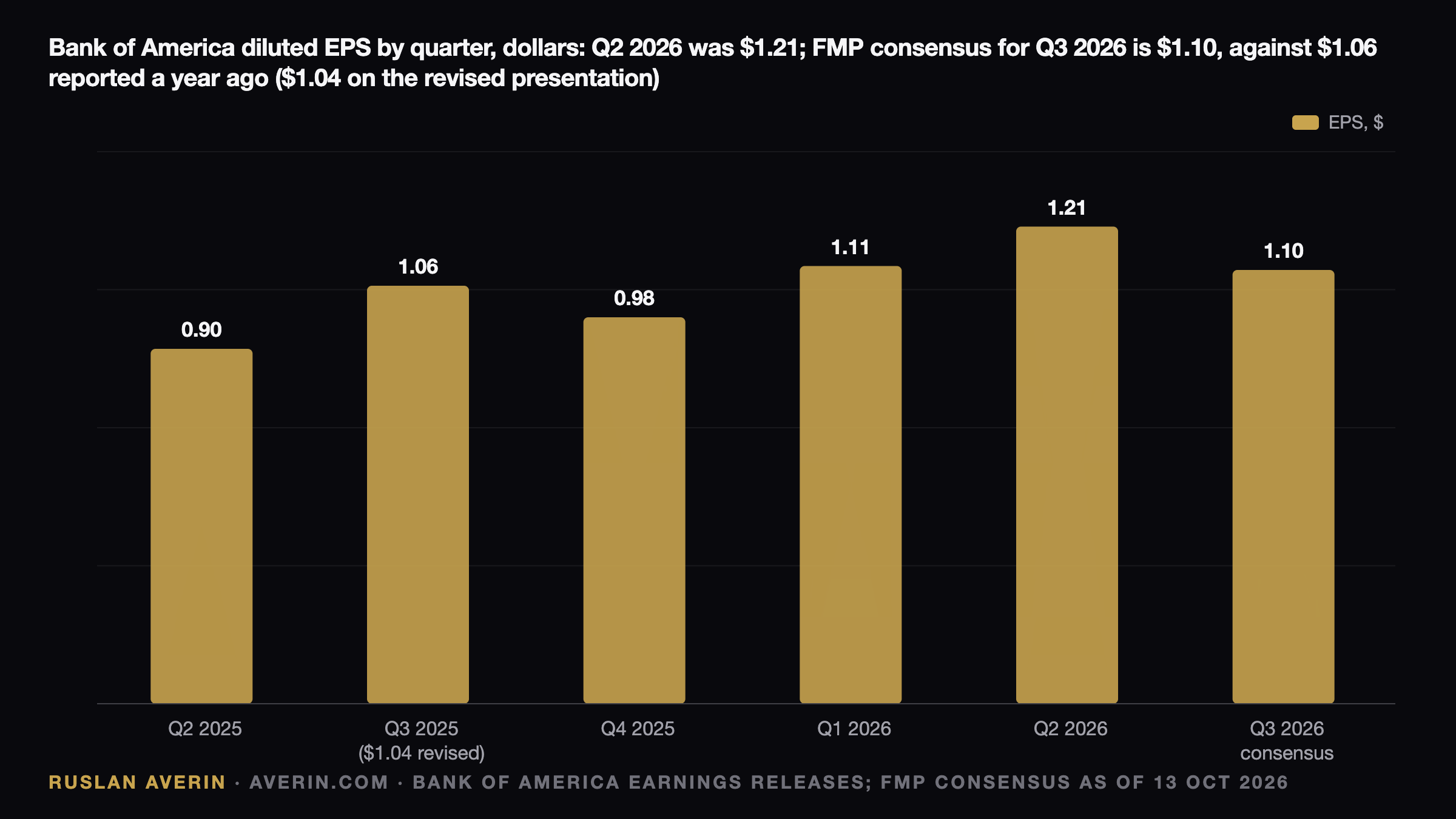
Consensus compiled by Financial Modeling Prep calls for EPS of $1.10 on revenue of $30.6 billion, drawn from 12 analysts on the earnings line, with a spread of $1.05 to $1.16. A separate dataset quoted by Tiger Brokers on 7 October points slightly higher, at $1.12 and $30.76 billion.
The comparison base requires care. Bank of America originally reported third-quarter 2025 EPS of $1.06 on revenue of $28.1 billion. In January 2026 it changed its accounting presentation and restated prior periods; the revised third quarter of 2025 shows revenue of $29.0 billion and net income of $8.3 billion, about $1.04 a share.
| Metric | Q3 2025 (revised) | Q2 2026 | Q3 2026 expectation |
|---|---|---|---|
| EPS | about $1.04 | $1.21 | $1.10 consensus |
| Revenue | $29.0 billion | $31.6 billion | $30.6 billion consensus |
| Net interest income | — | $16.0 billion | $16.3 billion threshold |
| Investment banking fees | $2.0 billion | $2.1 billion | $1.6–1.8 billion guided |
| Sales and trading | $5.4 billion | $7.1 billion | roughly flat year on year |
Measured against the restated base, $1.10 implies EPS growth near 6% and revenue growth near 5%. That is a marked deceleration from the second quarter, when EPS climbed 34% to $1.21 on revenue of $31.6 billion.
Net interest income has to do the heavy lifting
Second-quarter net interest income reached $16.0 billion, up 9% year on year, or $16.2 billion on a fully taxable-equivalent basis. Guidance has been raised three times: 5–7% growth for 2026 in January, 6–8% in April, and in July CFO Alastair Borthwick said the result would land at the upper end of 6–8%.
That forecast assumed one 25 basis point Federal Reserve hike in September. It arrived on 16 September, lifting the target range to 3.75–4.00%. Since net interest income was $60.1 billion in 2025, growth of 7–8% requires second-half income of roughly $32.6–33.2 billion, or about $16.3–16.6 billion per quarter.
The balance sheet remains asset-sensitive: the bank estimates a rate path 100 basis points above the forward curve would add about $1 billion of net interest income over twelve months. The counterweight is deposit pricing. Average deposits stood at $2.02 trillion in the second quarter, and the pass-through rate on the September hike is the single most informative disclosure of the morning.
The fee problem management flagged in advance
At the Barclays Global Financial Services Conference, Brian Moynihan said "what we're seeing is the market generally in investment banking is down 10% or so", citing Dealogic, and conceded the bank was "not as well positioned in some of the businesses that have more activity". Reports of that session put third-quarter investment banking fees at $1.6–1.8 billion, against $2.0 billion a year earlier and $2.1 billion in the second quarter.
Trading was framed as roughly flat year on year. The base is $5.4 billion, split between $3.1 billion in fixed income and $2.3 billion in equities, with equities up and fixed income down inside that quarter. Second-quarter trading revenue was $7.1 billion, up 33%, with equities up 70% to $3.6 billion.
JPMorgan co-president Doug Petno guided a day later to investment banking fees and Markets revenue rising by a mid-to-high-teens percentage. If the industry proves stronger than "down 10%", the issue becomes market share rather than the cycle.
Costs, credit and the capital cushion
Second-quarter noninterest expense was $18.6 billion, up 8%, with the efficiency ratio improving to 59%. Operating leverage was 6.6% in the quarter and more than 450 basis points across the first half, against a full-year target of 300–400 basis points. Borthwick dropped formal expense guidance, saying in July: "If the revenue isn't there, the expense will come down."
Credit has stayed unremarkable. Provision expense and net charge-offs were each about $1.4 billion in the second quarter, broadly flat sequentially, while card charge-offs and delinquencies improved year on year. Moynihan said in September that consumers "are still spending".
Capital return is the more dependable support. The CET1 ratio was 11.2% at end-June against a 10% minimum cited by management. The bank returned $8.0 billion in the second quarter, $6.0 billion in buybacks and $2.0 billion in dividends, with first-half repurchases of $13.2 billion and about $17 billion left on the $40 billion authorisation as of 30 June. The quarterly dividend rose 14% to $0.32 in July. At tangible book value of $29.37 per share, the stock trades near 1.9 times tangible book.
The checklist for Wednesday
JPMorgan, Wells Fargo and Citigroup report before the open on 13 October, with FMP consensus EPS of $5.93, $1.85 and $2.65 respectively. JPMorgan's fee line and any commentary on deposit costs after the hike will frame expectations a day early.
Analyst Ruslan Averin identifies four decisive readings: net interest income of $16.3 billion or better with the upper end of 6–8% intact; investment banking fees at or above the top of the $1.6–1.8 billion range; buybacks of at least $6 billion; and expenses near $18.6 billion with operating leverage still positive.
Much of the fee warning is already discounted. If net interest income and capital return land as guided, the share reaction should hinge on the 2027 outlook rather than third-quarter fees. The asymmetric risk is a trimmed net interest income forecast arriving alongside fees at the bottom of the range.