PLBY Group trades at $1.22, a market capitalisation of $141.5 million against trailing revenue of $122.3 million. The 52-week range runs from $1.081 to $2.750, so the stock sits near the bottom of it.
The company owns the Playboy brand and Honey Birdette, a premium lingerie retailer. What it is trying to become is a licensor rather than an operator.
Where the turnaround actually stands
| Metric | Value |
|---|---|
| Share price (7 Aug 2026) | $1.22 |
| Market cap | $141.5M |
| Revenue TTM | $122.3M |
| Shares outstanding | 116.0M |
| Q1 2026 revenue | $30.2M |
| Q1 2026 adjusted EBITDA | $5.0M, up from $2.4M |
| Q1 2026 net loss | −$4.0M, improved from −$9.0M |
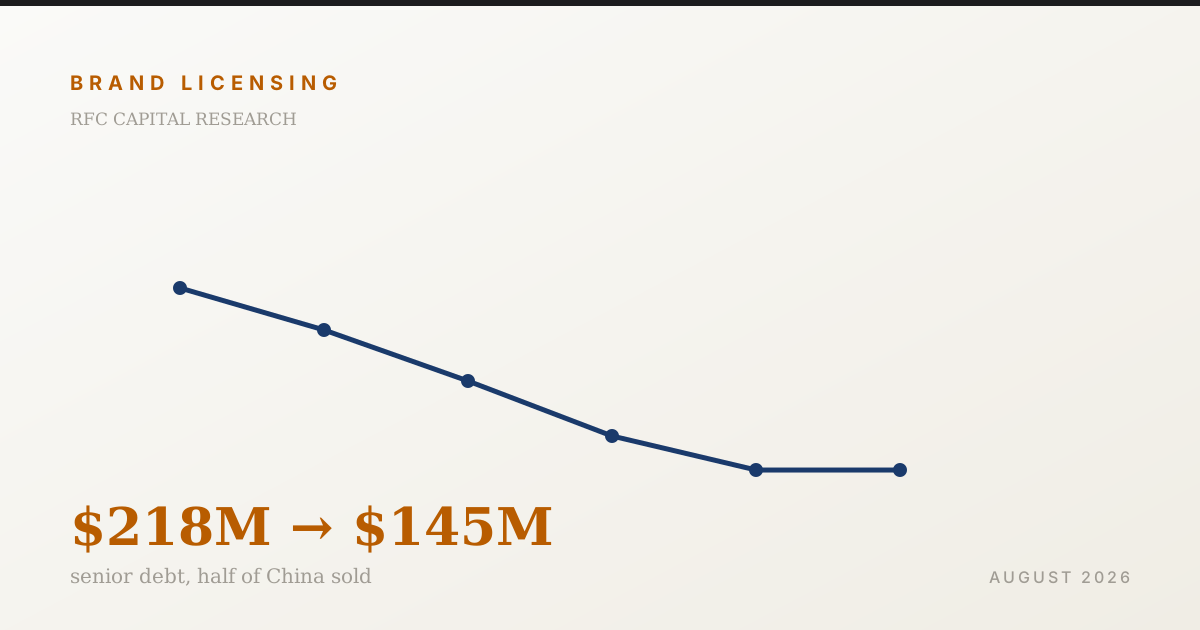
| Senior debt | $218M → $145M, target ~$108M by Q1 2028 |
Operating expenses fell 9% to $31.9 million. Management reports five consecutive quarters of positive adjusted EBITDA and describes the company as having moved from turnaround to growth.
The China transaction is the substantive event
PLBY sold a 50% stake in its China business for $45 million in cash plus $67 million in guarantees.
Read that structurally rather than as a headline. The company converted half of a growth market into cash in order to retire debt. That is what a balance sheet under pressure looks like when it is being repaired responsibly: you sell the option to fix the obligation.
It is the right sequencing — debt maturities are dated, brand potential is not — but it does mean the eventual upside from China accrues half to someone else. A turnaround financed by selling the future is a smaller company on the other side of it.
Where the model works and where it does not
The licensing business carries roughly 90% gross margin and more than $330 million in unrecognised revenue — contracted amounts not yet run through the income statement. That backlog is the single best asset in the story, because it converts to revenue with almost no incremental cost.
Then the awkward number: licensing revenue in the quarter was $10.9 million, down 5%.
That is the entire investment question in one line. The strategy is to become a high-margin licensor. The licensing line is shrinking. Everything else — debt reduction, cost cuts, the China cash — buys time for that line to turn. None of it substitutes for the turn itself.
What has to be true
Licensing has to grow again. Not stabilise. Grow. At 90% margin, each incremental licensing dollar is worth several dollars of Honey Birdette revenue, and the debt path assumes the engine works.
Honey Birdette has to hold. It is the direct-to-consumer piece and it carries inventory, stores and working capital — the opposite of asset-light. If it deteriorates while licensing is still soft, the cash that services debt has to come from somewhere else.
The brand has to retain licensing power. This is the unquantifiable one. Playboy is a recognised mark globally, which is why licensees pay. Brand equity built decades ago depreciates quietly, and a licence renewal cycle is where you discover how much has gone.
How to read it
At $141.5 million of market capitalisation against $145 million of senior debt, roughly half the enterprise belongs to lenders. Equity in that position is leveraged to the outcome: if licensing turns and debt reaches $108 million, the equity re-rates disproportionately. If licensing keeps sliding, the same leverage works against it, and asset sales become the recurring source of cash rather than a one-time repair.
Analyst consensus points to about $2.83, implying roughly 132% upside. Treat that as a statement about the spread of outcomes rather than a forecast. This is a binary-ish microcap where the debt schedule and the licensing line resolve in opposite directions, and the position size should reflect that rather than the target price.