The Bank of England spent more than a year, two public consultations and roughly half a million votes to conclude that its next banknotes should show wildlife rather than people. The result, published on Thursday 8 October, ends the era of Winston Churchill, Jane Austen, J.M.W. Turner and Alan Turing on sterling paper. For anyone holding pounds in cash, the decision changes nothing today — and something specific later.
Four creatures, four denominations
The chosen quartet is the European hedgehog, the buff-tailed bumblebee, the barn owl and the Atlantic puffin. Each will occupy one denomination, replacing Churchill on the £5, Austen on the £10, Turner on the £20 and Turing on the £50. The Bank has not disclosed which animal goes where; that allocation is reserved for an announcement closer to launch.
The reverse changes; the front does not change in principle. The Bank confirmed that the next series "will continue to include a portrait of the monarch", meaning King Charles III. Additional natural imagery may also feature, including some shortlisted species that failed to reach the final four.
Timing is intentionally loose. The first denomination is due "over the next few years", because designing, testing and printing a note takes several years. No date, no opening denomination and no price tag for the redesign have been published.
The consultation that produced the shortlist
Work started in July 2025, with resilience against counterfeiting given as the stated goal, and the public was asked to nominate a theme. That round drew more than 44,000 responses. In March 2026 the Bank settled on nature, the option put forward by 60% of respondents.
A panel of UK wildlife experts then assembled a shortlist of 18 animals in three groups: mammals; birds; and amphibians, insects and fish. The public vote ran from 3 June to 3 July 2026 and attracted 478,531 responses containing 2,549,003 individual selections — the largest participation the Bank has ever recorded for a banknote imagery consultation.
| Animal | Votes received |
|---|---|
| Buff-tailed bumblebee | 360,399 |
| Barn owl | 270,596 |
| European hedgehog | 259,665 |
| Red fox | 244,651 |
| Common kingfisher | 211,277 |
| Atlantic puffin | 183,137 |
The arithmetic shows the puffin finishing behind both the red fox and the common kingfisher. It was selected as the most popular marine animal, on the argument that it adds variety, helps users distinguish denominations and represents the coastline. The vote was advisory rather than binding, which is how a sixth-placed bird ended up on a banknote.
The political objection to dropping Churchill
Criticism arrived before the animals were even known. In June, Reform UK leader Nigel Farage said that "replacing Winston Churchill with a picture of a beaver on our banknotes... is the definition of woke". Robert Jenrick, Reform's Treasury spokesman, accused the Bank of wasting resources, and Conservative MP Tom Tugendhat described the direction as "bland neutrality".
The Bank's defence rests on two points: the theme emerged from public consultation rather than separate focus-group research, and counterfeiters have grown more capable at reproducing human faces. Chief Cashier Victoria Cleland said the near half-million responses demonstrated that "cash still matters". She hands over to Rhys Phillips on 19 October.
Used less at the till, hoarded more at home
Two data series point in opposite directions. UK Finance records cash as 3.9 billion payments in 2025, equal to 8% of all payments, down from 9% in 2024 and from 45% in 2015. Around 19 million people, roughly a third of adults, reach for cash once a month or less.
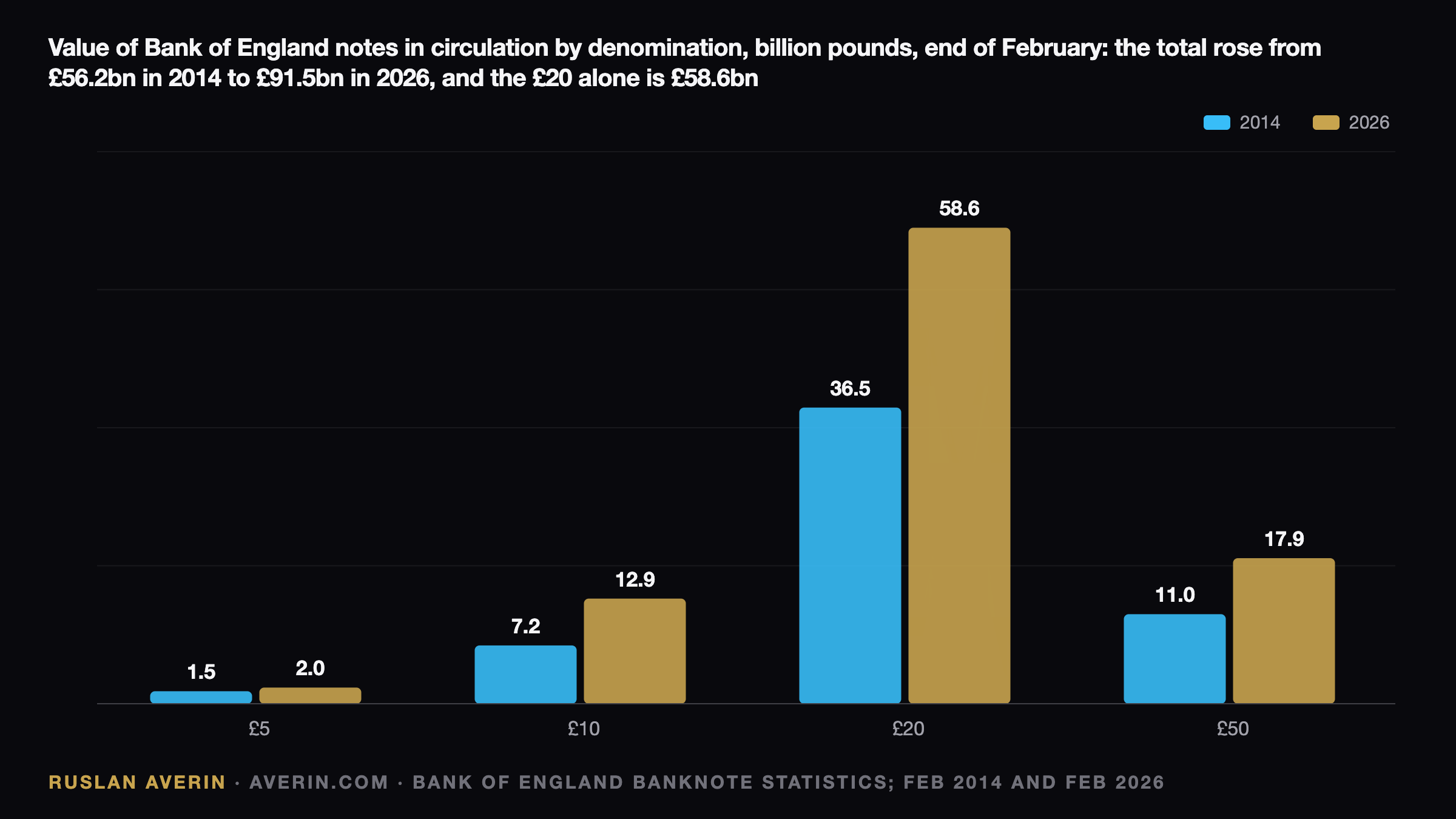
Yet the stock keeps expanding. At the end of February 2026 there were 4,984 million Bank of England notes outstanding, worth £91.5 billion, against 3,071 million notes worth £56.2 billion in 2014. The £20 dominates at £58.6 billion, about 64% of total value. In the reading of analyst Ruslan Averin, that gap confirms cash has migrated from spending to storage, at home and abroad. The Bank still identifies roughly one person in seven who prefers paying with cash.
Validity and the historical pattern
Nothing announced withdraws any note. Churchill, Austen, Turner and Turing polymer notes stay legal tender, as do notes bearing Queen Elizabeth II. King Charles III notes, issued from 5 June 2024, circulate beside them, printed only to replace worn stock and meet extra demand.
When the animal series arrives, old polymer notes will co-circulate for a period. Precedent indicates eventual withdrawal: paper £5 (Elizabeth Fry) ceased to be legal tender on 5 May 2017, paper £10 (Charles Darwin) on 1 March 2018, and paper £20 (Adam Smith) together with paper £50 (Boulton and Watt) on 30 September 2022. The protection for savers is explicit — "There is no deadline to exchange old banknotes with the Bank of England." A withdrawn note retains face value; it simply must pass through the Bank, a UK bank or the Post Office.
Exchanging sterling from outside the UK
The first step is an inventory. Paper notes create the problem; polymer notes, including every Churchill, Austen, Turner and Turing note, are fine for now. Exchange offices outside the UK frequently refuse withdrawn notes or quote far below face value.
Withdrawn notes can go by post to Dept NEX, Bank of England, Langston Road, Loughton, Essex IG10 3TN, accompanied by the exchange form, copies of photo identification and proof of a permanent address, which may be non-UK. Above £700, documentation on the source of funds is mandatory: bank statements, a will or probate, or a signed gift letter.
Payment comes by sterling cheque or SWIFT transfer to an overseas account accepting sterling. The Bank charges no SWIFT fee, though intermediary banks may. Delays reach up to 90 working days, and parcels travel at the sender's risk, so tracking and insurance matter.
In London, the Threadneedle Street counter opens Monday to Friday, 9:30am to 3pm, and can credit a UK or overseas account. Original identification and proof of address are required, with anti-money-laundering and sanctions checks applied. Anyone bringing £10,000 or more into Great Britain must declare it to customs, and the Bank requests that form. For £300 or less with photo identification, the Post Office is fastest; 51 branches serve people without a UK bank account.
What collectors actually pay for
Rarity, not nostalgia, sets auction prices. When the Churchill £5 launched, the Bank's charity sale with Spink on 3 October 2016 placed note AA01 000017 at £4,150 against an £800–£1,200 estimate; 601 notes raised £203,820. The 2024 auction of the first King Charles notes raised £914,127, or 11.7 times their £78,430 face value, with a £10 numbered HB01 00002 reaching £17,000 and £5 notes ending 88 and 888 selling for £2,200 and £2,400.
Against 399 million £5 notes and 2,932 million £20 notes in circulation, being the final portrait series confers no scarcity. Analyst Ruslan Averin regards sterling cash as a reserve rather than an investment, arguing that the genuine risk for overseas holders is not the hedgehog but a drawer of withdrawn paper notes that local exchangers will not accept at face value.