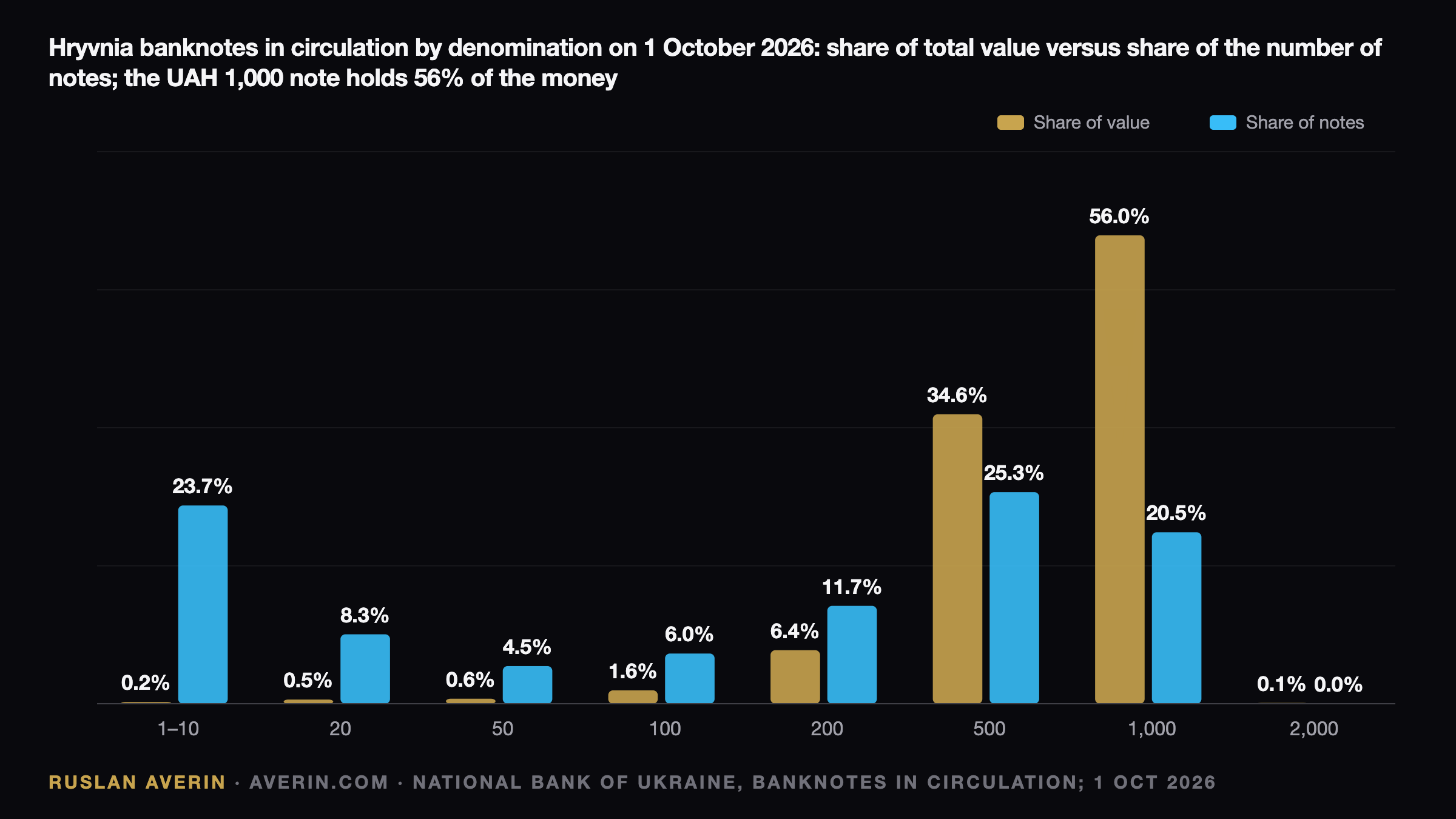
Ukraine's cash circulation has quietly become a two-denomination system. Of the UAH 962.5 billion in banknotes spread across 2.63 billion physical notes on 1 October, the UAH 1,000 and UAH 500 pieces together carry 90.6% of the value. That concentration, rather than any inflation scare, is the proper lens for reading the National Bank's decisions on denominations.
The regulator's answer on the largest note
On 12 October, deputy governor of the National Bank of Ukraine Volodymyr Lepushynskyi told Novyny.LIVE, in comments reported by TSN, that no UAH 5,000 banknote is planned. His reasoning was operational: cash circulation shows no real need for it. New denominations, he said, are introduced only on the basis of actual cash demand and the growth of the economy, and the NBU sees no preconditions for a return to the 1990s.
The statement echoed an earlier correction. On 18 November 2025 the NBU labelled a viral video of a supposed "new UAH 5,000 note" fake. The object shown was a 2008 presentation sample named after Panteleimon Kulish, produced by the NBU's Banknote and Coin Factory to demonstrate printing technology. It bears no denomination, is marked as not a means of payment, and was distributed only in souvenir booklets.
Where UAH 973 billion actually sits
Total cash in circulation stood at UAH 973 billion on 1 October, up by UAH 46.7 billion, or 5%, since the start of the year. Banknotes account for UAH 962.5 billion of that total, with coins making up the remainder. The distribution across denominations is sharply uneven, and that imbalance is the operational core of the entire denomination debate.
| Denomination | Share of notes by count | Share of value |
|---|---|---|
| UAH 1,000 (539 million notes) | 20.5% | 56.0% |
| UAH 500 (666 million notes) | 25.3% | 34.6% |
| UAH 200 | 11.7% | 6.4% |
| UAH 1 to 100 combined | 42.5% | 2.9% |
The table shows why small notes no longer drive logistics. Nearly half of all pieces in circulation carry under 3% of the money. Moving, counting and storing cash has become a business built around two denominations. The NBU stopped printing new UAH 200 notes from 2023 and UAH 100 notes from 2024, according to Minfin, drawing on existing stocks when replacement is needed.
The UAH 1,000 took over in four years
Introduced in 2019, the UAH 1,000 note held just 18.5% of banknote value on 1 October 2022, while the UAH 500 held 55.6%. The crossover came in January 2025, when the larger note overtook the smaller one by value. Over the past twelve months the value of UAH 1,000 notes rose 21.3%, while the value of UAH 500 notes fell 3.3%.
Aggregate banknote value grew 9.2% between 1 October 2025 and 1 October 2026, and 54.6% since 1 January 2022, before the full-scale invasion. The average note is now worth roughly UAH 366, against about UAH 211 at the start of 2022. September itself saw a decline, from UAH 971.5 billion on 1 September to UAH 962.5 billion on 1 October.
A new note with a very small footprint
On 4 September 2026 the NBU put the UAH 2,000 banknote into circulation, carrying a portrait of the poet and dissident Vasyl Stus. Governor Andriy Pyshnyi explained the trigger: UAH 1,000 notes made up more than 55% of the total value of banknotes in circulation, a threshold that in central-bank practice signals demand for a higher denomination.
Adoption remains minimal. NBU banknote statistics recorded 366,100 notes of UAH 2,000 worth UAH 732 million on 1 October. Economichna Pravda, citing the regulator, rounded this to roughly 400,000 notes and UAH 700 million, equal to 0.01% of all banknotes. The NBU said distribution would be gradual, with several million pieces produced during 2026.
Prices and the rate keep the rumour alive
Consumer inflation reached 10.0% year on year in September, up from 8.1% in August, according to the State Statistics Service, with prices rising 2.1% in the month alone. Core inflation was 8.8%. The NBU raised its key rate to 16% on 17 September. The hryvnia touched its weakest official level of 45.0564 per dollar on 6 October.
At the official rate of UAH 44.95 for 13 October, the UAH 2,000 note is worth about $44.50 and the UAH 1,000 about $22. A UAH 5,000 note would come to roughly $111, approximately one $100 bill. When the top denomination buys less than half a $100 bill, buyers of a car, a flat deposit or a generator carry thick stacks.
Foreign benchmarks point the other way
The European Central Bank decided in May 2016 to stop producing the €500 note, citing concerns it could facilitate illicit activities, and ended issuance around the end of 2018, though the note remains legal tender. The largest euro note still issued, the €200, equals about UAH 10,048 at the NBU's official euro rate of UAH 50.24 for 13 October. Even a UAH 5,000 note would be half that.
Russia offers a sharper contrast. Cash outside the Bank of Russia rose 20.9% in a year, reaching 22.23 trillion rubles on 1 October. Hryvnia banknotes grew 9.2% over the same period, close to the 10% inflation rate, leaving Ukraine's cash stock roughly flat in real terms while Russia's expanded. The Bank of England's animal-themed redesign is a reminder that most note changes concern security and design, not size.
The 1993 comparison does not hold
In 1993, according to the NBU, inflation on the karbovanets reached about 10,000% a year. The largest karbovanets note, 1,000,000, appeared in 1995, and the September 1996 reform replaced the currency with the hryvnia at 100,000 to 1. Today's 10% is a thousand times smaller, and Phillip Cagan's academic threshold of more than 50% monthly inflation sits far above September's 2.1%.
What the data does show is steady erosion. At 10% inflation, UAH 10,000 held in cash loses roughly a tenth of its purchasing power within a year. In analyst Ruslan Averin's view, the practical household question is how much cash to keep for blackouts and emergencies and where to hold the rest. The NBU's next rate decision later in October and its macro forecast on 29 October will set the tone.