A Fed decision and an earnings release that read as one document
Lennar published third-quarter results roughly two hours after the Federal Reserve raised rates on Wednesday, and the sequencing mattered. The builder earned $1.19 a share in the quarter ending 31 August, missed on both revenue and orders, and trimmed its full-year delivery target for the second time in 2026. The following morning Freddie Mac printed a 30-year mortgage at 6.95%, up from 6.76% the prior week, while Mortgage News Daily's daily index already read 7.24%.
Management's framing was compact: "Given continued pressure on interest rates and the deterioration in market conditions through the quarter, we are moderating our target full-year 2026 deliveries." The question going into the print was whether volume could be defended without surrendering margin. Volume held, deliveries landed inside guidance, and the margin stopped falling. Demand for future quarters is what cracked.
Scorecard for the quarter
| Metric | Q3 FY2026 | Q3 FY2025 | Change |
|---|---|---|---|
| Total revenue | $8.05B | $8.81B | −8.7% |
| Net earnings | $284M | $591M | −52% |
| EPS, GAAP / adjusted | $1.19 / $1.23 | $2.29 / $2.00 | −48% / −38.5% |
| Deliveries | 20,840 | 21,584 | −3.4% |
| New orders | 20,879 | 23,004 | −9.2% |
| Average sales price | $372,000 | $383,000 | −2.9% |
| Gross margin on home sales | 15.8% | 17.5% | 1.7 percentage points lower |
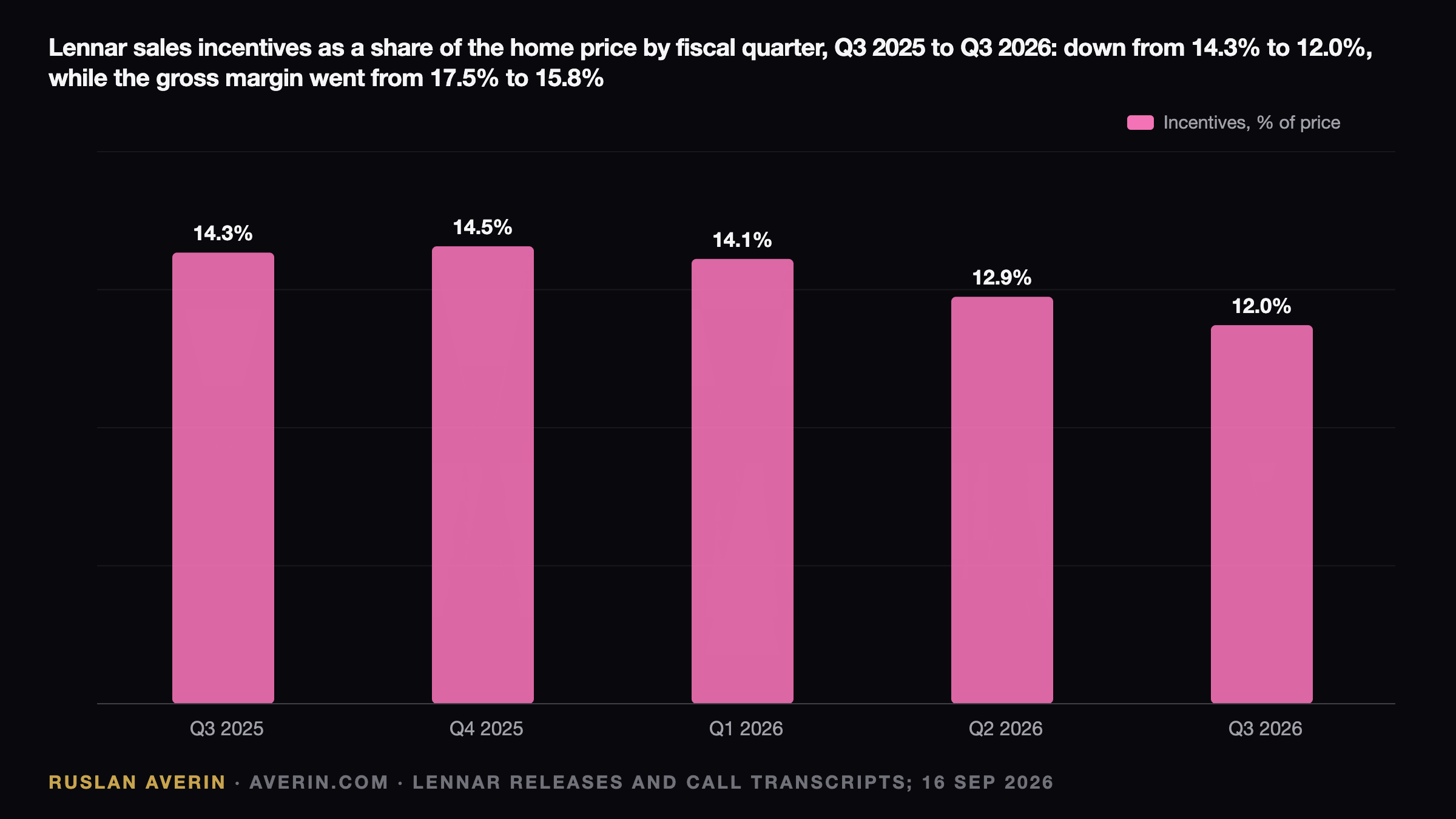
| Incentives, % of price | ~12.0% | 14.3% | 2.3 percentage points lower |
| SG&A, % of home sales | 9.2% | 8.2% | 1.0 percentage point higher |
| Net margin on home sales | 6.6% | 9.2% | 2.6 percentage points lower |
| Backlog | 16,857 homes / $6.35B | 16,953 / $6.65B | −0.6% / −4.6% |
Street expectations sat near $1.28–1.30 on adjusted EPS and $8.32–8.37 billion of revenue, so both lines came in 4–5% short. The adjusted number excludes $53 million of mark-to-market losses on technology investments — a year ago the same line produced $99 million of gains — plus $39 million of one-time financial services items. The tax rate moved to 26.4% from 24.4%, attributed to the Millrose spin-off. Through nine months, earnings stand at $3.36 a share versus $6.06 in 2025.
Mix is doing the work, and the damage
Regional order data show the affordability strategy functioning and the revenue mix eroding simultaneously. The West, averaging $552,000, produced 4,319 orders from 425 communities. South Central, averaging $227,000, produced 6,100 from 479 communities. Cheaper product sells in greater volume, which supports absorption while pulling the average price down.
Operationally the machine ran well. Starts pace and sales pace both registered 4.1 homes per community per month across 1,713 communities. Construction cost per square foot fell 1% sequentially, 6% year on year and 14% against the Q4 2023 baseline. Cycle time set a record at 116 days, from 121 last quarter and 126 a year earlier. Completed unsold inventory eased to 1.8 homes per community from 2.1. Of roughly 488,000 homesites owned and controlled, under 2.5% sit on the balance sheet.
Reading the CEO's language
Stuart Miller, sole CEO since Jon Jaffe retired at the end of 2025, acknowledged the shortfall directly: "While our earnings of $1.19 per share were below expectations, they reflect the nature of the environment in which we are operating, which has deteriorated since our last earnings call." He put the 30-year rate at approximately 6.8% at quarter end "and even higher since," tying the move to inflation above target, geopolitical tension and higher oil prices, alongside weaker consumer confidence.
The incentive story is where the wording repays attention. In June Miller called the decline to 12.9% "the first real and potentially sustainable decline" after three years of increases. Incentives fell again to about 12.0% and gross margin rose sequentially to 15.8% from 15.6%. Yet the release also cites "base price adjustments necessary to sustain volume." Lower incentives paired with lower list prices is a relabelling rather than a genuine recovery, and the 2.9% drop in average price to $372,000 indicates which occurred. No cancellation rate was disclosed and no 2027 comment was offered.
Guidance, cash and capital returns
Fourth-quarter guidance covers 22,000–23,000 deliveries, 19,500–20,500 orders, an average price of $370,000–380,000, a gross margin of 15.5–16.0% and SG&A "toward 8.7% to 9.0%." Full-year deliveries drop to 80,000–81,000 from 82,000–83,000. Implied full-year orders of roughly 80,600–81,600 mean the company sells what it builds and nothing more.
Financing the volume-first approach shows up in the balance sheet. Homebuilding cash fell to $1.15 billion from $3.44 billion at the end of November; debt climbed to $4.3 billion with $650 million drawn on the revolver after $400 million of 5.25% notes were repaid. Net debt to total capital is 12.7% against 2.8% in November. Buybacks totalled 3.0 million shares for $256 million at an average $85.49, versus 4.1 million for $507 million at $122.97 a year ago. The dividend stays at $0.50 a quarter, a 2.54% yield at $78.65.
Shares slid while the group rallied
LEN closed Wednesday at $78.36, down 2.1% in the Fed sell-off, fell 2.6% after hours to $76.34, then opened Thursday at a 52-week low of $76.07 within a $76.07–139.44 range. By midday it traded at $78.65, up 0.4%, on roughly two and a half times normal volume. The stock is down more than 40% in 2026 at 14.8 times trailing earnings of $5.28.
Peers moved the other way: D.R. Horton rose 1.9% to $141, Toll Brothers 2.0% to $135.27, PulteGroup 1.5%, NVR 0.8% and KB Home 0.6% ahead of its 22 September report, with ITB and XHB up about 0.9%. The 10-year fell six basis points to 4.94–4.98%, its first decline in nine sessions. Targets have been cut — Truist to $75, BofA to $70, BTIG at $67 — while Goldman holds $100 against a MarketBeat consensus of "Reduce," 10 sells to one buy.
The demand backdrop confirms the print
September's NAHB index fell to 32 from 35 against a consensus of 34, the weakest since September 2025, with current sales 35, expectations 37 and buyer traffic 23. Thirty-eight percent of builders cut prices, averaging 6% for a sixth straight month, and 66% used incentives, the most since December. NAHB's Bill Owens attributed weaker traffic largely to rising mortgage rates.
August starts reached 1.275 million, down 2.6%, though single-family starts rose 7.6% to 918,000; permits slipped to 1.394 million and completions fell 11.9% to 1.128 million. Existing-home sales totalled 3.98 million, the fewest since June 2025, at a median $429,100, up 1.6%, with 4.9 months of supply. Pending sales rose 0.3%. MBA's purchase index is 19% below last year and refinancing 65% lower at a 6.97% contract rate. Bright MLS's Lisa Sturtevant said the hike "all but guarantees" borrowing costs "will remain stuck at or above the 7% threshold."
The conclusion drawn from the data
Analyst Ruslan Averin describes Lennar as a bond proxy with a construction business attached: earnings now track the 10-year, and margin is capped by whatever incentive keeps absorption at 4.1 sales per community each month. That is a description, not an indictment. Miller's claim that "the fundamental shortage of housing in America has not been solved" holds, and a builder running 116-day cycle times is positioned to capture the upturn.
The upturn, however, is a rates event, and the post-decision dot plot leaves the funds rate at 4.1% through 2027. The signal worth watching is the fourth-quarter order print: guidance of 19,500–20,500 with a result above 21,000 while incentives stay near 12.0% would show demand clearing at current prices without deeper discounting.