The number that matters is on the reserves line
September's viral figure was 45,000 — the cost of a thousand dollars after PUMB's cash desk quoted exactly 45.00. That was one bank on one morning. The National Bank's official rate for Friday was 44.66, six kopecks higher, and the average across banks was 44.42 to buy against 44.92 to sell, putting a thousand dollars at UAH 44,430. Exchange offices worked 44.70–44.85, PrivatBank sold at 44.84, monobank at 44.83.
The more consequential number sits elsewhere. International reserves stood at $48.66 billion on 1 September, down 5.0% in August and 15% since January — roughly four months of imports, and $8.6 billion lighter than at the start of the year. The rate is stable because that line is falling.
Eight weeks of billion-dollar weeks
The National Bank has sold more than $1 billion net every week for eight consecutive weeks. The sequence from index.minfin runs $1.01 billion in the week of 20–24 July, then $1.14 billion, $1.02 billion, $1.10 billion, $1.19 billion, $1.27 billion, a run-record $1.33 billion in the week of 31 August to 4 September, and $1.19 billion in the week to 11 September. August cost $4.8 billion, following $5.09 billion in June and $4.79 billion in July; purchases back came to $0.45 million. Since January: $33.9 billion.
August reserves fell from $51.2 billion to $48.66 billion because aid thinned while interventions did not. Inflows to government foreign-currency accounts were $927 million, of which the World Bank supplied $894 million; total assistance received was $2.11 billion, against $5.71 billion in July and $18.0 billion in the second quarter. Interventions took $4.85 billion, debt service another $722 million. The EU's second macro-financial instalment of about €3.7 billion is "expected in September" and was unconfirmed as of Thursday.
Demand that a key rate cannot reach
The January–August goods trade deficit reached $39.7 billion, with imports at $66.3 billion, up 26%, and exports at $26.6 billion, up 1.1%. Importers are front-loading winter: Taras Lesovyi of Globus Bank cites energy resources, fuel and equipment, with diesel up about 22% in a month at the pump and A-95 up 9%, while the September grain export outlook was trimmed from 43 to 38–40 million tonnes after port strikes.
Households are the second leg. The online purchase limit rose from UAH 50,000 to UAH 200,000 a month on 11 August; non-cash buying jumped 40% in August to $552 million, and net household purchases hit $562 million after $446.6 million in July — a twelfth straight month of net buying. On the interbank, clients bought $385.6 million a day against sales of $221.7 million, a gap near $164 million that Serhiy Mamedov puts at 15–20% excess demand.
Former NBU Council chair Bohdan Danylyshyn, writing on 15 September, framed the limit plainly: "A high key rate has not removed the structural shortage of currency... A high rate can restrain part of the demand, but it does not unblock the ports." He also flags consumer lending growing 36.3% a year.
What the regulator chose
The key rate went from 15.5% to 16%, effective 18 September, a move the National Bank said "will support the attractiveness of hryvnia assets and the stability of the FX market". Governor Andriy Pyshnyi cautioned that "the inflation trajectory in the coming months may be higher than the previous forecast envisaged", with a further increase possible. The Council reaffirmed managed flexibility on 3 September: two-way fluctuations allowed, no return to a fixed rate. Lesovyi called the public mood "cognitive dissonance: prices are rising, yet exchange rates remain relatively stable".
Where the path is expected to run
| Forecaster | September | End-2026 | 2027 |
|---|---|---|---|
| Globus Bank, Taras Lesovyi | 44.7–45.4; cash up to 45 | — | — |
| Globus Bank, Serhiy Mamedov (17 Sept) | 44.6–45.4 | 45.5–46.5 | — |
| ICU, Taras Kotovych | 44.5–45.0 | 45.8 | 49.8 |
| Andriy Shevchyshyn | cash 45.20–46.00 (base case) | — | — |
| CES consensus, six houses | — | median 46.0 (range 45.6–46.3) | median 49.0; Dragon 49 / 53 |
| Government, draft budget 2027 | — | average 45.7 | average 47.1; end-year 48.3 |
| IMF, WEO | — | average 45.4 | average 47.5 |
| NBU, July forecast | — | reserves $69.7 billion | reserves $73.7 billion |
No published view sees strengthening. The government calls its 47.1 average and 48.3 year-end figures "a calculation parameter, not a forecast or a target for the NBU". The July reserves projection of $69.7 billion assumes roughly $54 billion of direct budget support during 2026; $31.3 billion arrived through August, leaving about $22 billion for four months.
The rate's journey and its price tag
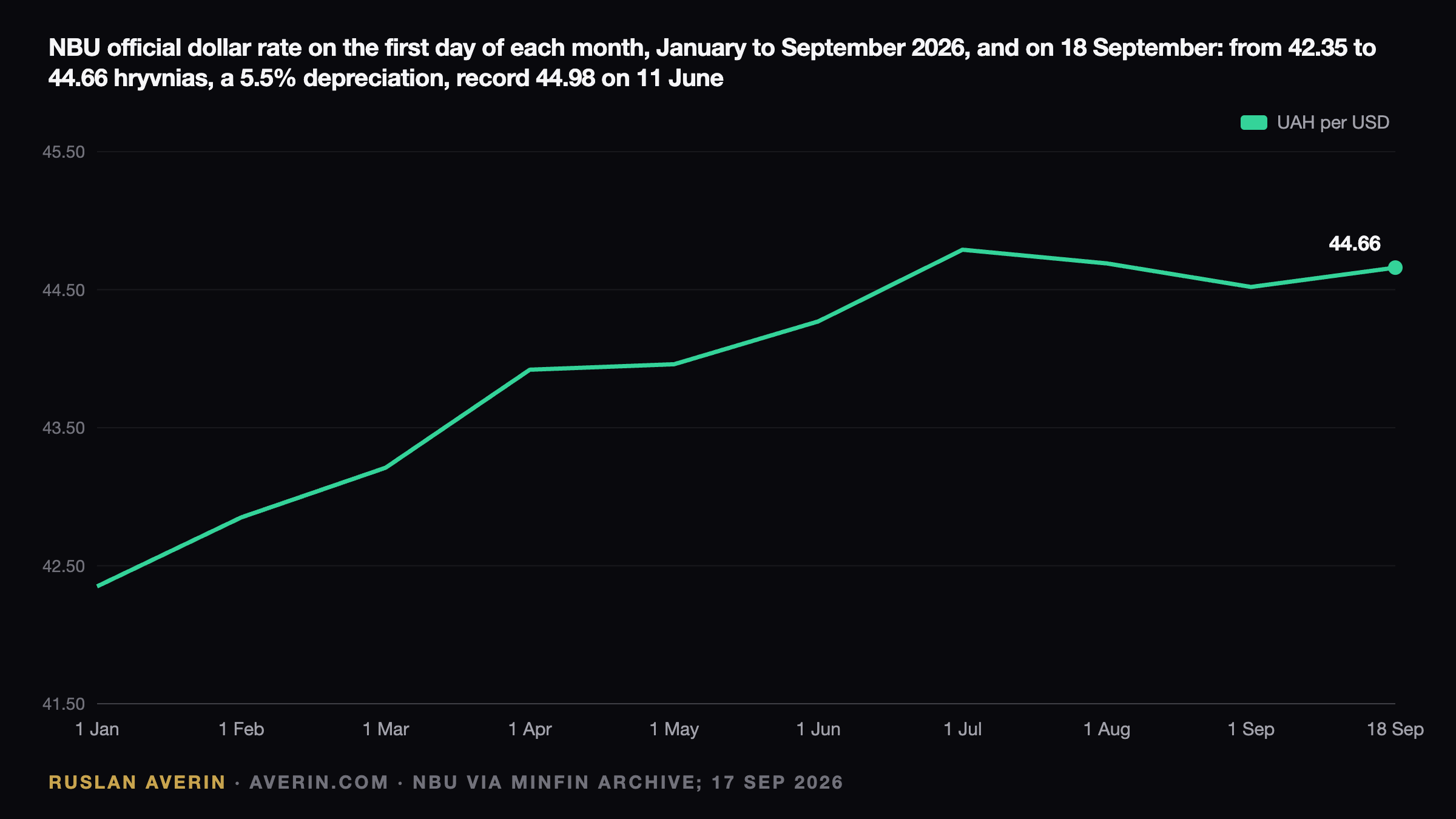
The dollar opened 2026 at 42.35, then 43.21 on 1 March, 43.96 on 1 May, 44.27 on 1 June, 44.79 on 1 July, 44.69 on 1 August, 44.52 on 1 September — a 5.5% rise year to date and 8.3% over twelve months from 41.18 on 17 September 2025. September has sawed rather than slid: 44.46, 44.73, 44.47, then 44.55, 44.62, 44.64, 44.60, 44.66, with the interbank closing at 44.68–44.71. The euro moved from 49.79 to 51.23, up 3.3%, after 52.25 on 24 August; the zloty sits at 11.83.
Inflation reached 8.1% year on year in August, up from 7.7% in July and 7.2% in June, with transport up 23.8% and core also at 8.1%. On 17 September A-95 averaged UAH 89.13 a litre and diesel UAH 98.56, with BRSM and Socar adding UAH 2 in a day. Average wages were UAH 32,243 in July, up 21.7% nominal and 12.9% real, though July brought the first monthly decline in six months.
The saver's arithmetic
Deposit interest carries 18% tax plus the 5% military levy; government bond income carries none. That gap decides everything. A twelve-month hryvnia deposit at the UIRD index yields 13.99% gross and 10.8% net; the best offers reach 17.5% gross, or 13.5% net. The 15 September auction priced one-year paper at 15.17% and a 2.4-year issue maturing in February 2029 at 16.10%, both untaxed. Dollar deposits pay 1.13% gross, 0.87% net; euro deposits 0.46% gross, 0.35% net.
Against the consensus 46.0 for December — about 3% from 44.66 — every hryvnia option wins comfortably. Against the budget's 48.3 for end-2027, near 8% a year, the bonds still clear the bar while the taxed deposit barely does. Against Dragon Capital's 53 scenario, roughly 19% over fifteen months, nothing in hryvnias keeps pace, which is why it is labelled alternative. Individuals may buy UAH 200,000 of non-cash currency monthly via apps, with no cap on cash purchases at bank counters.
In analyst Ruslan Averin's assessment, 45 marks the ceiling of the September range rather than the opening of a new move, so long as the billion-a-week selling continues. The decisive datapoint is the reserves release on 7 October: a reading under $47 billion with interventions unchanged would mean the level is being defended with money the regulator does not expect to replace, and the 46–47 forecasts would start looking mild.