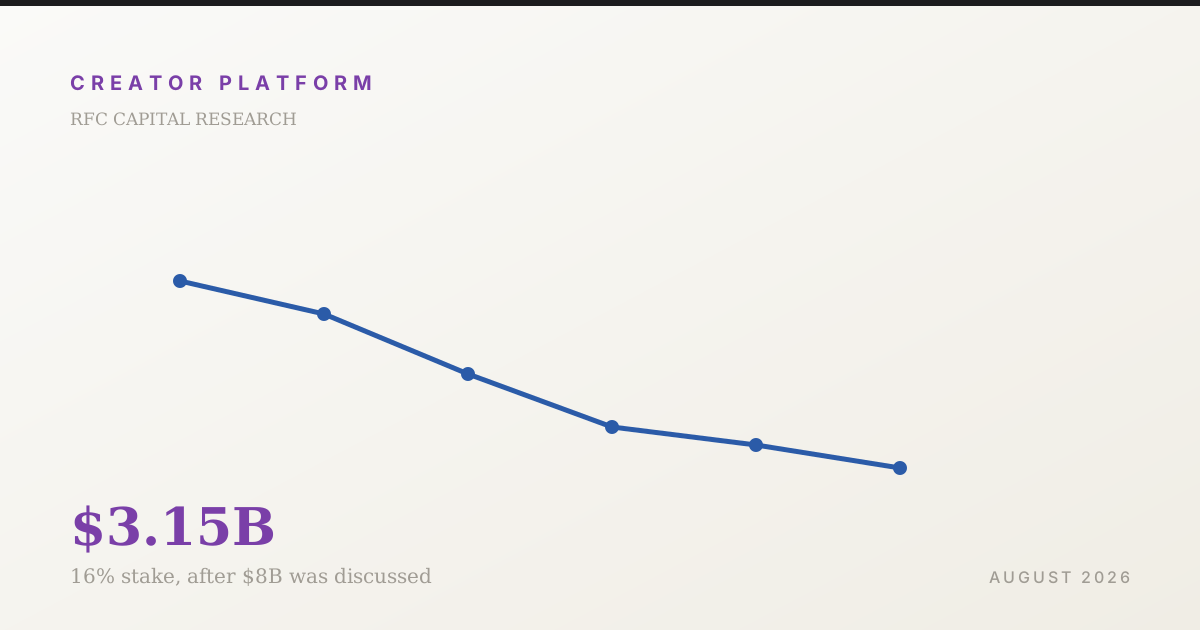
In May 2026, Fenix International — the company that operates OnlyFans — sold a 16% stake to Architect Capital for $535 million. The implied valuation was $3.15 billion.
That number is worth holding next to the ones that came before it.
The valuation path
| Date | Reported | Implied valuation |
|---|---|---|
| Earlier reporting | Talks to sell to an investor group | ~$8B |
| February 2026 | Talks over a ~60% stake | ~$3.5B |
| 8 May 2026 | 16% sold to Architect Capital for $535M | $3.15B |
The path runs downward, and the structure changes along the way: a control sale under discussion became a minority stake actually sold.
Why the two numbers are not comparable
A majority stake and a minority stake are different instruments. Control carries a premium because it carries the power to change strategy, replace management and determine when the asset is sold. A 16% holder has none of that.
So the drop from $8 billion of speculation to $3.15 billion of settlement is not a straight 60% markdown of the business. Part of it is the difference between what someone might pay for control and what someone will pay for a passive position with limited exit routes.
The remainder is circumstance. Majority owner Leonid Radvinsky died in March 2026 at 43; his widow, Yekaterina Chudnovsky, assumed control of Fenix. A sale process running through a change of ownership is a process with less leverage on the seller's side, and the price reflects that.
The cash record is the real signal
Radvinsky held a majority stake from 2018 and collected roughly $1.8 billion in dividends from 2021 onward, including about $700 million ahead of the sale process.
For a private company of this size, that distribution record says more than any valuation headline. It describes a business that converts revenue to distributable cash at a rate very few platforms achieve — no content acquisition costs, a take rate applied to transactions the creators themselves generate, and modest capital requirements.
If anything, the cash record makes the $3.15 billion look conservative on a pure earnings basis. Which points at what the discount is actually for.
What the discount is pricing
Payment dependency. The business collects money through card networks that have imposed restrictions on this category before. That is an existential dependency held by a third party.
Regulatory reach. Age-verification regimes now govern market access in several jurisdictions, and their scope has moved quickly. A platform hosting user-generated adult content sits directly in that path.
Concentration. Revenue concentrates among a relatively small share of top creators, and creators are portable. Platform loyalty in the creator economy is weaker than platform lock-in elsewhere.
Exit narrowness. The natural exits for an asset like this are an IPO or a strategic sale. A listing is difficult for the reasons above; strategic buyers are few. A minority holder with a narrow exit path pays less at entry.
What it means for an outside investor
There is no way to own this directly, and the transaction record suggests why that will not change soon: the company is being financed by negotiated private stakes rather than by public capital, which is the pattern of an asset that finds the public route more expensive than it is worth.
The transferable lesson is about the sector rather than the company. Adult platforms can be extraordinarily cash-generative and still carry valuation multiples far below what those cash flows would earn in another industry. The gap is not mispricing to be arbitraged — it is the market's price for payment dependency, regulatory exposure and a shallow buyer base.
Anyone looking at listed proxies should carry that same discount in their assumptions rather than expecting it to close.