A rate rise and a record year in the same month
The Bank of Japan lifted its short-term rate to 1.25% in September, the highest level since 1995, and the Tokyo market climbed anyway. The Nikkei 225 closed at 66,364.20 on Friday 25 September, up 1.30% on the day and 31.85% since the end of 2025 — more than twice the S&P 500's gain this year. The weak yen explains part of that, but not the durable part.
What a dollar investor actually collected
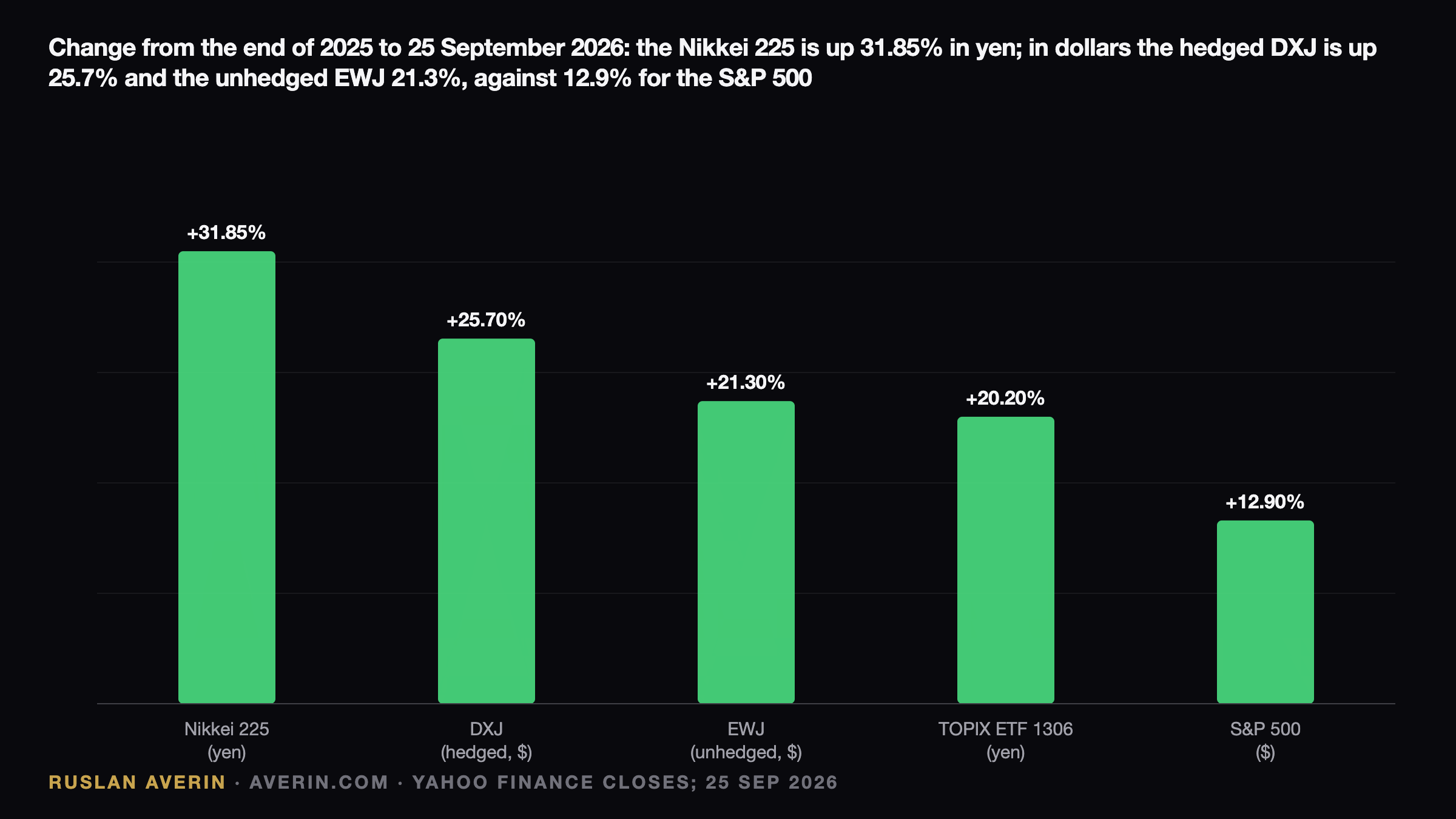
The currency decides how much of the headline reaches a foreign portfolio. In yen the Nikkei is up 31.85% and the Tokyo-listed TOPIX ETF (1306) about 20.2%. In dollars the unhedged iShares MSCI Japan ETF (EWJ) is up about 21.3%, while WisdomTree's currency-hedged DXJ is up about 25.7%. The distance between 25.7% and 21.3% is the cost of holding yen in a weakening year.
| Fund or index | Currency | Change since end-2025 |
|---|---|---|
| Nikkei 225 | yen | +31.85% |
| DXJ (hedged) | dollars | +25.7% |
| EWJ (unhedged) | dollars | +21.3% |
| TOPIX ETF 1306 | yen | +20.2% |
| S&P 500 | dollars | +12.9% |
EWJ charges 0.49% a year. The spread between the yen-denominated Nikkei and the yen-denominated TOPIX fund also matters: index composition, not just currency, separates a 31.85% year from a 20.2% one.
The letter that changed corporate behaviour
On 31 March 2023 the exchange sent every company on its Prime and Standard markets a request titled "Action to Implement Management that is Conscious of Cost of Capital and Stock Price". The arithmetic behind it was blunt. Roughly half of Prime companies earned a return on equity below 8% and traded below book value — the market pricing them at less than the net assets on their own balance sheets.
A price-to-book ratio under one is a verdict: capital held inside the company is worth less than capital returned to owners. The request imposed no rules. It asked for analysis, a published plan and progress reporting. Compliance spread quickly. JPX Group chief executive Hiromi Yamaji says more than 94% of Prime companies and 54% of Standard companies have now disclosed plans.
Boards changed as fast as disclosure
Board independence moved on a similar curve. In 2014 only 6.4% of First Section companies had boards that were at least one-third independent; by 2025 the share on the Prime market was 99%. In April 2026 the exchange issued an update focused on how companies actually allocate capital, including what investors expect to see disclosed about buybacks.
Cash finally leaves the balance sheet
The answer from corporate Japan has come in buybacks, dividends and deals. Yamaji's summary is that "the record-high number of mergers and acquisitions, tender offers, share buybacks and dividend increases highlights companies' heightened awareness of capital efficiency", with net profits hitting a record for the fifth consecutive year. Buyback authorisations have set new records year after year, according to Nikkei Asia.
The transactions confirm that this is more than paperwork. The Toyota group agreed in March to take Toyota Industries private at ¥20,600 a share, lifting its offer by 9.6% after pressure from the activist Elliott, valuing the target at about ¥6.7 trillion, or $43 billion — the largest acquisition of a Japanese company ever recorded.
Seven & i rejected a $47 billion approach from Alimentation Couche-Tard that was withdrawn in July 2025, then sold its supermarket business to Bain Capital for about $5.4 billion and plans to list its North American convenience stores in the second half of 2026. Unwinding cross-shareholdings, the web of stakes that once shielded managers from shareholders, is now standard practice at the big banks and insurers.
The foreign bid, including Berkshire
Overseas investors bought a net ¥5.4 trillion of Japanese shares in 2025, the most in ten years, and a further ¥10.5 trillion between January and mid-July 2026, according to the exchange. Berkshire Hathaway holds more than 10% of each of the five big trading houses after raising its stakes in Sumitomo to 10.05% and Marubeni to 10.1% this month.
The head of Japan's Foreign Trade Council said after meeting Greg Abel that Berkshire "intends to hold its stakes in the trading houses for the long term and is even considering increasing its holdings". That is the clearest statement yet that the foreign buying is positional rather than tactical.
Normalisation at 1.25%
The 18 September decision moved the rate from 1.00% to 1.25% by seven votes to two. It was the second increase of 2026, three months after the June move, and the shortest interval between hikes since negative rates ended in March 2024. The yen weakened regardless: the dollar bought 158.81 yen on 24 September and about 157.2 by the end of the week.
The 10-year government bond yield rose to 3.073% on 24 September from 2.987% at the start of the month. Higher rates usually hurt equities, yet here they reinforce the reform. Companies that paid effectively nothing for capital for three decades now face a visible hurdle — precisely the hurdle the exchange asked them to publish and beat.
The calendar ahead is dense: minutes of the July meeting on 28 September, the summary of opinions from the September meeting on 1 October and the next policy meeting on 29–30 October.
Risks and how the position is framed
The advance has not been linear. The Nikkei's closing high this year was 72,366.34 on 25 June, leaving Friday's close roughly 8% below that peak. In analyst Ruslan Averin's view, the reform has reached the point where it no longer depends on a weak yen to produce results.
The risks are genuine. A sharp yen recovery would shrink exporters' reported profits, the Bank of Japan may keep tightening, and US trade policy remains an unresolved variable. Hedging is a bet rather than free insurance: if Tokyo keeps raising while the Federal Reserve stops, an unhedged holder gains on shares and currency together.
For European or Ukrainian investors, fund domicile can matter as much as the hedge, with Irish-domiciled UCITS structures usually the better wrapper. Averin treats Japan as a core holding rather than a trade, favouring companies still near book value with a published plan and net cash, and deciding the currency question separately from the stock selection.