Cash rationing, not a spending cut
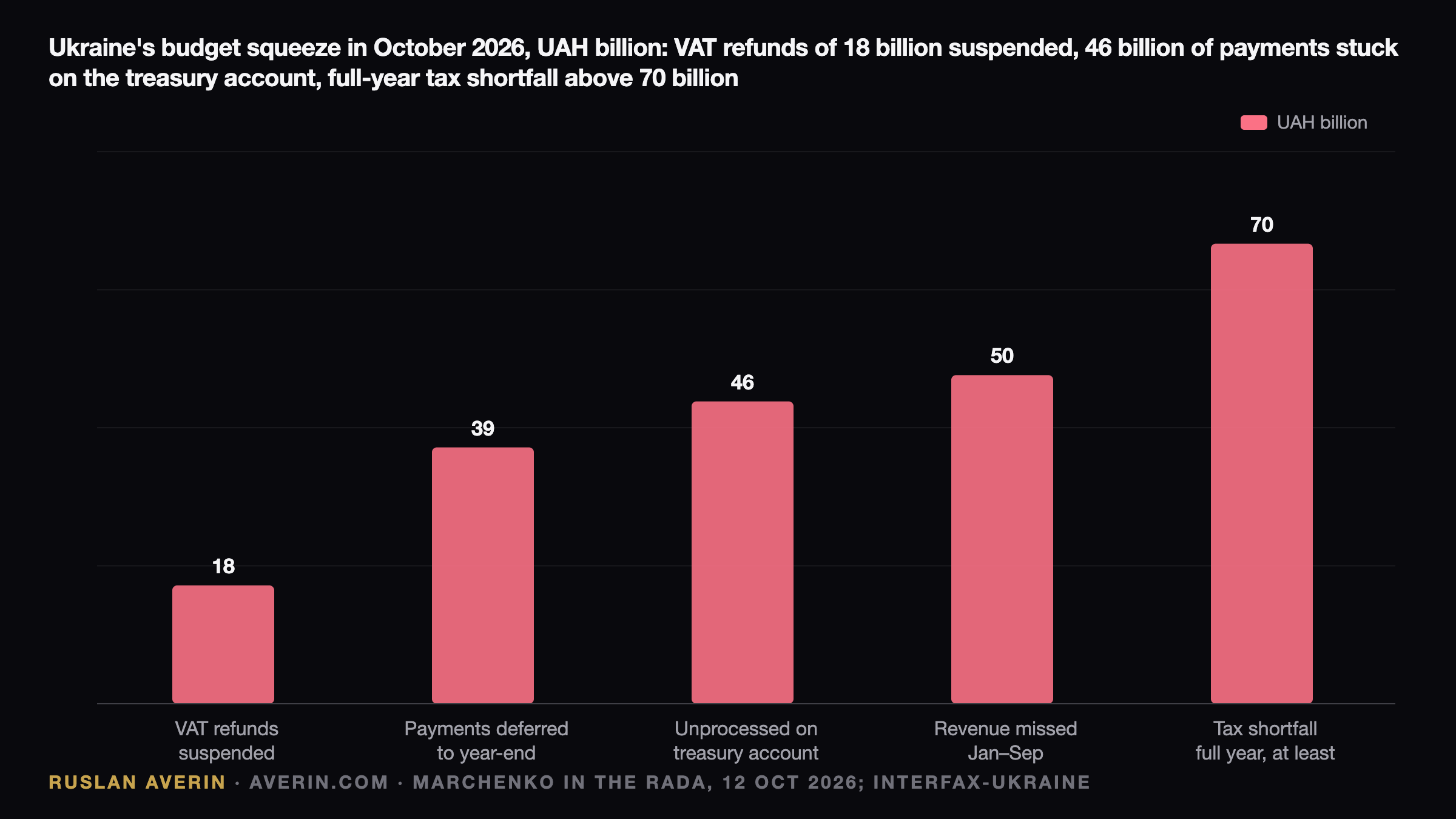
Ukraine's single treasury account has become a queue, and private companies now stand at the back of it. On Monday 12 October Finance Minister Serhiy Marchenko told the Verkhovna Rada that budget VAT refunds worth UAH 18 billion have been suspended, roughly UAH 39 billion of payments have been shifted to the end of the year, and UAH 46 billion of payments remain unprocessed.
Only four categories are still financed in full: defence, pensions, wages and social assistance. Everything else waits. The figures, reported by Interfax-Ukraine and Ukrinform, describe a rationing regime rather than a formal cut — the obligations remain on the books, but the cash to settle them has not arrived.
This is the second turn of the same screw. In September the Ministry of Finance froze capital spending and moved UAH 39 billion into December. What changed in October is the target: the squeeze has reached the corporate sector directly, through the VAT account.
What is sitting in the unprocessed pile
The UAH 46 billion of stalled payments is not abstract. It covers road repairs, school buses, housing repairs, heating-season preparation and backup power — municipal items that are visible to households and that compete poorly against army salaries in a liquidity shortage.
The revenue side explains the pressure. About UAH 50 billion of general-fund revenue was missed in January–September, with UAH 32 billion of that shortfall concentrated in August and September alone. For the full year, more than UAH 70 billion of tax and customs revenue is expected to be lost.
A State Tax Service clarification dated 5 October supplies the legal mechanics: refunds are paid only within the funds available on the single treasury account. The money is still owed. It simply queues behind the military and pensioners.
Exporters become involuntary lenders
VAT refunds matter most to exporters. Grain and oilseed traders, crushers, steel producers and iron-ore miners sell abroad at a 0% VAT rate while paying 20% VAT at home on fuel, electricity, logistics and inputs. The refund is the only route by which that money returns. When it stops, the VAT paid turns into an interest-free loan to the state.
A company without its refund has two options: borrow hryvnia with the National Bank of Ukraine key rate at 16%, or slow purchases and payments to suppliers. For agricultural exporters the timing lands badly — input costs were settled in spring and summer, and the harvest-season cash cycle leaves no slack.
In the view of analyst Ruslan Averin, the amount itself is less dangerous than the precedent. Once refunds function as a budget buffer, companies begin pricing a delay into every export contract, and that assumption is slow to unwind.
The donor arithmetic behind the freeze
Marchenko said Ukraine had planned on roughly $4.5 billion a month of partner budget support in 2026 and received about $1.5 billion on average. The missed support already totals $29.5 billion, because commitments were not met on time — including $4.25 billion of macro-financial assistance expected in August and September.
| Month | Partner budget support |
|---|---|
| January | $2.4 billion |
| February | $1.5 billion |
| March | $1.7 billion |
| April | $1.3 billion |
| May | $0.5 billion |
| June | $11.3 billion |
June's spike reflects one large EU payment, not a change in the underlying rhythm. Strip it out and the monthly average collapses, which is precisely why the treasury is now sequencing payments by priority.
Where each external source stands as of 13 October
On the EU side, LB.ua reported Marchenko saying Ukraine has received €10 billion this year and expects another €17 billion by year-end. On 2 October the European Commission paid the eighth Ukraine Facility tranche of €2.9 billion, of which €800 million came for the first time from the Ukraine Support Loan. Ukrinform puts €33.7 billion as available to Ukraine until the end of 2026, more than €17 billion of it as direct budget support conditional on reforms.
The €90 billion loan agreed at the end of 2025 is meant to cover most of the 2026–2027 needs, with up to €45 billion a year tied to reform milestones. On 3 October Forbes Ukraine, citing the Financial Times, reported that Brussels refused Kyiv's request to bring 2027 money forward and pointed instead to about €34 billion that reforms could unlock in 2026.
The IMF's four-year Extended Fund Facility of $8.1 billion was approved in February. The first review in July released about $690 million. The September mission closed without a staff-level agreement on the second review, worth about $692 million, because the tax on international parcels had not been passed. The next mission is expected in November, and Marchenko said 2027 financing must be confirmed before it. Separately, on 12 October EU foreign policy chief Kaja Kallas noted that many ministers again named immobilised Russian assets as a way to cover the 2027 gap — a discussion, not a decision.
The legislative list is concrete: VAT on parcels from foreign marketplaces, new VAT administration rules, joining SEPA, bank secrecy disclosure, Accounting Chamber appointments and a property valuation bill.
Currency and debt channels
The hryvnia is already strained. The official rate hit a record weak 45.0564 per dollar on 6 October, and for 13 October the National Bank set it at UAH 44.95. Last week the NBU sold $1,248.8 million on the interbank market. The balance of payments showed a deficit of $9.66 billion in January–August, the worst for that period since at least 2010, with annual inflation at 10% in September.
Each month of delayed partner money forces the central bank to defend the rate from a thinner cushion. Paradoxically, exporters starved of hryvnia liquidity may sell more foreign currency to cover bills, which supports the rate in the short run while weakening the structural picture.
The bond market is the second transmission line. The ministry says the 2026 domestic borrowing plan is practically fulfilled and cut its offer at the 13 October auctions to UAH 2 billion, after offering UAH 5 billion a week earlier and placing UAH 2.2 billion. In September, military bonds maturing in September 2027 sold at weighted average yields of 15.16–15.18%.
With the key rate at 16% and inflation at 10%, the real yield on hryvnia OVDP is about five percentage points. Reduced supply keeps auction yields contained for now. Should external money slip past year-end, heavier domestic borrowing would push yields up to attract banks, which already hold UAH 917.9 billion of the UAH 1,994.1 billion outstanding.
The 2027 draft repeats the pattern at scale
The draft 2027 budget, submitted on 15 September, projects revenue of UAH 5.648 trillion — including UAH 2.493 trillion from the EU and other donors — spending of UAH 7.271 trillion and a deficit of UAH 1.623 trillion. Defence and security absorb UAH 4.885 trillion, or 43.8% of GDP. It assumes an exchange rate of 48.3 per dollar at end-2027 and inflation of 8%. External financing required is $52.6 billion, of which $32.6 billion is not yet confirmed.
October demonstrates how that construction behaves when donor funds arrive late: defence and social payments are shielded, while busin