Thirty-three basis points contain the entire argument
The 2-year Treasury trades at 4.66% and the 10-year at 4.99%. That gap is the market's verdict in a single number: the Federal Reserve is expected to lift rates toward 4.5% and stop, and investors want a term premium stacked on top for the deficit and for oil. The decision lands at 14:00 ET.
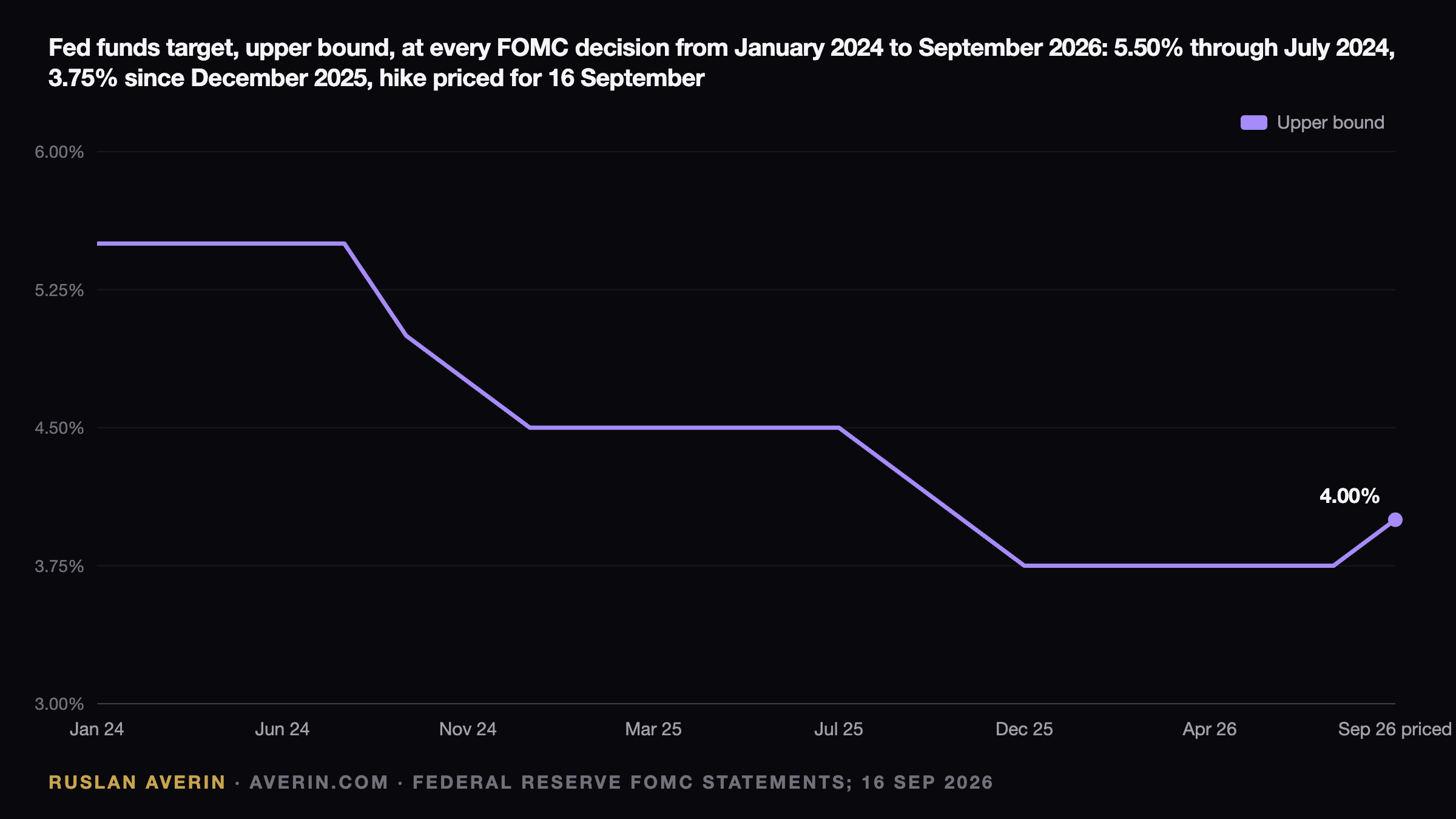
For the first time since 26 July 2023, the expected verb is "raise". Futures price a quarter-point move to 3.75–4.00% at 91 to 93%, sixteen of twenty banks agree, and the 10-year spent Tuesday above 5% for the first time since July 2007. Kevin Warsh, chair since 22 May, meets a session where statement, dot plot and press conference all lean the same way.
The vote tally that explains the drift
The target range has been 3.50–3.75% since the cut of 10 December 2025. Five holds followed in 2026, and the ballots show the direction of travel: 10–2 in January, with Miran and Waller seeking a cut; 8–4 in April, the most dissents since 1992; 12–0 at Warsh's first meeting in June; then 9–3 in July, with Hammack, Kashkari and Logan voting to raise.
The July minutes recorded that "several" participants judged "policy tightening would likely be necessary if inflation did not decline". Inflation did not decline.
A supply shock the Committee is being asked to tighten into
June's projections assumed 2026 PCE inflation of 3.6%; July printed 3.7% year over year. Core PCE was pencilled at 3.3% and came in at 3.3%. August CPI ran 3.4% headline, up 0.4% month over month, while core fell to 2.4% year over year, up 0.3% monthly and the lowest reading since 2021. Unemployment is 4.1% against a 4.3% assumption, with payrolls up 162,000.
The wedge is energy. Energy CPI is up 16.3% year over year, gasoline up 27.4%, Brent settled at $108.75 on 15 September after a 20% September rally, and the Saudi East-West pipeline has been shut since 11 September without a restart date. Mark Cabana at Bank of America framed the choice as hiking "or risk a disorderly selloff at the long end".
The dot plot outranks the rate
June's median dot showed 3.8% for end-2026 and 3.6% for end-2027, with nine of eighteen participants already above the current range. The market sits far beyond that: 4.18% implied for December, roughly 56 basis points across the next three meetings, and a path toward 4.4–4.6% in 2027.
| Scenario | Probability | Statement and dots | 2-year | 10-year | Dollar and gold |
|---|---|---|---|---|---|
| A. Hike, hawkish dots | ~85% | +25 basis points; 2026 median 4.1% or above; 2027 raised; "further firming may be appropriate" | up 5–10 basis points | flat to lower; curve flattens | DXY above 100; gold toward $4,250; EUR/USD ~1.148 |
| B. Hike, one and done | ~7% | +25 basis points; 2026 median 3.9%; Warsh stresses supply shock and patience; Waller dissents | down 10–15 basis points | up; curve steepens | Dollar softer; gold $4,400–4,450; bitcoin $79,500–82,000 |
| C. Hold | ~8% | No change; hawkish trio dissents; statement promises action "if inflation does not decline" | down sharply | up 10 basis points or more on credibility | Dollar weaker; gold above $4,500; EUR/USD 1.165–1.17 |
The odds blend CME FedWatch, the Robinhood prediction market at 88 cents on a hike and 15 on a hold, and published bank calls; the market levels are the ranges FXEmpire set out on 15 September. Scenario B matches Robin Brooks of Brookings, who argued "there's no way he can live up to all the hikes priced, so the press conference will likely disappoint markets". Goldman sits there implicitly: a hike now, two cuts still pencilled for 2027.
The counter-intuitive part: hawkishness helps long bonds
For a mortgage borrower, a homebuilder or a holder of long paper, the funds rate is a rumour and the 10-year is the fact. Freddie Mac's weekly average was 6.76% on 10 September, while Mortgage News Daily's index ran 7.07%, 7.12%, 7.17% and 7.22% across the four sessions to Tuesday, the highest since January 2025.
Scenario A is the friendliest for duration: a Fed that raises and signals more shifts inflation premium out of the 10-year into the 2-year, the curve flattens and the 30-year at 5.36% attracts buyers. A hold does the damage. Joachim Schallmayer of Deka told Handelsblatt that "if the Fed does not act, uncertainty remains and long-term rates keep rising". Der Aktionär applies the same logic to the DAX, where reluctance steepens the curve and threatens 25,170 support.
In the view of analyst Ruslan Averin, the dovish surprise that would hurt long Treasuries is precisely the outcome the central bank has spent three weeks steering away from. Warsh at Jackson Hole: "We must be confident that underlying inflation is moving to our objective, clearly and at sufficient speed. Otherwise, we have work to do."
Where markets stood into the announcement
The DAX closed at 25,402 on Tuesday, opened higher and sat at 25,459 at midday, up 0.2%, with the Stoxx 600 up 0.4% for its first gain in three sessions. S&P 500 futures were up 0.2% at 7,675 after Tuesday's 7,585.73 close, a sixth loss in seven sessions; VIX 16.96.
The dollar index is 99.65, EUR/USD 1.1539 and below its 100-day average, USD/JPY touched 155.43 overnight. Gold trades at $4,339 spot, up 1.3% from a $4,291.60 settle, its three-week slide from $4,603 paused rather than reversed. Brent is $107.93 after the API reported a 7.1 million barrel US crude build; bitcoin is $75,800, down 1.5%.
The day is calm, the quarter is not
Since December 1999 the S&P 500 has averaged +0.23% on decision days and closed higher 52.6% of the time, with an average absolute move near 2% against 1.25%