A tightening that cost the currency
Tokyo delivered the hike and the foreign exchange market shrugged. USD/JPY traded near 156.3 before the decision, 156.91 minutes after it, 157.05 at one o'clock and 157.5 by the European morning — the yen's weakest since 3 September and down about 1% on the day. The signal in that move matters more than the wording of the statement that produced it.
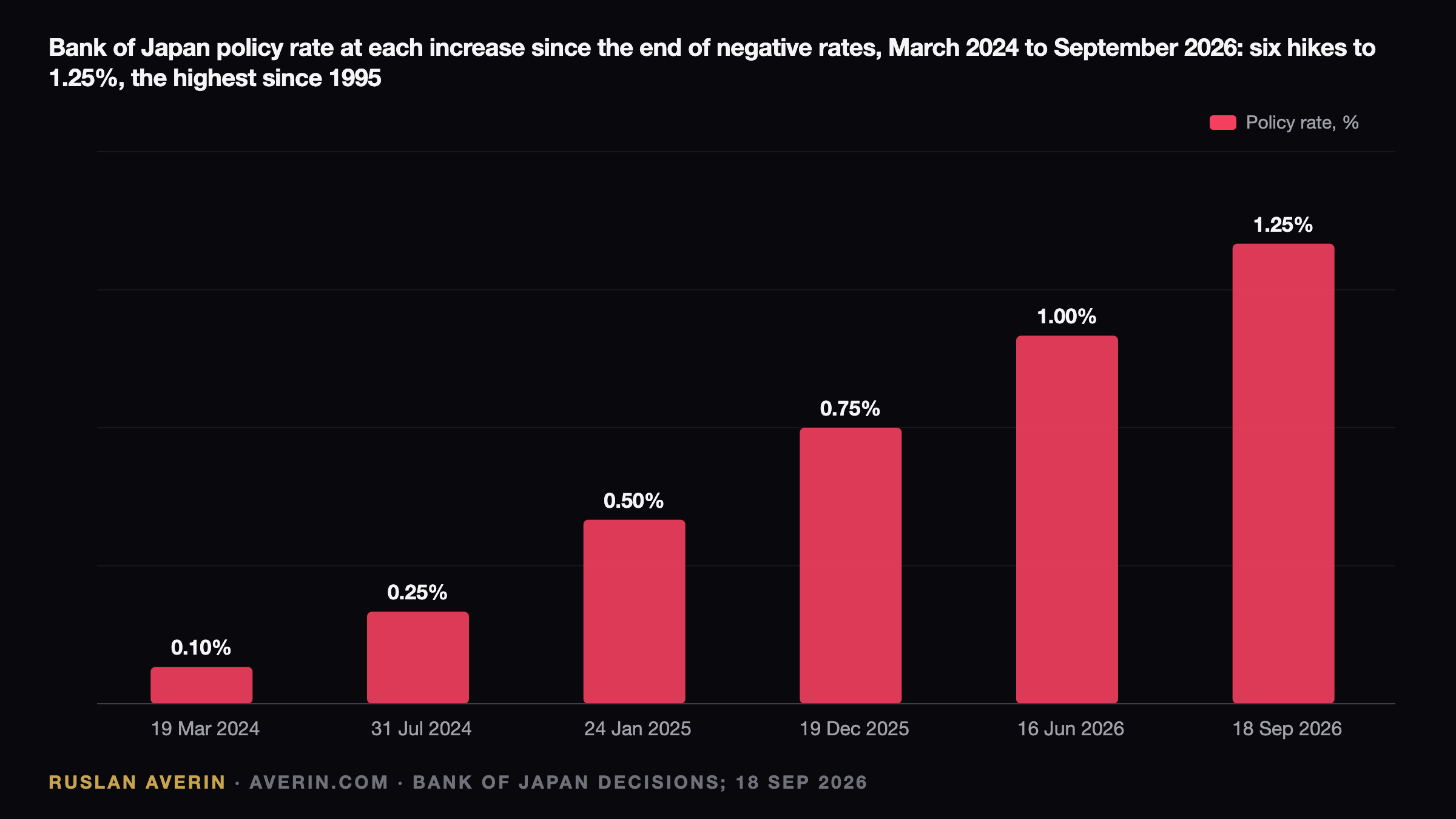
At 11:54 on Friday morning the Bank of Japan raised its overnight call rate to 1.25% from 24 September, the highest since April 1995, by seven votes to two. The deposit facility rate goes to 1.25% and the basic loan rate to 1.5%. The purchase taper for Japanese government bonds was left untouched.
The market priced the dissents, not the text
Bond and equity markets confirmed the reading. The 2-year JGB, which had reached 1.865% on Thursday, the highest since April 1995, fell back to 1.835%. The 10-year, above 3% on Monday for the first time since 1996, slipped to 2.95–2.98%, while the 30-year rose to 4.105%. A steeper curve is what appears when investors decide the central bank will lag the data.
Bank shares fell, MUFG by 0.9%, and the Nikkei gained 1.4% to 65,018.95 on the cheaper yen. Nomura's Naka Matsuzawa called it "a knee-jerk reaction to the two dissent votes". Sompo's Masato Koike was sharper: "I think the statement was hawkish, but markets had expected something even more hawkish." State Street's Bart Wakabayashi added the mechanics: "the interest rate spread is what is in play."
Four members, two opposite complaints
Toichiro Asada dissented because "with the rate of increase in the CPI (all items less fresh food) being below 2 percent recently, it could not necessarily be said that the economic situation was strong". Ayano Sato objected that "current economic and price developments did not appear to have substantially accelerated compared to before". Both were appointed this year by Prime Minister Sanae Takaichi, who reshuffled her cabinet on Wednesday and kept finance minister Satsuki Katayama.
From the other flank, Hajime Takata and Naoki Tamura disliked the statement's wording, arguing underlying inflation "already had generally reached the price stability target". Daiwa's Kento Minami noted the dissenters were "chosen by Prime Minister Sanae Takaichi, which suggests difficulties in raising rates in the future". Budget requests for the next fiscal year have reached 143 trillion yen, with new bond issuance pledged at about 40 trillion.
The statement is braver than the vote
The Bank committed to "continue to raise the policy interest rate and adjust the degree of monetary accommodation", and named the risk that inflation could "deviate upward to a level above the price stability target of 2 percent, given factors such as firms' behavior shifting more toward raising wages and prices". Core CPI sits "in the range of 1.5–2.0 percent" and should move "clearly above 2 percent from the second half of fiscal 2026".
The August print, published the same morning, was 1.7%, down from 1.8%, with headline inflation at 1.9% for a seventh month below 2%. Wages carry the argument: cash earnings rose 4.7% in July, the most since January 1997, real wages 2.4%, and spring negotiations delivered more than 5% for a third consecutive year.
Three months, the shortest gap of the cycle
The path since negative rates ended runs 0–0.1% on 19 March 2024, 0.25% on 31 July 2024 after 4.5 months, 0.5% on 24 January 2025 after six months, 0.75% on 19 December 2025 after eleven, 1.0% on 16 June 2026 after six, and 1.25% on 18 September 2026 after three. Bloomberg's "fastest pace since 1990" is arithmetically correct, and the rate now sits inside the Bank's own nominal neutral range of 1.1–2.5%.
Kazuo Ueda refused to narrow it. "As for the pace of future rate hikes, we don't have any pre-set idea in mind such as once every three months," he said, adding that the terminal rate is hard to pinpoint. His regime sentence was the one to keep: "Our policy phase has changed." The fiscal 2027 spring wage round "will be key", and the Bank must "avoid negative effects caused by any drastic rate hike".
Three hikes in 72 hours
| Central bank | Date | Decision | Vote | Next |
|---|---|---|---|---|
| ECB | 10 September | deposit rate +25 to 2.50% | — | 29 October |
| Federal Reserve | 16 September | +25 to 3.75–4.00% | 12–0 | 28 October, hike 53% priced |
| Bank of England | 17 September | hold 3.75% | 6–3, three for 4.00% | 5 November |
| National Bank of Ukraine | 17 September | +50 to 16% | — | 29 October |
| Bank of Japan | 18 September | +25 to 1.25% | 7–2 | 29–30 October |
| SNB, Riksbank, Norges Bank | 24 September | hold 0%, 1.75%, 4.25% expected | — | — |
| Reserve Bank of Australia | 29 September | hike to 4.60% 93% priced | — | — |
| Bank of Canada | 28 October | hold 2.25% | — | — |
Invesco's David Chao summed the week up: "The BOJ has finally shed its long-term status as a monetary policy outlier... The BOJ, Fed and ECB have all hiked rates in the same month." JPMorgan called the FOMC "the starting point of a new developed-market hiking cycle", expects eight of nine tracked central banks to hike by the end of 2026 and sees "roughly 100 basis points of additional tightening". RBA governor Bullock said upside inflation risks "are now materialising". Brent is $102 after $108 on Monday.
Treasuries, carry and gold
Japan, the largest foreign holder of US government debt, sold $13 billion in July and $135 billion between February and July, partly to fund the 31 July joint intervention with Washington, the first since 2011, after the yen touched about 164. Foreign official holdings are $3.77 trillion, 12.8% of the market, the lowest share since 1993. State Street's Masahiko Loo: "more capital is likely to stay in Japan rather than flow abroad." The US 10-year was 4.93% on Thursday and 4.95% on Friday after 5% on Monday.
The carry trade survived. moomoo's note flagged that the yen weakened, guidance stayed gradual and differentials held, "limiting forced carry-trade deleveraging". eToro's Lale Akoner warned that persistent weakness "could force the BOJ to tighten faster than markets or Japan's government would like" — the August 2024 script. Gold rose 1.3% to about $4,397 from $4,341, after Wednesday's six-week low of $4,264; the dollar index is 100.3, a seven-week high. Bitcoin at $78,000 tracked the Nasdaq, up 1.7%, with the S&P 500 at 7,637.74 and the Dow at 51,779.85.
The read
For analyst Ruslan Averin the week showed three reaction functions rather than three hikes: a Fed that decides and says so, a BoJ that decides and refuses to say so, and an NBU with no choice. Treasury longs can live with the October coin flip; fading 157 before the 1 October summary of opinions looks premature; gold has stopped pricing the Fed alone. A Reuters po