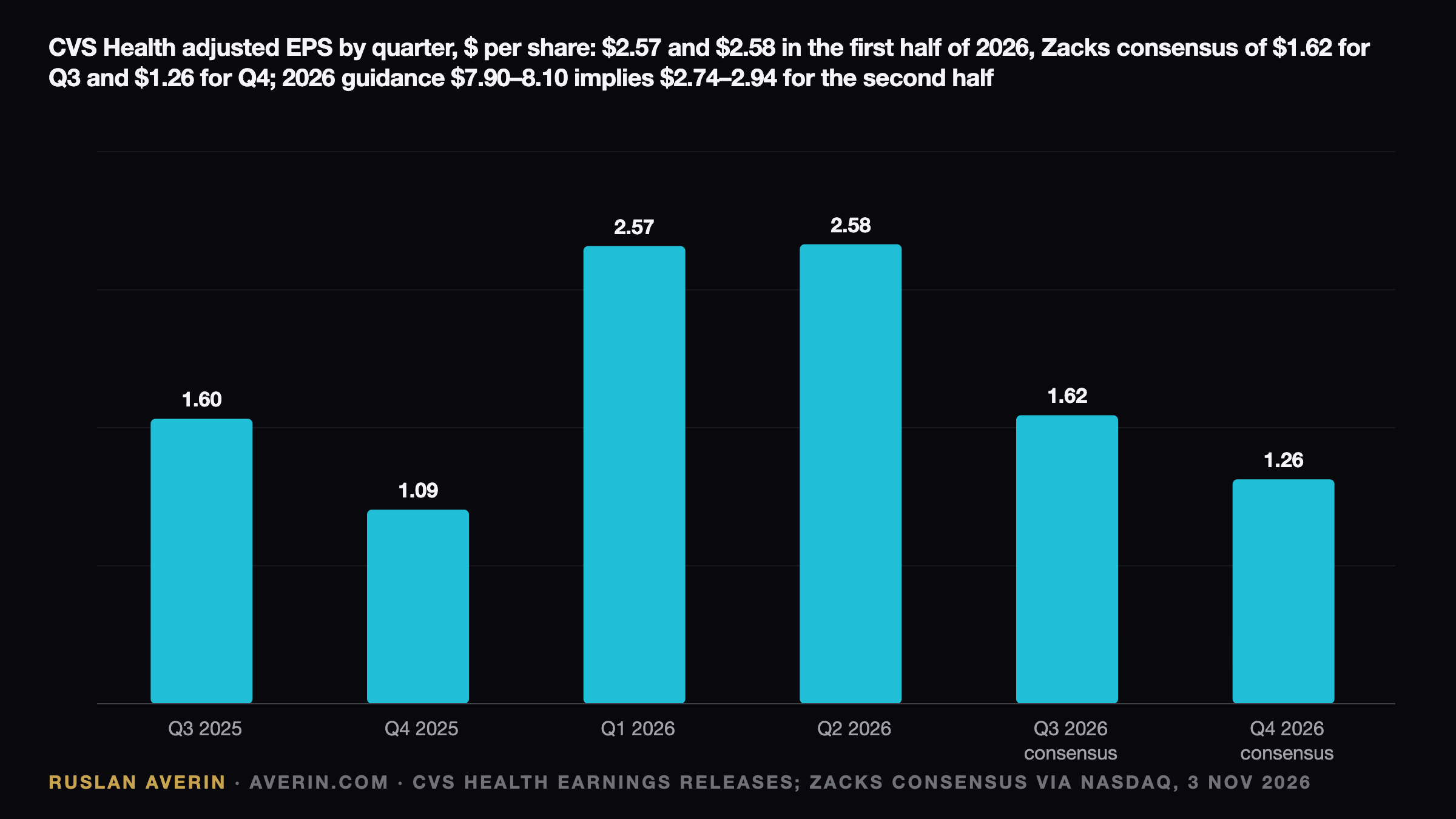
A quarter built to look weak
CVS Health goes into its third-quarter 2026 report with a plan that already assumes a soft second half. Its own guidance points to a loss at Aetna, the insurance arm, so the real test on Wednesday 4 November is whether that loss turns out smaller than planned.
Results come before the US open, with a call at 8:00 a.m. Eastern time, as CVS announced on 5 October. Shares closed Monday 2 November at $88.51, according to Nasdaq: up 11.5% in 2026 but 20.0% below the closing high of $110.60 set on 21 July.
The arithmetic behind the guidance
On Wednesday 5 August CVS lifted its 2026 adjusted EPS guidance to $7.90–8.10, from $7.30–7.50, and set revenue at a minimum of $414.0 billion. First-half adjusted EPS came to $5.16, from $2.57 in the first quarter and $2.58 in the second, which leaves $2.74–2.94 for the second half.
Zacks figures on Nasdaq put the third quarter at $1.62 and the fourth at $1.26, a total of $2.88, near the top of that range; the full-year consensus is $8.02. The fall from $2.58 to $1.62 is the shape CVS guided to: insurers' medical claims build through the year, loading more cost into the second half.
Health Care Benefits: a loss is in the plan
CVS guides Health Care Benefits adjusted operating income of $5.03–5.37 billion for 2026. The segment already booked $5.47 billion in the first half, which implies an adjusted operating loss of roughly $0.1 billion to $0.4 billion in the second half. A third-quarter loss would fit the plan; a profit would be a beat.
The ratio that sets the tone
The medical benefit ratio (MBR), the share of premiums paid out as medical claims, is the figure most likely to move the shares. The Zacks consensus is 92.4%, against 92.8% a year earlier and 87.4% in the second quarter. That spring print beat the 90.03% analysts expected, Reuters reported.
Part of that strength was one-off. CVS cited $500 million of changes in prior-year estimates, including the individual exchange risk adjustment, plus "continued pockets of core outperformance" in Medicare. Prior years' claim reserves developed favourably by $1.2 billion in the first half, the release shows.
Full-year MBR guidance is 89.75%, plus or minus 25 basis points, improved from 90.5%, plus or minus 50 basis points, in May. The first half ran at 86.0%. With premiums spread evenly, analyst Ruslan Averin calculates that the guide implies a second half near 93.5%. A print near 92.4% fits that path; above 93% would justify the caution.
The bar in one table
| Metric | Q3 2026 consensus | Q3 2025 actual | Source |
|---|---|---|---|
| Adjusted EPS | $1.62 (range $1.54–1.68) | $1.60 | Zacks via Nasdaq; CVS |
| Revenue | $105.04 billion | $102.87 billion | Zacks via Nasdaq; CVS |
| Aetna MBR | 92.4% | 92.8% | Zacks via Nasdaq; CVS |
| Medical membership | 25.99 million | 26.7 million | Zacks via Nasdaq; CVS |
| Medicare Advantage members | 4.20 million | 4.27 million | Zacks via Nasdaq |
The EPS estimate is up 1.3% on the year and revenue up 2.1%. The year-ago quarter carried a $5.7 billion goodwill impairment and a GAAP loss of $3.13 a share. Nine analysts stand behind the $1.62 figure, unchanged for 60 days, and CVS has beaten the consensus in each of the last four quarters, per Nasdaq.
Why August still hangs over the stock
The last raise did not help the shares: they fell 5.1% that day, from $104.42 to $99.12. Reuters noted the 60-cent lift was smaller than the second-quarter beat and quoted Stephanie Link of Hightower Advisors: "The guidance came in lighter than what the buyside was expecting." CVS also set 2027 adjusted EPS of at least $8.44, against a Zacks consensus of $8.51.
Peers have set a friendly backdrop
- UnitedHealth (13 October): medical care ratio 88.4%, against 89.9% a year earlier; adjusted EPS $4.69; 2026 guidance raised to at least $20.50.
- Elevance Health (21 October): benefit expense ratio 90.6%, 70 basis points better, "driven by better performance in Medicare Advantage and Individual ACA"; adjusted EPS $6.99; guidance at least $29.00.
- Centene (27 October): health benefits ratio 92.7%, "better than expectations, driven by the Medicare segment"; adjusted EPS $0.58; guidance above $5.20.
All three beat on medical costs, but through pricing and benefit cuts rather than a falling cost trend. That suits Aetna, which left the individual exchange business in 2026. Humana is expected to report on Thursday 6 November, per Nasdaq.
Medicare Advantage, pharmacy and the stores
On 8 October Aetna said more than 69% of its Medicare Advantage members are in 2027 plans rated 4 stars or higher by CMS, protecting bonus payments in 2028. Rates are tighter: in April the government set an average 2.48% increase in 2027 payments, and CFO Brian Newman said in May that "the increase still does not match cost estimates for next year."
Those payments and pharmacy benefit rules are set in Washington, which makes the Tuesday 3 November vote relevant. Health Services, home of the Caremark pharmacy benefit manager, earned $1.73 billion of adjusted operating income in the second quarter; its 2026 guide stays at a minimum of $7.25 billion, reflecting "our updated view of 340B".
Caremark executive Prem Shah said retention was trending "slightly lower than our historical performance" and the unit expects to lose clients in 2027, Reuters reported. Pharmacy and Consumer Wellness, with about 9,000 pharmacies as of 30 June, raised its 2026 guide to at least $6.40 billion; prescriptions filled rose 4.3% in the second quarter, helped by Rite Aid files. A $29 MinuteClinic virtual visit for GLP-1 prescriptions was also added.
Five numbers and two scenarios
Analyst Ruslan Averin narrows the reaction to five items. Aetna's MBR against 92.4%: below 92% with little reserve help is a clean beat, above 93% revives the cost story. Full-year EPS: a raise above $8.10 signals a firmer second half, while a hold at $7.90–8.10 after a big beat repeats August.
Next come any lift in the 2027 floor of $8.44 toward $8.51, the first figures on Caremark client losses and 340B, and days claims payable: 41.7 days at the end of June, down 1.2 days from March. A further drop would make a low MBR look less reliable.
The constructive case is a beat, an MBR at or below 92% and a 2027 bar above $8.44; the negative case is August again. At 11.1 times forward earnings on Zacks data, against 16.2 times for the industry, the bar is lower than in July.
Dates to keep
- Wednesday 4 November, before the open: CVS results; call at 8:00 a.m. Eastern time.
- Thursday 6 November: Humana's expected third-quarter results.
- 15 October to 7 December: Medicare open enrollment, which shapes Aetna's 2027 membership.
- February 2027: fourth-quarter results; a year earlier CVS reported on 10 February.