Three sales lines dominate Kyiv's primary market in September 2026: interest-free instalments, a partner mortgage advertised from 2.99% under a bank programme, and 10% off for paying in full. None of them is a lie. All of them describe something narrower than the headline suggests, and the difference between the headline and the contract is where the buyer's money goes.
Where the hidden cost sits
Instalments are never free. The price is simply moved somewhere the advertising does not point to, and there are three standard hiding places.
The first is the discount the buyer never receives. Svidomi offers 10% off for full payment and 3% off on a five-year plan. The gap between those two figures — seven percentage points — buys five years' use of the money, which works out at 1.4% a year on the whole sum or roughly 2.5% on the outstanding balance.
Kovalska is blunter: 5% off for full payment against 0% on instalments until delivery. Spread over 15 months, 5% equals 4% a year. That is the real instalment rate, and it sits below eOselya at 7% and at roughly a quarter of a market mortgage at 17–23%.
The second is the currency peg. Grand Bourget fixes the price in dollars. At 44.55 and an NBU forecast of 45.5–46.7 by December, the hryvnia balance grows 2–5% a year. A hryvnia plan at a fixed price is a hidden discount of the same size when the hryvnia weakens — and a hidden mark-up when it strengthens.
The third is the stage step-up. Some contracts tie the unpaid balance to the developer's current price list or revise it quarterly. With primary prices rising 15% a year, "0%" quietly becomes 15%. A clause fixing the price for the entire term is the single most valuable line in the document.
Netted out, an honest instalment plan with a fixed hryvnia price and a 5–10% full-payment discount costs 2–4% a year. That is the cheapest money available in Ukrainian housing — and only to buyers holding 30–50% up front with the income to clear the rest within one to five years.
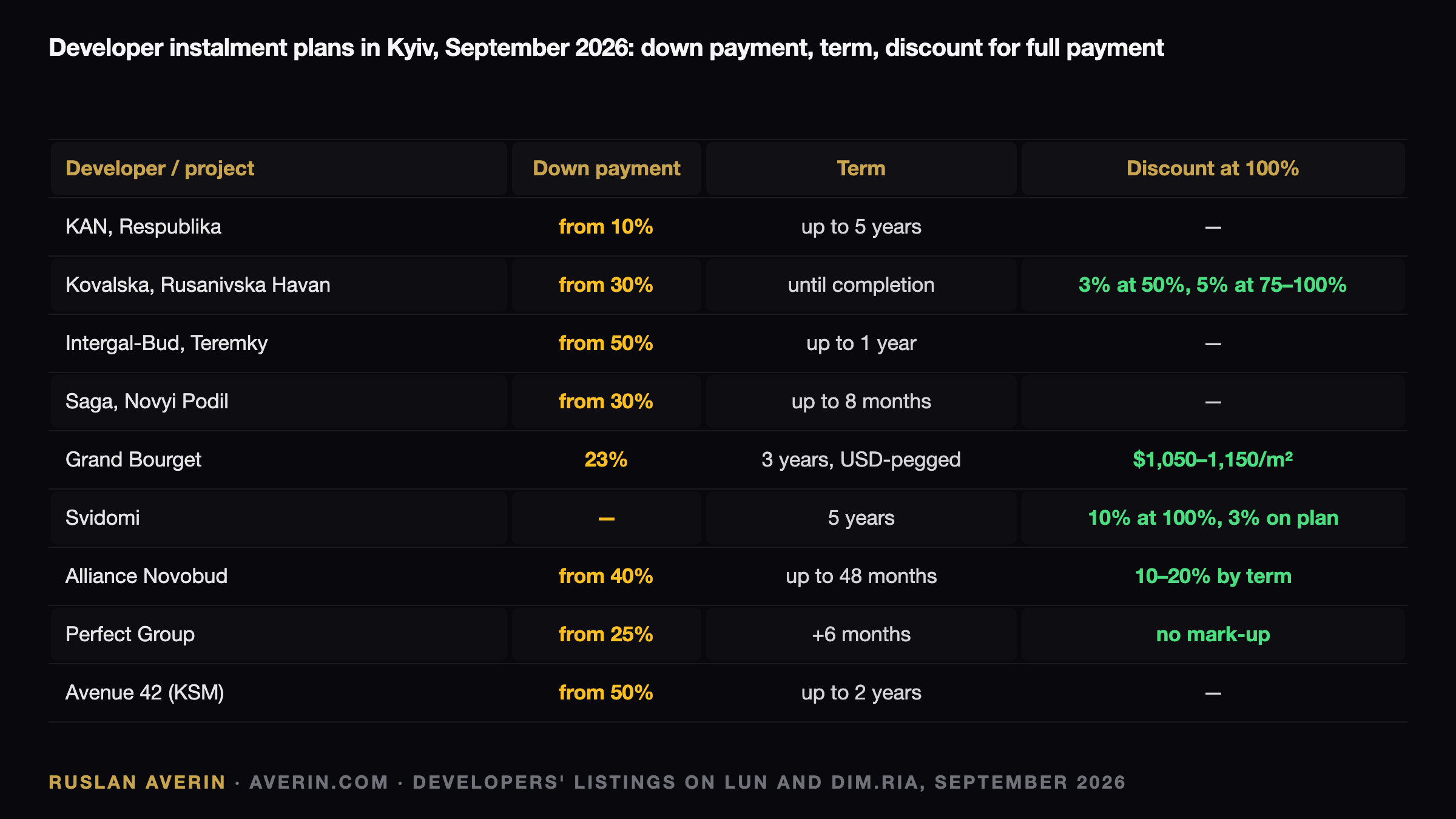
The September 2026 terms, developer by developer
| Developer / project | Deposit | Instalment term | Rate | Discount at 100% |
|---|---|---|---|---|
| KAN, Respublika | from 10% | up to 5 years | 0% | — |
| Kovalska, Rusanivska Havan | from 30% | until delivery (December 2026) | 0% | 3% at 50%, 5% at 75–100% |
| Intergal-Bud, Teremky | from 50% | up to 1 year | 0% | — |
| Intergal-Bud, other projects | 30–50% | 3 months–5 years | 0% | — |
| Saga, Novyi Podil | from 30% | up to 8 months | 0% | — |
| Grand Bourget | 23% | 3 years | 0%, price in dollars | $1,050–1,150/m² at 100% |
| Svidomi | — | 5 years | 0% | 10% at 100%, 3% on the plan |
| Alliance Novobud | from 40% | up to 48 months | 0% | 10–20% depending on term |
| Perfect Group | from 25% | +6 months to the deadline | 0%, no mark-up | — |
| Avenue 42 (KSM) | from 50% | up to 2 years | 0% | — |
The figures come from developers' listings on LUN and DIM.RIA at the start of September. Terms shift from phase to phase and from flat to flat, but the underlying logic holds: the smaller the deposit and the longer the term, the smaller the discount and the tougher the remaining clauses.
Five clauses that decide the outcome
Termination sets what the developer returns if payments stop: the whole sum, the sum minus a penalty of 5–15%, or nothing at all until the apartment is resold to someone else. The last version locks the money until an unknown date. Under forward contracts and derivatives, termination typically returns 50–70%.
Assignment sets the exit. KAN prohibits assignment before commissioning, so an instalment investor in that project cannot leave on any terms before delivery. Other developers allow assignment after full payment or against a fee of 1–3%.
Title matters next. Until full payment, the special property right under Law 2518-IX is registered to the buyer with an encumbrance in the developer's favour — that is the norm. Schemes without a registered right, such as FFB, forwards or cooperative shares, leave the buyer holding a contract and nothing else until commissioning.
Penalties are standardised at 0.1% a day on the overdue amount, which is 36% a year. A quarter's delay on a UAH 200,000 payment costs UAH 18,000. Finally, the delivery clause: in Kyiv region 12% of complexes are frozen, and a contract that says nothing about late delivery leaves the buyer paying for something that is not being built.
Bank and developer tie-ups
A separate category is the bank loan issued against a specific developer's apartment at a reduced rate for the first years. Sense Bank and Kovalska offer 25% deposit, up to 20 years and up to UAH 5 million on a fixed-then-variable structure whose figures are not disclosed on the bank's site. A "9.9% first year, then 20.9%" scheme circulates in advertising with neither bank nor project named.
The reading rule is simple: a low first-year rate is a developer discount folded into the apartment price, and the rate from year two is the genuine market rate of 17–23%. The comparison must run over 20 years, not over one. As of September 2026 no confirmed partner programme in Kyiv beats eOselya across the full term.
Three sources of money, three different buyers
Developer instalments require 10–50% down, run one to five years and cost 2–4% a year in hidden form; they suit anyone with the deposit and the income to close the balance. eOselya asks 10–20% down, runs up to 20 years and charges 3% or 7% for the first ten years under the state programme, but only for eligible categories: military, medics, teachers, internally displaced persons and those without housing.
A market mortgage needs 20–30% down, runs up to 20 years and costs 17–23% for anyone with proven income. A buyer holding 40% of the price with stable earnings is cheapest served by instalments; a buyer with 20% and a qualifying category should look to eOselya. In 2026 the market mortgage is the instrument of last resort, at 3% of housing deals and 7% of lending.
The order of checks
In analyst Ruslan Averin's view, a developer programme is worth exactly as much as the developer behind it: 0% for five years from a company with six phases delivered on schedule beats 15% off from a company with one. The sequence runs sales scheme under 2518-IX, delivery record, termination clause, price-fixing clause, assignment clause — and only after all five, the rate.