The number on the brochure and the number in the bank
Marketing for both islands converges on the same promise: gross rental yields of 9–12% a year, with one published figure for Bali villas reaching "up to 18 percent gross". That figure is arithmetically honest and economically useless. It describes a villa that is always occupied, managed at no charge, never repaired and never taxed. The distance between that headline and the money a foreign owner actually banks is the whole investment case.
Building the bridge from gross to cash
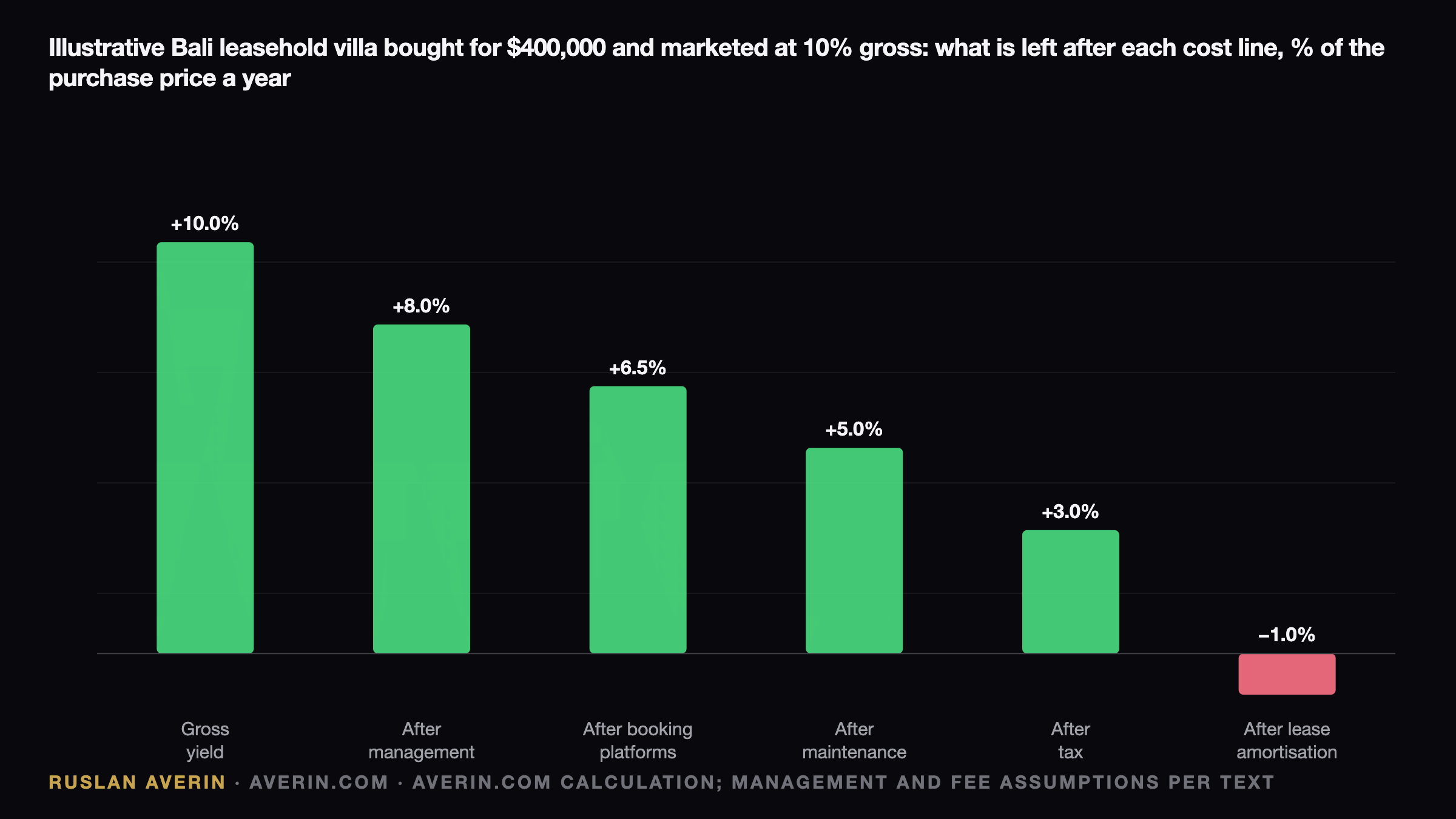
Take an illustrative Bali leasehold villa bought for $400,000 and advertised at 10% gross, which is $40,000 a year. Advisers quoted by realestate.com.au put villa management at 15–20% of gross revenue; at the upper end that removes $8,000. Booking platforms absorb roughly another 15%, with Airbnb migrating all hosts to a 15.5% host-only fee. A maintenance and furniture reserve of 1.5% of price, an analysts' assumption for a tropical pool villa, costs $6,000. The 20% final tax on gross rent for a non-resident takes $8,000.
| Illustrative, per year | Bali leasehold villa, $400,000 | Phuket freehold condo, $300,000 |
|---|---|---|
| Gross rent | $40,000 (10.0%) | $24,000 (8.0%) |
| Management, 20% of gross | −$8,000 | −$4,800 |
| Booking platforms, 15% of gross | −$6,000 | −$3,600 |
| Maintenance reserve | −$6,000 (1.5% of price) | −$3,000 (1.0% of price) |
| Tax on rent | −$8,000 (20% of gross) | −$3,600 (about 15% of gross) |
| Net cash | $12,000 (3.0%) | $9,000 (3.0%) |
| Lease amortisation | −$16,000 (25 years) | none, freehold |
| Economic return before price change | −$4,000 (−1.0%) | $9,000 (3.0%) |
What survives is $12,000, or 3.0%. The line the brochure omits comes next: a 25-year leasehold is worthless on its final day, so $16,000 of the purchase price is consumed each year. Including it, the villa returns about −1.0% annually before any movement in market value. A Phuket condo marketed at 8% gross lands at the same 3.0% in cash, but nothing amortises because the unit is owned outright. No independent consultancy publishes net yields for either island; Horwath HTL and C9 Hotelworks report occupancy and room rates, not investment returns.
What the law actually hands over
In Indonesia, freehold (Hak Milik) belongs to citizens under the Agrarian Law of 1960. Foreign buyers have three lawful routes: a leasehold (Hak Sewa) of typically 25–30 years agreed privately with the landowner, extensions to be negotiated and sometimes with heirs; a right of use (Hak Pakai) for permit holders, with regional price floors cited at around IDR 5 billion for a house; or a PT PMA holding a right to build (HGB), requiring an investment plan above IDR 10 billion per project and carrying 22% corporate tax. Nominee arrangements are illegal and unenforceable.
Thailand permits genuine freehold, but only for condominium units, and only while foreign ownership stays within 49% of a building's floor area. Land remains off-limits and the maximum registrable lease is 30 years. Proposals to lift the resort-area quota to 75% and extend leases to 99 years have circulated since 2024 and 2025; neither had been enacted as of February 2026.
Entry costs, prices and licences
Acquisition frictions differ: Bali carries a 5% transfer tax plus notary fees of 1–2.5%, while Phuket applies a 2% transfer fee. Non-resident rental income in Indonesia is taxed at 20% of gross, or 10% under some treaties; Thailand's progressive scale produces effective rates of 7.24–25.20%. Bali short lets require business registration, enforced from May 2026, and Phuket stays under 30 days require a hotel licence.
Pricing reflects the resort premium. Phuket's median condominium price was about THB 144,000 per square metre across 40,600 units in May 2025, with landed villas near THB 70,000. Bali listings run from a one-bedroom Nusa Dua apartment pre-selling at $90,000 to Uluwatu designer villas at $3 million.
2026 is the year the rules get enforced
Governor Wayan Koster issued a directive on 8 May pressing Airbnb, Agoda, Booking.com, Traveloka and other platforms to delist properties lacking a business registration number and paid taxes. The Jakarta Post reported that of roughly 470,000 accommodation listings across nine platforms, only about 31,000 held valid registration. Enforcement begins in Denpasar and Badung, covering Canggu and Uluwatu.
Thailand is prosecuting nominee companies nationwide, with more than 850 charged by early 2026 and 11,426 firms reviewed on Koh Samui and Koh Phangan alone. July raids closed five unlicensed Phuket hotels and led to five arrests; an estimated 30% of island properties operate without a licence. Penalties for sub-30-day letting reach a year in prison or THB 20,000, plus THB 10,000 per day. Foreigners account for about three in five Phuket villa purchases, and brokers report deals slipping toward condominiums.
Full flights, fuller pipelines
Bali drew a record 6.95 million foreign visitors in 2025, up 10%, while Phuket received 8.8 million and its airport processed 17.4 million passengers, 39% above stated capacity. Supply is outrunning that demand. Bali hotel occupancy fell by 2.5 percentage points to 73.2%, with 45 hotels and 5,641 rooms in the pipeline, and Canggu short-term listings grew more than 40% in a year as occupancy slipped. Phuket occupancy fell 6% while average rates rose 5%; Chinese arrivals dropped 44%, Russia stayed the largest market, and 41 projects with more than 8,000 rooms cluster in Bang Tao and Cherngtalay.
Currency and the closing comparison
Between 2 January and 25 September 2026 the dollar climbed from IDR 16,716 to IDR 17,914, a rise of 7.2%, and from THB 31.39 to THB 33.345, a rise of 6.2%, on ECB reference rates. Local-currency rent bought fewer dollars, and a resale price converts back at a discount.
In the view of analyst Ruslan Averin, the decision separates two kinds of ownership rather than two coastlines. A Phuket condo inside the foreign quota can be sold, inherited and financed; a Bali leasehold is prepaid land rent that should be benchmarked against a 25-year annuity. The PT PMA route creates real property at small-business scale, with IDR 10 billion committed and a corporate tax return to file.
Residence is frequently the true motive, and it is priced separately: Indonesia's second-home visa requires proof of funds of IDR 2 billion, while Thailand Privilege starts at THB 650,000 for five years and reaches THB 1.5 million for ten. Averin notes that at a 3% cash return, a 10-year US Treasury at 5.2% is the hurdle every tropical villa must clear.